 Indietro
Classical Conditioning: Mechanisms and Key Concepts
Guida di studio - Note intelligenti
 Appunti personalizzati basati sui tuoi materiali, ampliati con definizioni chiave, esempi e contesto.
Classical Conditioning
Introduction to Classical Conditioning
Classical conditioning is a fundamental learning process first systematically studied by Ivan Pavlov. It describes how organisms learn to associate two stimuli, resulting in a change in behavior. This mechanism is essential for understanding how emotional and physiological responses can be acquired through experience.
Definition: Classical conditioning is a type of associative learning where a neutral stimulus becomes capable of eliciting a response after being paired with a stimulus that naturally brings about that response.
Examples:
Animals salivating at the sound of a bell that signals food.
Humans developing emotional reactions (e.g., fear, pleasure) to previously neutral stimuli.
Basic Terms in Classical Conditioning
Unconditioned Stimulus (US): A stimulus that naturally and automatically triggers a response (e.g., food).
Unconditioned Response (UR): The unlearned, naturally occurring response to the US (e.g., salivation to food).
Conditioned Stimulus (CS): An originally neutral stimulus that, after association with the US, triggers a conditioned response (e.g., bell or tone).
Conditioned Response (CR): The learned response to the previously neutral CS (e.g., salivation to the bell).
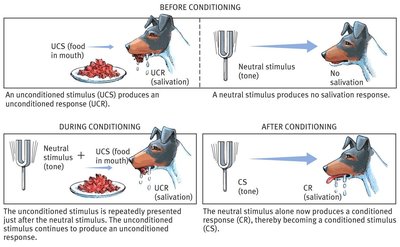
Historical Beginnings: Ivan Pavlov
Ivan Pavlov (1849–1936) was a Russian physiologist who discovered classical conditioning while studying digestion in dogs. He observed that dogs would begin to salivate not only at the taste of food but also at the sight of the food or the person who fed them, leading to the identification of learned associations between stimuli.
Key Processes in Classical Conditioning
Acquisition
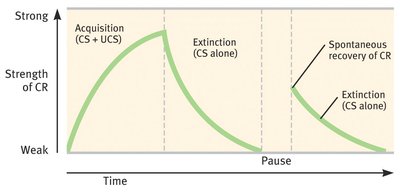
Acquisition is the initial stage of learning when a response is first established. During this phase, the organism learns the association between the CS and the US.
Temporal Contiguity: The CS and US must be presented close together in time (except in taste aversion).
Spatial Contiguity: The CS and US should occur in the same location (except in auditory conditioning).
Order of Presentation: The CS must precede the US for effective conditioning.
Biological Constraints: Some associations are more easily learned due to biological predispositions.
Extinction
Extinction occurs when the CS is repeatedly presented without the US, leading to a decrease in the CR. The learned association weakens and may eventually disappear.
Spontaneous Recovery
After a rest period following extinction, the CR may reappear when the CS is presented again. This phenomenon is known as spontaneous recovery, indicating that extinction does not erase the learned association but suppresses it.
Generalization
Generalization is the tendency for stimuli similar to the original CS to elicit a response similar to the CR. For example, if a dog is conditioned to salivate to a 50 Hz tone, it may also salivate to a 75 Hz tone, though typically to a lesser degree.
Second-Order Conditioning
Second-order conditioning occurs when a new neutral stimulus is paired with an already established CS, allowing the new stimulus to elicit the CR even without direct association with the US.
Example: If a blue light is paired with a tone that has already been conditioned to elicit salivation, the blue light alone can eventually trigger salivation.
Summary Table: Key Terms in Classical Conditioning
Term | Definition | Example |
|---|---|---|
Unconditioned Stimulus (US) | Stimulus that naturally triggers a response | Food |
Unconditioned Response (UR) | Natural response to the US | Salivation to food |
Conditioned Stimulus (CS) | Previously neutral stimulus that triggers CR after association | Bell or tone |
Conditioned Response (CR) | Learned response to the CS | Salivation to bell |
Acquisition | Learning phase where CS and US are paired | Bell + food → salivation |
Extinction | CR diminishes when CS is presented without US | Bell alone, no food → less salivation |
Generalization | Similar stimuli elicit similar responses | Different tones → salivation |
Second-order Conditioning | New stimulus paired with CS elicits CR | Light + bell → salivation |
Additional info: Classical conditioning is foundational for understanding more complex forms of learning and is widely applied in behavioral therapy, advertising, and education.
