 Indietro
Comprehensive Study Notes on Inflation and Trade Cycles
Guida di studio - Note intelligenti
 Appunti personalizzati basati sui tuoi materiali, ampliati con definizioni chiave, esempi e contesto.
Inflation: Meaning, Features, and Definitions
Meaning of Inflation
Inflation is a sustained and general increase in the prices of goods and services in an economy. It reduces the purchasing power of money, meaning that the same amount of money buys fewer goods and services over time. Inflation is a central topic in macroeconomics due to its wide-ranging effects on economic stability, income distribution, savings, and investment.
Inverse Relationship: When the general price level rises, the value of money falls, and vice versa.
Example: If ₹100 could purchase five units of a commodity earlier but only three units later, the purchasing power of ₹100 has declined.
Definitions by Economists
A. C. Pigou: Inflation arises when money income expands more than the production of goods and services.
G. Crowther: Inflation is a condition where the value of money falls and prices rise.
Paul Samuelson: Inflation occurs when the general level of prices and costs is rising.
Harry G. Johnson: Inflation is a sustained rise in prices.
Milton Friedman: Inflation is described as taxation without representation, as it erodes the real value of money and income.
Features of Inflation
General rise in prices: Involves a broad increase in prices, not just one commodity.
Continuous or sustained increase: The rise must persist over time.
Fall in purchasing power: Money buys fewer goods and services.
Unequal effects: Different groups are affected differently (e.g., debtors may benefit, creditors may lose).
Monetary and real causes: Can arise from increased money supply or supply-side issues.
Effect on cost of living: Raises the cost of essentials like food, housing, and transport.
Types of Inflation
Classification of Inflation
Inflation can be classified based on its causes, the items included in its calculation, and the level at which prices are measured.
Demand-Pull Inflation: Caused by aggregate demand exceeding aggregate supply.
Cost-Push Inflation: Caused by rising production costs.
Core Inflation: Excludes volatile items like food and fuel to show underlying trends.
Headline Inflation: Includes all goods and services, reflecting the actual price rise faced by consumers.
Wholesale Price Inflation (WPI): Measures price changes at the wholesale level.
Consumer Price Inflation (CPI): Measures price changes for goods and services purchased by households.
Importance: Understanding the type of inflation helps policymakers choose appropriate measures to control it.
Demand-Pull Inflation and Its Causes
Meaning and Causes
Demand-pull inflation arises when aggregate demand in an economy increases faster than aggregate supply, leading to a general rise in prices.
Increase in Money Supply: More money in circulation increases purchasing power.
Deficit Financing: Government spending exceeds revenue, financed by borrowing or money creation.
Credit Creation: Easy loans and advances boost consumption and investment.
Increase in Exports: Domestic goods supplied abroad reduce local availability, raising prices.
Repayment of Public Debt: Transfers money to the public, increasing demand.
Black Money: Unreported income increases demand for goods and assets.
Increase in Population: Higher demand for essentials due to population growth.
Increase in Income: Higher incomes lead to increased consumption.
Government Expenditure: Increased spending can outpace production growth.
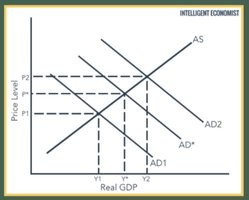
Example: A rightward shift in aggregate demand (from AD1 to AD2) raises the price level from P1 to P2.
Demand-pull inflation can be controlled by restricting credit, reducing unnecessary government expenditure, increasing taxation, and expanding production.
Cost-Push Inflation and Its Causes
Meaning and Causes
Cost-push inflation occurs when the general price level rises due to increased costs of production, even if demand remains unchanged.
Increase in Wages: Higher wages without productivity gains raise costs.
Increase in Material Costs: Rising prices of raw materials and fuel.
Increase in Profit Margin: Firms with market power may raise prices for higher profits.
Supply Shocks: Sudden events like wars or natural disasters disrupt supply.
Failure of Monsoon/Natural Calamities: Reduces agricultural output, raising prices.
Oil Crisis: Higher oil prices increase costs across the economy.
Shortage of Raw Materials: Disruptions in supply chains raise input costs.
Monopoly and Imperfect Competition: Firms may restrict supply and raise prices.
Exchange-Rate Changes: Depreciation makes imports more expensive.
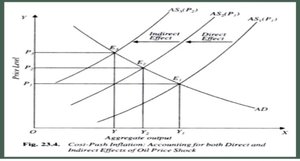
Example: A leftward shift in aggregate supply (from AS1 to AS2) raises the price level from P1 to P2, while output declines from Y1 to Y2.
Cost-push inflation requires supply-side solutions such as increasing production, improving infrastructure, and reducing input costs.
Effects of Inflation on the Economy
Major Effects
Decline in Value of Money: Reduces purchasing power.
Effect on Real Income: Real income falls if prices rise faster than money income.
Effect on Investment and Production: Moderate inflation may encourage investment, but excessive inflation creates uncertainty.
Effect on Employment: Demand-pull inflation may increase employment; cost-push inflation may reduce it.
Effect on Income Distribution: Asset owners may benefit; fixed-income groups may lose.
Effect on Farmers: Gains depend on the relative prices of crops and inputs.
Effect on Fixed-Income Groups: Suffer due to rising costs and fixed incomes.
Effect on Debtors and Creditors: Debtors benefit; creditors lose.
Social and Political Disturbances: May lead to unrest, hoarding, and corruption.
Effect on Economic Stability: Reduces savings and long-term investment.
Nature and Causes of Inflation in a Developing Economy
Demand-Pull Factors
Increase in income, government expenditure, foreign aid, and money supply.
Long gestation periods for development projects and unproductive expenditure.
Cost-Push Factors
Inelastic supply, backward agriculture, supply shocks, structural rigidities, exchange-rate changes, rising wages, infrastructure bottlenecks, inefficient public sector and administration.
Summary: Inflation in developing economies is both a monetary and structural problem, requiring comprehensive solutions.
Measures to Control Inflation
A. Monetary Measures
Credit Control: Restricting credit through higher interest rates.
Open Market Operations: Selling government securities to reduce money supply.
Variable Reserve Ratio: Increasing reserve requirements for banks.
Demonetisation: Withdrawing currency notes from circulation.
B. Fiscal Measures
Direct and Indirect Taxes: Reducing disposable income and consumption.
Public Borrowing: Withdrawing excess purchasing power.
Compulsory Saving: Reducing current consumption.
Reduction in Public Expenditure: Lowering aggregate demand.
C. Direct Measures
Price Control: Fixing maximum prices for essentials.
Public Distribution System: Supplying essentials at controlled prices.
Imports: Increasing domestic supply.
Increase in Production: Encouraging agricultural and industrial output.
Prevention of Hoarding: Strict action against artificial shortages.
Trade-Off Between Inflation and Unemployment: The Phillips Curve
Short-Run Phillips Curve
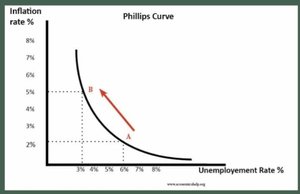
The Phillips Curve illustrates the inverse relationship between inflation and unemployment in the short run. As inflation rises, unemployment tends to fall, and vice versa. This trade-off is central to short-term economic policy decisions.
Long-Run Phillips Curve
In the long run, the Phillips Curve becomes vertical, indicating no permanent trade-off between inflation and unemployment. Expectations adjust, and attempts to reduce unemployment below its natural rate only result in higher inflation.
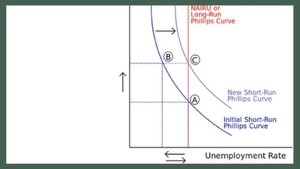
Limitations: The relationship is not stable; supply shocks and changing expectations can shift the curve.
Stagflation: High inflation and high unemployment can occur together, contradicting the simple Phillips Curve.
Stagflation: Causes and Consequences
Definition and Causes
Stagflation is a situation where inflation and unemployment rise simultaneously, accompanied by stagnant or declining economic growth. It is often caused by supply shocks, cost-push inflation, low productivity, excessive regulation, high taxes, deficit financing, and policy uncertainty.
Consequences
Unemployment and job losses
Rising prices and declining real income
Slow economic recovery and declining GDP
Market volatility and loss of confidence
Difficult policy decisions, as measures to reduce inflation may worsen unemployment
Trade Cycle (Business Cycle)
Meaning and Characteristics
A trade cycle refers to recurring fluctuations in economic activity, characterized by alternating periods of expansion and contraction. These cycles are not perfectly regular but follow a wave-like pattern.
Phases: Prosperity (expansion), Recession, Depression (contraction), Recovery (revival)
Key Variables: Output, income, employment, prices, investment, and profits fluctuate together.
International Character: Trade cycles can affect multiple economies due to global interconnections.
Phases of a Trade Cycle
Four Major Phases
Prosperity: High income, employment, investment, and production; rising prices and interest rates.
Recession: Declining demand, output, income, and employment; pessimism and falling investment.
Depression: Lowest economic activity, high unemployment, falling prices, and under-utilized resources.
Recovery: Rising demand, production, investment, and employment; optimism returns.
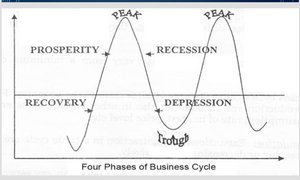
Example: The cycle begins at the trough, moves through recovery and prosperity to the peak, then declines through recession and depression before repeating.
Features and Causes of Trade Cycles
Key Features
Periodic occurrence, wave-like movements, indefiniteness, co-movement of variables, uncertainty, international character, recurrence, self-generation, and fluctuation in key variables.
Causes
Climatic Changes: Weather and environmental factors can influence economic activity.
Psychological Factors: Optimism and pessimism among entrepreneurs and consumers affect investment and spending.
Monetary Factors: Changes in money supply and interest rates impact borrowing and investment.
Economic Factors: Over-investment, under-consumption, and over-saving can create imbalances.
Summary: Trade cycles are influenced by a combination of climatic, psychological, monetary, and economic factors, leading to recurring fluctuations in economic activity.
