 Indietro
Consciousness and Sleep: Mini-Textbook Study Notes for Introduction to Psychology
Guida di studio - Note intelligenti
 Appunti personalizzati basati sui tuoi materiali, ampliati con definizioni chiave, esempi e contesto.
Consciousness
Definition and Alterations
Consciousness refers to our subjective experience of the world, our bodies, and our mental perspectives. It can be altered in various ways, including sleep paralysis, locked-in syndrome, out-of-body experiences, near-death experiences, and mystical experiences.
Sleep paralysis: Occurs when a person is unable to move just before falling asleep or right before waking up.
Altered states: Include hallucinations, out-of-body experiences, near-death experiences, and mystical experiences.
Why Do We Need Sleep?
Functions of Sleep
Sleep is essential for several biological and psychological functions:
Learning and memory: Sleep aids in long-term memory formation and remembering emotional information.
Immune system: Critical for maintaining immune health.
Insight and problem-solving: Promotes cognitive abilities.
Neural development: Supports neural connectivity and development.
Energy conservation: Helps conserve energy.
Biology of Sleep
Circadian Rhythm and Regulation
The sleep-wake cycle is governed by the circadian rhythm, a 24-hour biological cycle regulated by the suprachiasmatic nucleus (SCN) in the hypothalamus. The SCN responds to external cues, mainly light, and triggers the pineal gland to release melatonin, increasing sleep pressure.
Circadian rhythm: Cyclical biological changes on a 24-hour basis.
SCN: Controls circadian rhythm and hormone release.
Melatonin: Hormone released by the pineal gland to induce sleep.
Disruptions: Jet lag and late shifts can cause health problems.
How Much Sleep Do We Need?
Sleep Requirements Across the Lifespan
Newborns: About 16 hours per day.
Adults: 7–10 hours per day.
Gene mutation DEC2: Allows some people to function with only 6 hours of sleep.
Klein-Levin Syndrome: Rare disorder causing excessive sleep (15–20+ hours/day) and behavioral changes.
Stages of Sleep
Sleep Cycle and Brain Waves
Sleep consists of five stages, cycling every 90–120 minutes, with 4–6 cycles per night. Stages 1–4 are Non-REM (NREM) sleep, and stage 5 is REM sleep.
Stages 1–4 (NREM): Light to deep sleep, decreased heart rate and respiration, no eye movements, fewer dreams.
Stage 5 (REM): Vivid dreams, quick eye movements, increased heart rate and respiration, paralysis of skeletal muscles.
Interpreting Brain Waves
EEG (electroencephalogram) is used to visualize brainwaves, measuring electrical activity in the brain. Two key properties are frequency (number of wave cycles per second) and amplitude (height of the waves).
Frequency: Indicates the stage of brain activity.
Amplitude: Indicates the strength of brain activity.
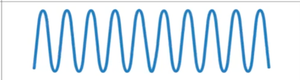
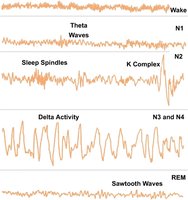
Awake: Beta waves (high frequency, low amplitude). Stage 1: Theta waves (lower frequency than beta). Stage 2: Sleep spindles (high frequency) and K complex (high amplitude). Stages 3 & 4: Delta waves (low frequency, high amplitude). Stage 5 (REM): Brain activity resembles beta waves.
Sleep Patterns in a Typical Night
Stage 3 & 4 duration decreases as the night progresses.
REM duration increases as the night progresses.
Stage 1 is only re-entered if we wake up.
Dreams
NREM vs. REM Dreams
NREM dreams: Shorter, repetitive, thought-like, related to daily concerns.
REM dreams: Emotional, illogical, biologically crucial, prone to plot shifts.
REM-rebound: Intense REM sleep after deprivation, with vivid dreams.
Lucid Dreaming
Lucid dreaming: Awareness that one is dreaming; some can control their dreams.
May help with nightmares.
Sleep Disorders
Common Disorders
Insomnia: Difficulty falling or staying asleep; most common.
Narcolepsy: Rapid, unexpected onset of sleep.
Sleep apnea: Blockage of airway during sleep, causing awakenings and fatigue.
Sleepwalking: Walking while fully asleep.
Nightmares vs. Night Terrors
Nightmare | Night Terror | |
|---|---|---|
Definition | Vivid, scary dreams that wake you up | Sudden waking episode with screaming, sweating, confusion |
Stage of Sleep | REM (late night/morning) | NonREM (first few hours) |
Awake/Asleep | Wake up completely | Stay asleep even if eyes open |
Reaction | Mild, sweat, increased HR | Extreme, screaming, escaping bed |
Memory | Remember story in detail | No memory next morning |
Interaction | Easily comforted | Confused, terrified |
Theories of Dreaming
Freud’s Dream Protection Theory
Wish fulfillment: Dreams act out unconscious wishes.
Manifest content: Actual imagery and storyline.
Latent content: Hidden psychological meaning.
Lacks scientific support; dream content often literal and negative.
Activation–Synthesis Theory
Dreams reflect inputs from brain activation in the pons, which the forebrain attempts to weave into a story.
Neurotransmitter levels shift during REM sleep:
Neurotransmitter | Level in REM Sleep | Effect on Dream |
|---|---|---|
Acetylcholine | Very High | Fires up random images, memories, emotions |
Norepinephrine | Extremely Low | Makes you forget the dream after waking |
Serotonin | Extremely Low | Removes logic, making bizarre storylines feel real |
Dreaming and the Forebrain
Forebrain and parietal lobes are crucial for dreaming; damage eliminates dreams.
Dreams are consistent over time, not random.
Neurocognitive Theory
Dreams are simulations exploring possible outcomes.
Dreaming relates to neurodevelopment and life experience.
Children’s dreams are simpler, less emotional, and lack movement.
Dream Continuity Hypothesis: Dreams mirror life circumstances and cognitive capacities.
Alterations in Consciousness
Types of Altered States
Hallucinations: Realistic perceptual experiences without external stimuli.
Out-of-body experiences: Sense that consciousness has left the body.
Near-death experiences: Often reported during life-threatening events; themes vary cross-culturally.
Mystical experiences: Sense of unity or oneness, often religious.
Déjà vu: Feeling of reliving a new experience; may be linked to dopamine or temporal lobe activity.
Hypnosis
Nature and Theories
Hypnosis is an interpersonal situation involving imaginative suggestions to alter consciousness.
Myths: Not a trance state, does not increase suggestibility or control behavior, awareness is maintained.
Memory quantity increases, but accuracy does not.
Sociocognitive theory: Approach based on attitudes, beliefs, and experiences.
Dissociation theory: Division of consciousness between personality functions.
Psychoactive Drugs
Types and Effects
Depressants: Alcohol, barbiturates, Quaaludes, Valium; decrease CNS activity.
Stimulants: Tobacco, cocaine, amphetamines, methamphetamine, caffeine; increase CNS activity.
Opiates: Heroin, morphine, codeine, oxycodone; sense of euphoria, decreased pain.
Psychedelics: Marijuana, LSD, ecstasy, psilocybin; altered perception, mood, thoughts.
Substance Abuse and Dependence
Definitions and Factors
Abuse: Recurrent problems associated with drug use.
Dependence: Clinically significant impairment or distress.
Tolerance: Reduced effect with repeated use; requires higher doses.
Withdrawal: Unpleasant effects when stopping drug use.
Physical dependence: Continued use to avoid withdrawal symptoms.
Psychological dependence: Intense craving motivates continued use.
Factors: Sociocultural, personality, learning, genetics.
Depressants
Alcohol and Sedative-Hypnotics
Alcohol and sedative-hypnotics depress CNS activity.
Sedatives: Calming effect; Hypnotics: Sleep-inducing effect.
Alcohol is the most widely used and abused drug.
Blood alcohol content depends on weight, gender, and stomach contents.
Females have higher blood alcohol content than males at the same weight.
Balanced Placebo Design
The balanced placebo design is used to study the effects of alcohol and expectations. It includes four groups based on what participants are told and what they actually receive.
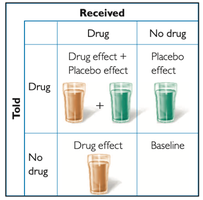
Received Drug | Received No Drug | |
|---|---|---|
Told Drug | Drug effect + Placebo effect | Placebo effect |
Told No Drug | Drug effect | Baseline |
Sedative-Hypnotics
Prescribed for anxiety or insomnia.
Three classes: barbiturates, nonbarbiturates, benzodiazepines.
Benzodiazepines are most widely used and can be highly addictive.
Stimulants
Effects and Examples
Increase CNS activity, heart rate, respiration, and blood pressure.
Nicotine: Highly addictive, activates acetylcholine receptors.
Cocaine: Powerful natural stimulant, quick and short-lived high.
Amphetamines: Lab-produced, intense CNS effect, high risk for overdose.
Narcotics
Opiates and Their Effects
Derived from opium poppy; relieve pain and induce sleep.
Heroin, morphine, codeine; heroin is most abused.
Used medically but can lead to abuse; dangerous interactions with other drugs.
Psychedelics
Hallucinogenic Drugs
Produce dramatic alterations in perception, mood, and thought.
Marijuana is the most used psychedelic drug in Canada.
LSD and ecstasy (MDMA) are other examples.
