 Indietro
Damage Responses and Brain Hemispheres: Structure and Function
Guida di studio - Note intelligenti
 Appunti personalizzati basati sui tuoi materiali, ampliati con definizioni chiave, esempi e contesto.
Damage Responses and Brain Hemispheres
Brain Damage and Neural Response
The human brain demonstrates remarkable complexity in its response to injury. While some neurons in the brain and spinal cord do not regenerate, the brain can adapt through several mechanisms.
Non-regeneration of neurons: Severed neurons in the brain and spinal cord typically do not regrow, leading to lasting effects from injuries.
Preassigned brain functions: Specific regions of the brain are dedicated to certain functions, such as language or vision.
Neural plasticity: The brain can reorganize itself, especially in young children, allowing unused areas to take on new functions after damage. For example, in cases of blindness or deafness, other brain regions may compensate.
Neurogenesis: The process by which new neurons are produced, migrate, and form new connections, contributing to recovery and adaptation.
Splitting the Brain: Corpus Callosum and Its Effects
One of the most studied interventions for severe epilepsy is the surgical severing of the corpus callosum, the bundle of fibers connecting the two hemispheres. This procedure, known as a split-brain operation, has profound effects on behavior and cognition.
Corpus callosum severed: The main communication pathway between hemispheres is cut, stopping seizures but altering information sharing.
Personality and intellect: These remain largely intact after surgery.
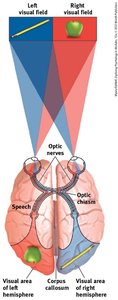
Visual information-sharing: Each hemisphere processes information from the opposite visual field, but cannot share it directly with the other hemisphere.
Behavioral changes: The left hemisphere tends to issue rational, goal-directed commands, while the right hemisphere may offer conflicting demands.
Split-Brain Experiments: Understanding Hemispheric Specialization
Split-brain experiments reveal how each hemisphere processes information independently. Classic studies use visual tasks to demonstrate the distinct roles of the left and right hemispheres.
Visual field projection: Information from the left visual field is processed by the right hemisphere, and vice versa.
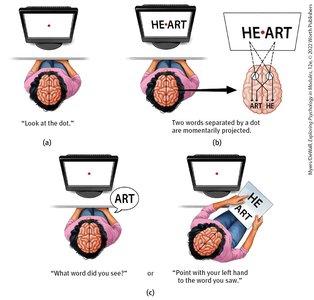
Speech and language: The left hemisphere typically controls speech and language, so only information presented to the right visual field (processed by the left hemisphere) can be verbalized.
Pointing tasks: The right hemisphere can guide the left hand to point to objects seen in the left visual field, even if the person cannot verbally identify them.
Hemispheric Specialization: Functions of the Left and Right Hemispheres
Although the human brain is unified, its hemispheres are specialized for different tasks. Understanding these differences helps explain the effects of brain damage and split-brain surgery.
Right hemisphere:
Increased activity during perceptual tasks
Modulates speech and enables inference-making
Organizes self-awareness
Left hemisphere:
Handles math tasks
Controls language and provides quick, literal interpretations
Unified brain: Despite specialization, the brain works as an integrated whole, with each hemisphere contributing unique abilities.
Key Terms and Concepts
Neural plasticity: The brain's ability to reorganize and adapt after injury.
Neurogenesis: The creation of new neurons in the brain.
Corpus callosum: The major fiber bundle connecting the two hemispheres.
Split-brain: A condition resulting from severing the corpus callosum, leading to independent functioning of each hemisphere.
Example: Split-Brain Patient Task
In a classic experiment, a split-brain patient is shown the word "HEART" split across the visual fields. When asked what word they saw, they verbalize "ART" (right visual field, left hemisphere). When asked to point with their left hand, they indicate "HE" (left visual field, right hemisphere).
Additional info:
Plasticity is greater in children, allowing for more recovery after injury.
Neurogenesis is most active in certain brain regions, such as the hippocampus.
