 Indietro
Damage Responses and Brain Hemispheres: Structure and Function
Guida di studio - Note intelligenti
 Appunti personalizzati basati sui tuoi materiali, ampliati con definizioni chiave, esempi e contesto.
Damage Responses and Brain Hemispheres
Brain Damage and Neural Response
The human brain demonstrates remarkable complexity in its response to injury. While some neurons cannot regenerate, the brain can adapt through processes such as neural plasticity and neurogenesis.
Severed Neurons: Neurons in the brain and spinal cord do not regenerate after being severed, which limits recovery from certain injuries.
Preassigned Functions: Specific regions of the brain are dedicated to particular functions, such as language or vision.
Neural Plasticity: The brain can reorganize itself, especially in young children, allowing unused areas to take over functions lost due to damage (e.g., blindness or deafness).
Neurogenesis: The creation of new neurons, which may migrate and form new connections, contributing to recovery and adaptation.
Example: After a stroke, some patients recover lost abilities as other brain regions adapt to take over the damaged functions.
Splitting the Brain: Corpus Callosum and Its Effects
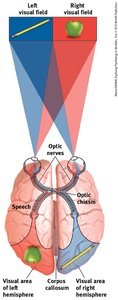
Split-brain research has provided insight into the specialized functions of the brain's hemispheres. The corpus callosum, a bundle of nerve fibers, connects the left and right hemispheres and allows communication between them.
Corpus Callosum Severed: In cases of severe epilepsy, the corpus callosum may be surgically severed, stopping seizures but ending information sharing between hemispheres.
Personality and Intellect: These remain largely intact after the procedure.
Visual Information: Each hemisphere processes information from the opposite visual field.
Behavioral Effects: The left hemisphere tends to give rational, goal-directed orders, while the right hemisphere may offer conflicting demands.
Example: A person with a split brain may verbally identify objects seen in the right visual field (processed by the left hemisphere), but may only point to objects seen in the left visual field (processed by the right hemisphere).
Hemispheric Specialization
The left and right hemispheres of the brain are specialized for different tasks, yet work together to create unified human experience.
Right Hemisphere:
Increased activity during perceptual tasks
Modulates speech and enables inference-making
Organizes self-awareness
Left Hemisphere:
Handles math tasks
Controls language and provides quick, literal interpretations
Unified Brain: Despite specialization, the brain functions as a unified whole, integrating information across hemispheres.
Example: The left hemisphere is dominant in language production, while the right hemisphere is more involved in spatial and perceptual tasks.
Split-Brain Experiments
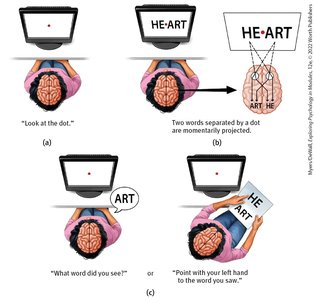
Split-brain experiments illustrate how each hemisphere processes information independently when the corpus callosum is severed.
Experimental Setup: Words or images are projected to either the left or right visual field.
Findings: The left hemisphere can verbalize what it sees in the right visual field, while the right hemisphere can point to what it sees in the left visual field.
Implications: These experiments reveal the distinct roles of each hemisphere in perception and action.
Additional info: Split-brain research has contributed to understanding lateralization of brain function, which is foundational in neuropsychology and cognitive neuroscience.
