 Indietro
Developmental Psychology and Prenatal Development: Key Concepts and Theories
Guida di studio - Note intelligenti
 Appunti personalizzati basati sui tuoi materiali, ampliati con definizioni chiave, esempi e contesto.
Developmental Psychology
Introduction to Developmental Psychology
Developmental Psychology is the scientific study of how people change and remain the same throughout their lifespan, from conception to death. It encompasses physical, cognitive, and psychosocial development, drawing from multiple disciplines such as biology, sociology, and anthropology.
Lifespan Perspective: Development is lifelong, multidirectional, multidimensional, multidisciplinary, characterized by plasticity, and multi-contextual.
Domains of Development:
Physical: Changes in body, brain, sensory capacities, and health.
Cognitive: Changes in thinking, intelligence, language, and memory.
Psychosocial: Changes in emotions, personality, and social relationships.
Contextual Influences:
Normative age-graded: Typical experiences for a certain age group.
Normative history-graded: Influences from the era or cohort one is born into.
Non-normative life events: Unique experiences not shared by most peers.
Socioeconomic Status (SES): Influences lifestyle, stress, and opportunities.
Culture: Shared values, traditions, and behaviors; ethnocentrism vs. cultural relativity.
Theories of Development
Psychodynamic Perspective
The psychodynamic perspective emphasizes the influence of inner forces, memories, and conflicts, often unconscious, on behavior.
Freud's Psychoanalytic Theory: Early childhood experiences shape personality; development driven by instincts and managed through socialization. Criticized for lack of scientific testability and reliance on case studies.
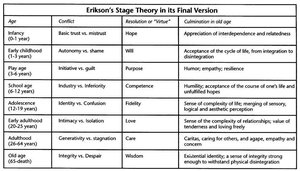
Erikson's Psychosocial Theory: Development occurs through a series of psychosocial crises across the lifespan, each requiring resolution for healthy development.
Table: Erikson's Stages of Psychosocial Development
Age | Conflict | Resolution or "Virtue" | Culmination in Old Age |
|---|---|---|---|
Infancy (0-1) | Basic trust vs. mistrust | Hope | Appreciation of interdependence and relatedness |
Early childhood (1-3) | Autonomy vs. shame | Will | Acceptance of the cycle of life, from integration to disintegration |
Play age (3-6) | Initiative vs. guilt | Purpose | Humor, empathy, resilience |
School age (6-12) | Industry vs. inferiority | Competence | Humility; acceptance of the course of one's life and unfulfilled hopes |
Adolescence (12-19) | Identity vs. confusion | Fidelity | Sense of complexity of life; merging of sensory, logical, and aesthetic perception |
Early adulthood (20-25) | Intimacy vs. isolation | Love | Sense of the complexity of relationships; value of tenderness and loving freely |
Adulthood (26-64) | Generativity vs. stagnation | Care | Caritas, caring for others, and agape, empathy and concern |
Old age (65-death) | Integrity vs. despair | Wisdom | Existential identity; a sense of integrity strong enough to withstand physical disintegration |
Learning Theory (Behaviorism and Social Learning)
Behaviorism focuses on observable behavior and the effects of learning from the environment. B.F. Skinner emphasized reinforcement and punishment, while Albert Bandura introduced Social Learning Theory, highlighting learning through observation and imitation (modeling) and the concept of reciprocal determinism.
Reciprocal Determinism: Individuals influence and are influenced by their environment.
Bandura's Bobo Doll Experiment: Demonstrated that children imitate aggressive behavior observed in adults.
Cognitive Theory
Cognitive theories focus on changes in mental processes over time. Jean Piaget, Lev Vygotsky, and Information-processing theorists are key contributors.
Jean Piaget's Theory: Children progress through four stages of cognitive development, each characterized by different ways of thinking and understanding the world.
Assimilation: Integrating new experiences into existing schemas.
Accommodation: Modifying schemas in response to new information.
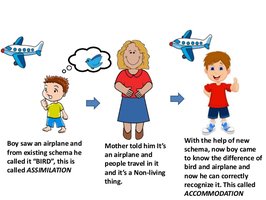
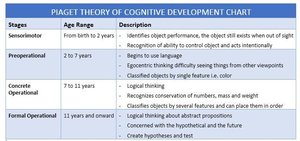
Table: Piaget's Stages of Cognitive Development
Stage | Age Range | Description |
|---|---|---|
Sensorimotor | Birth to 2 years | Object permanence; intentional actions |
Preoperational | 2 to 7 years | Use of language; egocentric thinking; classifies objects by single feature |
Concrete Operational | 7 to 11 years | Logical thinking; conservation of number, mass, and weight; classifies objects by several features |
Formal Operational | 11 years and onward | Abstract and hypothetical thinking; creates hypotheses and tests |
Ecological Systems Theory
Urie Bronfenbrenner's theory explains development as influenced by multiple environmental systems, from immediate family to broader societal and historical contexts.
Microsystem: Immediate environment (family, school).
Mesosystem: Interconnections between microsystems.
Exosystem: Indirect environments (community, media).
Macrosystem: Cultural and societal influences.
Chronosystem: Historical and generational context.
Research Methods in Developmental Psychology
Scientific Method and Research Designs
Developmental psychologists use the scientific method to form hypotheses and test theories. Major research designs include:
Longitudinal Studies: Follow the same individuals over time to measure change. Advantages: track development; Disadvantages: time-consuming, expensive, risk of attrition.
Cross-Sectional Studies: Compare individuals of different ages at one point in time. Advantages: quick, inexpensive; Disadvantages: cohort effects, cannot track individual change.
Sequential Studies: Combine longitudinal and cross-sectional approaches to separate age effects from cohort effects.
Prenatal Development and Birth
Genetics and Heredity
Genes: Units of heredity located on chromosomes; humans have 23 pairs.
Mitosis: Cell division for growth and repair.
Meiosis: Cell division for gametes (sperm and egg), resulting in genetic diversity.
Genotype vs. Phenotype: Genotype is genetic makeup; phenotype is expressed traits.
Dominant and Recessive Genes: Dominant alleles express in phenotype even if only one is present; recessive alleles require two copies.
Monozygotic (Identical) Twins: One zygote splits; genetically identical.
Dizygotic (Fraternal) Twins: Two eggs fertilized by two sperm; genetically similar as siblings.
Periods of Prenatal Development
Germinal Period (0-2 weeks): Zygote formation, cell division, implantation in uterus.
Embryonic Period (3-8 weeks): Major organs and structures form; placenta develops; most vulnerable to teratogens.
Fetal Period (9 weeks-birth): Growth and maturation of organs; age of viability at 24 weeks; rapid weight gain in last trimester.
Birth and Postpartum
Stages of Birth:
First Stage: Uterine contractions, cervix dilation.
Second Stage: Delivery of baby through birth canal.
Third Stage: Delivery of placenta.
C-Section: Surgical delivery through the abdomen; used for complications or multiple births.
Postpartum Concerns:
Baby Blues: Mild, short-term sadness after birth.
Postpartum Depression: More severe, lasting depression; may require treatment.
Postpartum Anxiety and Psychosis: Severe anxiety or psychotic symptoms; require immediate medical attention.
