 Indietro
Developmental Psychology: Family, Peers, Achievement, Health, and Death
Guida di studio - Note intelligenti
 Appunti personalizzati basati sui tuoi materiali, ampliati con definizioni chiave, esempi e contesto.
Families
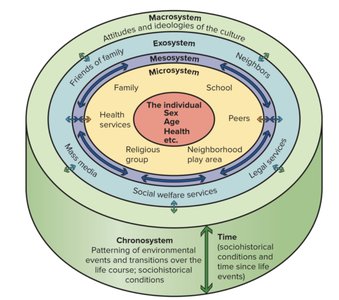
Bronfenbrenner's Systems Theory
Bronfenbrenner's ecological systems theory explains how a child's development is influenced by different environmental systems, ranging from immediate surroundings to broader societal contexts. The theory emphasizes the complex, bidirectional interactions between the individual and their environment.
Microsystem: Immediate environment (family, school, peers, health services, religious group, neighborhood play area).
Mesosystem: Interconnections between microsystems (e.g., relationships between family and school).
Exosystem: Indirect environment (friends of family, neighbors, mass media, social welfare services, legal services).
Macrosystem: Societal and cultural context (attitudes and ideologies of the culture).
Chronosystem: Patterning of environmental events and transitions over the life course; sociohistorical conditions and time since life events.
Bidirectional Impact: Each system influences the individual, and the individual can also affect their environment. For example, marital quality affects parenting, which impacts child development, and child behavior can influence marital stability.
Reciprocal Socialization: Parents socialize children, and children, through their behavior and needs, also influence parents.
Scaffolding: Parents provide support to help children achieve tasks they cannot do alone, gradually reducing help as children gain competence.
Adolescent-Parent Conflict
Conflict between adolescents and parents often arises due to developmental changes in both parties.
Adolescent Changes: Puberty, increased logical reasoning, idealistic thinking, changes in schooling, peer relationships, dating, and desire for independence.
Parent Changes: Marital status, economic burden, health concerns.
Baumrind’s Parenting Styles
Parenting styles are classified based on responsiveness and control, affecting child outcomes.
Authoritarian: Strict, non-negotiable, punitive. Children are anxious, have low self-esteem, and fear making mistakes.
Authoritative: Encourages independence with limits. Children have high self-esteem, intrinsic motivation, and internalize values.
Neglectful: Uninvolved. Children exhibit misconduct, lack self-control.
Indulgent/Permissive: Highly involved, few demands. Children expect to get their way, lack self-control, and may have authority problems.
Parents as Managers: Parents manage social relationships, information, chores, and home structure, influencing children's development.
Peers
Peer Relationships and Friendship
Peers are individuals of similar age or maturity. Friendships play a crucial role in social and emotional development throughout life stages.
Childhood: Friends are similar in age, gender, interests; popularity is important.
Adolescence: Fewer, more intense friendships; self-disclosure and reassurance of worth.
Adulthood: Gender differences in friendship styles (women: talk, men: activities).
Late Adulthood: Positive experiences, health benefits (socioemotional selectivity theory).
Parental Influence: Parents affect peer relationships through their own friends, activities, permissions, and neighborhood choices.
Cliques vs Crowds
Clique: Small group (5-6), same gender/age, similar activities, strong in-group identity.
Crowd: Larger, less personal, based on reputation/labels, more important in early adolescence.
Peer Status
Popular: High likeability and visibility, socially successful, lower depression/anxiety.
Rejected: Low likeability, high visibility, higher risk for problems.
Controversial: Mixed likeability, high visibility, depends on close friendships.
Neglected: Neutral likeability, low visibility, stable.
Average: Moderate likeability and visibility, healthy psychological development.
Achievement
Internal Factors
Achievement is influenced by mindset, self-efficacy, response to failure, goal orientation, and motivation.
Mindset: Carol Dweck identified fixed (abilities cannot change) and growth (abilities can improve) mindsets.
Self-efficacy: Belief in one's ability to master situations and achieve favorable outcomes.
Goal Orientation: Mastery (focus on learning) vs. Performance (focus on winning).
Motivation: Intrinsic (internal drive) vs. Extrinsic (external rewards/punishments).
External Factors
Montessori Education: Child-centered, hands-on, collaborative, multi-age, self-directed.
Child-Centered Kindergarten: Considers physical, cognitive, socioemotional needs; focuses on process of learning.
Direct Instruction: Teacher-centered, step-by-step, high expectations, efficient for procedures.
Constructivist Approach: Learner-centered, active engagement, develops problem-solving and critical thinking.
Health
Biopsychosocial Model
The biopsychosocial model integrates biological, psychological, and social factors in understanding health and illness.
Biological: Genetics, physical wellbeing, health, brain chemistry, immune function.
Psychological: Thoughts, emotions, coping mechanisms, stress response, beliefs, behaviors, experiences.
Social: Family, culture, work environment, socioeconomic status (SES), time and place.
Socioeconomic Status (SES)
Income: Earnings, assets, purchasing power.
Education: Level of formal schooling, health literacy.
Occupation: Job type, working conditions, access to healthcare.
Coping Strategies
Problem-focused: Actively solving problems; best for controllable situations.
Emotion-focused: Managing feelings; best for uncontrollable situations.
Potential Downsides: Problem-focused can be ineffective for unchangeable problems; emotion-focused can lead to avoidance or denial.
Benefits of Reducing Screen Time
Reduced emotional distress
Increased physical activity
Improved body weight
Enhanced attention span
Death, Dying, and Grieving
Attitudes Toward Death
In some cultures, death is avoided or denied, reflected in language, rituals, and efforts to maintain youth.
Open casket makeup, euphemisms for death, isolation of older people, belief in afterlife.
End-of-Life Decisions
Living Will: Legal document for advance care planning.
Euthanasia: Painless ending of life for those suffering from incurable diseases or severe disabilities.
Passive Euthanasia: Withholding treatment.
Active Euthanasia: Deliberately inducing death.
A "Good" Death
Hospice Care: Supportive care for terminally ill patients.
Palliative Care: Relief of pain and suffering.
Kubler-Ross Stages of Dying
Denial and Isolation: Refusal to accept reality.
Anger: Frustration and resentment.
Bargaining: Attempting to postpone death.
Depression: Processing grief and loss.
Acceptance: Achieving peace.
Erikson: Integrity vs. Despair
In late adulthood, individuals reflect on their lives, seeking integrity and peace with their choices. Reminiscence therapy involves discussing past events, which can enhance emotional wellbeing, cognitive engagement, and social connections.
