 Indietro
Infancy and Toddlerhood: Physical, Cognitive, and Psychosocial Development
Guida di studio - Note intelligenti
 Appunti personalizzati basati sui tuoi materiali, ampliati con definizioni chiave, esempi e contesto.
Infancy and Toddlerhood
Overall Physical Growth
Infancy and toddlerhood are periods of rapid and dramatic physical development, laying the foundation for later growth and functioning.
Average Newborn Size: Newborns in the U.S. weigh about 7.5 pounds and are 20 inches long. Initial weight loss (about 5%) is normal and followed by rapid growth.
Growth Patterns: By 4 months, infants double their birth weight; by 1 year, they triple it; by 2 years, they quadruple it (20–40 pounds).
Length: Average length at 1 year is 29.5 inches; at 2 years, 34.4 inches.
Body Proportions: The head is initially 50% of body length in the womb, 25% at birth, and 20% by age 25.
The Brain in the First Two Years
Brain development is especially pronounced during infancy and toddlerhood, involving growth, connectivity, and specialization.
Neurons: Infants are born with most of their neurons (~85 billion), but these are immature.
Dendritic Growth: Dendrites proliferate, allowing a single neuron to have thousands of connections by age two.
Synaptogenesis: Formation of new synaptic connections (synaptic blooming) is followed by synaptic pruning, which strengthens used connections and eliminates unused ones (about 40% lost).
Myelination: Myelin develops around axons, speeding neural transmission and improving coordination; most dramatic in early years, continues into adolescence.
Brain Region Maturation: Motor areas mature before sensory areas; prefrontal cortex is least developed in infancy.
Lateralization: Functions become localized to one hemisphere (e.g., left for language, right for visuospatial abilities); structural asymmetries exist even in infants.
Neuroplasticity: The brain can reorganize and adapt in response to experience and injury, especially in infancy.
From Reflexes to Voluntary Movements
Newborns exhibit reflexes—automatic responses to stimuli—that gradually give way to voluntary movements as the nervous system matures.
Common Reflexes: Sucking, rooting, grasping, stepping, eye-blink, swallowing, sneezing, gagging, withdrawal.
Reflex Assessment: Reflexes are indicators of nervous system health; abnormal persistence or absence may signal developmental issues.
Transition: Reflexes disappear within months, replaced by voluntary behaviors.
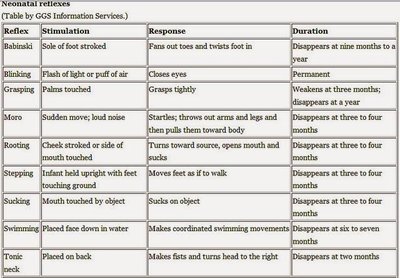
Neonatal Reflexes Table
The following table summarizes key neonatal reflexes, their stimulation, responses, and duration:
Reflex | Stimulation | Response | Duration |
|---|---|---|---|
Babinski | Sole of foot stroked | Fans out toes and twists foot in | Disappears at nine months to a year |
Blinking | Flash of light or puff of air | Closes eyes | Permanent |
Grasping | Palms touched | Grasps tightly | Weakens at three months; disappears at a year |
Moro | Sudden move; loud noise | Startles; throws out arms and legs and then pulls them toward body | Disappears at three to four months |
Rooting | Cheek stroked or side of mouth touched | Turns toward source, opens mouth and sucks | Disappears at three to four months |
Stepping | Infant held upright with feet touching ground | Moves feet as if to walk | Disappears at three to four months |
Sucking | Mouth touched by object | Sucks on object | Disappears at three to four months |
Swimming | Placed face down in water | Makes coordinated swimming movements | Disappears at six to seven months |
Tonic neck | Placed on back | Makes fists and turns head to the right | Disappears at two months |
Motor Development
Motor development follows predictable patterns, progressing from reflexive actions to voluntary, coordinated movements.
Cephalocaudal Principle: Development proceeds from head to tail (e.g., head control before walking).
Proximodistal Principle: Development proceeds from the center outward (e.g., trunk control before finger control).
Milestones: Examples include holding up the head (average 6 weeks), sitting alone (average 7 months), crawling, walking.
Fine Motor Skills: Involve small muscles (fingers, toes, eyes); e.g., Palmer Grasp (fingers and palm, no thumb) at 4 months, Pincer Grasp (forefinger and thumb) at 9 months.
Gross Motor Skills: Involve large muscle groups (head, torso, arms, legs); e.g., balancing, crawling, walking.
Cognitive Development and Language
Infants and toddlers undergo significant cognitive changes, including the development of schemas, object permanence, and language skills.
Piaget and the Sensorimotor Stage
Cognitive Equilibrium: The balance between what is seen and what is known; maintained through assimilation and accommodation.
Schema: Framework for organizing information.
Assimilation: Fitting new information into existing schemas.
Accommodation: Modifying schemas to incorporate new information.
Sensorimotor Stage: First stage of cognitive development (birth to 2 years), divided into six substages:
Reflexes
Primary Circular Reactions
Secondary Circular Reactions
Coordination of Secondary Circular Reactions
Tertiary Circular Reactions
Beginning of Representational Thought
Object Permanence: Understanding that objects exist even when out of sight; typically acquired by 8 months.
Stranger Anxiety: Fear of unfamiliar people, emerging around the same time as object permanence.
Language Development
Language Acquisition: Begins before birth; newborns recognize their mother's voice and language.
Communication: Infants use posture, gestures, cries, and facial expressions.
Cooing: Early vocalizations (consonant-vowel combinations) reflect native language.
Babbling: Intentional vocalizations (e.g., ma-ma-ma) begin around 7 months.
Gesturing: Precedes spoken language and predicts later language development.
Receptive Language: Understanding words before being able to speak them (e.g., own name by 6 months).
Holophrasic Speech: One-word expressions to convey meaning (e.g., "ju" for "juice").
Psychosocial Development
Infants and toddlers develop temperament, attachments, and a sense of trust and autonomy, which influence later personality and social relationships.
Temperament
Definition: Innate characteristics including mood, activity level, and emotional reactivity.
New York Longitudinal Study: Identified three temperament types:
Easy Child (40%): Adapts quickly, calm, positive mood.
Difficult Child (10%): Negative mood, trouble adapting, cries frequently.
Slow-to-Warm-Up Child (15%): Low activity, slow to adapt, often negative mood.
Parenting Fit: Recognizing and adapting to a child's temperament fosters effective interactions.
Temperament vs. Personality: Temperament is stable; personality develops through interaction of biology and experience.
Forming Attachments
Attachment: Close bond with caregiver, foundation for future relationships and self-concept.
Erikson's Trust vs. Mistrust: First stage (birth to 1.5 years); consistent caregiving fosters trust, while neglect leads to mistrust.
Autonomy vs. Shame and Doubt: Second stage; toddlers develop independence through exploration, or shame/doubt if restricted.
Reactive Attachment Disorder: Results from social neglect or deprivation; characterized by inhibited, withdrawn behavior and developmental delays.
Bowlby's Attachment Theory
Attachment Bond: Essential for normal social and emotional development; persists throughout life.
Secure Base: Parental presence provides safety for exploration.
Caregiver Responsiveness: Responsive, mutually enjoyable interactions are necessary for healthy attachment.
Evolutionary Function: Negative responses to separation serve adaptive purposes.
The Strange Situation Technique
Assessment: Laboratory test measuring infant attachment to caregiver.
Procedure: Parent and infant in unfamiliar room; stranger enters; parent leaves and returns; child's behavior is observed.
Attachment Styles:
Secure: Explores freely, upset when caregiver leaves, happy upon return.
Ambivalent/Resistant: Clings to caregiver, extremely distressed when separated, ambivalent upon reunion.
Avoidant: Ignores caregiver, little emotion upon separation or reunion.
Disorganized/Disoriented: Inconsistent coping, may cry and avoid caregiver or freeze.
Example: A child with secure attachment will explore toys, show distress when the caregiver leaves, and be comforted upon their return.
Additional info: Early intervention is important for developmental delays; attachment styles influence later social and emotional functioning.
