 Indietro
Intelligence Testing and Theories in Psychological Science
Guida di studio - Note intelligenti
 Appunti personalizzati basati sui tuoi materiali, ampliati con definizioni chiave, esempi e contesto.
Intelligence Testing
Key Terminology and Historical Context
Intelligence testing is a major area within psychological science, focusing on the measurement and understanding of cognitive abilities. The field has evolved through various approaches and has been influenced by social and scientific forces.
Intelligence: The ability to learn, reason, solve problems, and adapt to new situations.
Mental Age: A concept introduced by Alfred Binet, referring to the age level at which an individual performs intellectually.
Intelligence Quotient (IQ): A score derived from standardized tests designed to measure intelligence.
Anthropometrics: Measurement of physical and mental characteristics, pioneered by Sir Francis Galton.
Stanford-Binet Test: An early standardized intelligence test developed by Lewis Terman.
Normal Distribution of Intelligence Scores
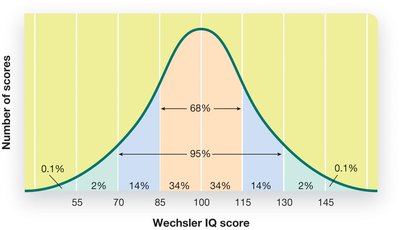
Intelligence test scores typically follow a normal distribution, with most individuals scoring near the average and fewer scoring at the extremes.
Standardized IQ tests: Scores are distributed so that 68% of people fall within one standard deviation of the mean, and 95% within two standard deviations.
The Wechsler Adult Intelligence Scale (WAIS)
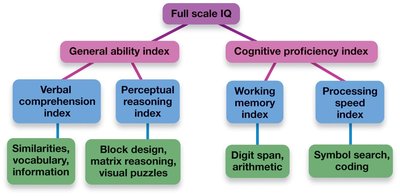
The WAIS is a widely used intelligence test for adults, consisting of multiple subscales that assess different cognitive abilities.
General Ability Index: Includes verbal comprehension and perceptual reasoning.
Cognitive Proficiency Index: Includes working memory and processing speed.
Types of Problems Used in WAIS
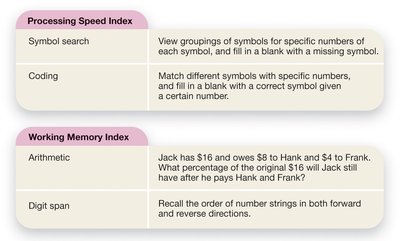
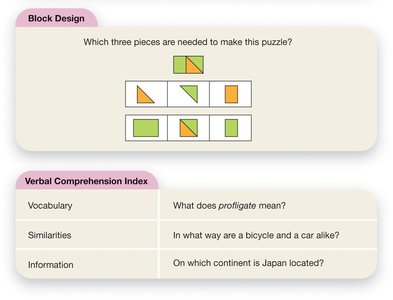
WAIS uses a variety of tasks to measure intelligence, such as symbol search, coding, arithmetic, digit span, matrix reasoning, block design, vocabulary, similarities, and information.
Raven’s Progressive Matrices
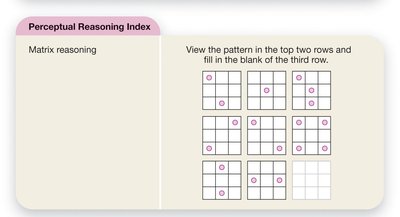
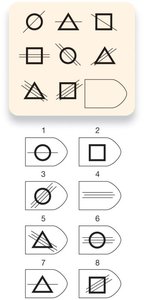
This test measures abstract reasoning and is often used to assess nonverbal intelligence. It requires the test taker to identify the missing piece in a pattern.
Controversies and Social Impact
Intelligence testing has a complex history, including its association with eugenics and debates about cultural and racial bias.
Eugenics: The misuse of intelligence testing to promote selective breeding and social Darwinism.
Cultural Bias: Tests may favor certain groups due to language, content, or process.
Stereotype Threat: The risk of confirming negative stereotypes about one's group, which can affect test performance.
Theories of Intelligence
Beliefs About Intelligence: Entity vs. Incremental Theory
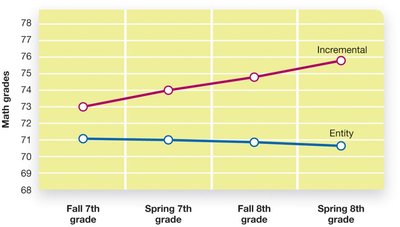
Beliefs about intelligence can influence academic performance. The entity theory views intelligence as fixed, while the incremental theory sees it as malleable.
Entity Theory: Intelligence is a stable trait that cannot be changed.
Incremental Theory: Intelligence can be developed through effort and learning.
Application: Students with incremental beliefs tend to achieve higher grades.
Fluid and Crystallized Intelligence
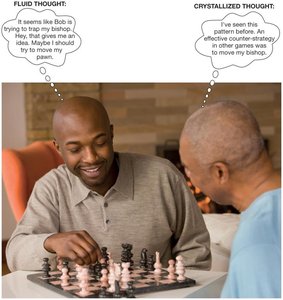
Intelligence is often divided into two types: fluid intelligence (Gf) and crystallized intelligence (Gc).
Fluid Intelligence (Gf): The ability to solve new problems, use logic, and identify patterns. It is dynamic and changes over time.
Crystallized Intelligence (Gc): The accumulation of knowledge, facts, and skills acquired through experience.
Measuring Fluid Intelligence
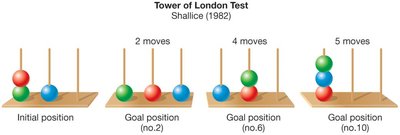
Tasks such as the Tower of London test assess planning and problem-solving abilities, which are components of fluid intelligence.
Measuring Crystallized Intelligence
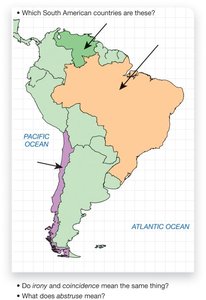
Tasks that require recalling factual information, such as naming countries, assess crystallized intelligence.
General and Multiple Intelligence Theories
Early theories proposed a single general intelligence factor, "g," while later theories recognized multiple specific abilities.
Spearman: Proposed "g" (general intelligence) and "s" (specific abilities).
Thurstone: Identified seven primary mental abilities.
Hierarchical Model: Intelligence is nested, with general and specific abilities.
Gardner’s Multiple Intelligences: Proposed several distinct forms of intelligence, such as verbal, logical, visuospatial, bodily, musical, interpersonal, intrapersonal, naturalist, and existential.
Type of Intelligence | Description |
|---|---|
Verbal/Linguistic | Ability to read, write, and speak effectively |
Logical/Mathematical | Ability to think with numbers and use logic |
Visuospatial | Ability to create and manipulate mental images |
Bodily/Kinesthetic | Ability to control body movements |
Musical/Rhythmical | Ability to produce and comprehend music |
Interpersonal | Ability to understand others' emotions and motives |
Self/Intrapersonal | Self-awareness and understanding one's own emotions |
Naturalist | Ability to recognize processes in the natural world |
Existential | Ability to ask questions about life and existence |
Learning Styles: Myth vs. Evidence
The idea that individuals learn best through specific modalities (e.g., visual, auditory) lacks strong scientific support. Effective learning focuses on understanding meaning rather than modality.
Biological, Environmental, and Behavioural Influences on Intelligence
Genetic Influences
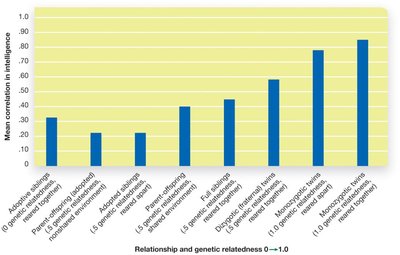
Genetic relatedness is correlated with similarities in intelligence scores. Twin and family studies reveal that intelligence has a hereditary component.
Brain Size and Intelligence
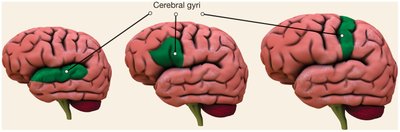
Brain size was once believed to be directly related to intelligence, but modern research shows only a modest relationship. The complexity of the brain's surface (gyri) is also important.
Environmental Influences
Several environmental factors affect intelligence, including birth order, socioeconomic status, nutrition, stress, nootropic drugs, and education.
Birth Order: Older children may have slight advantages in intelligence due to environmental factors.
Socioeconomic Status (SES): Higher SES is associated with better access to resources that promote cognitive development.
Nutrition and Stress: Adequate nutrition and low stress support optimal cognitive functioning.
Nootropic Drugs: Substances that may enhance cognitive abilities.
Education: Formal education is a key factor in developing intelligence.
The Flynn Effect
The Flynn effect describes the observed rise in average IQ scores throughout the 20th century, though this trend may be slowing or reversing in recent years.
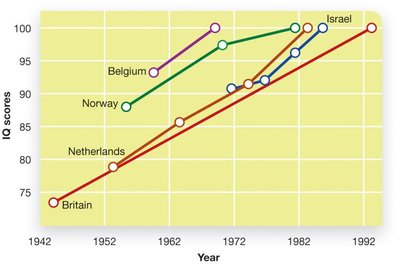
Sex Differences and Stereotypes in Intelligence
Sex Differences
Research shows no significant differences in overall intelligence between males and females, though males tend to show greater variability in scores. Some cognitive abilities may differ, with females excelling in verbal and emotional tasks and males in visuospatial tasks.
Stereotype Threat: Awareness of stereotypes can negatively impact performance.
Summary Table: Major Intelligence Theories and Tests
Theory/Test | Main Features |
|---|---|
Stanford-Binet | Measures mental age and IQ |
Wechsler Adult Intelligence Scale | Multiple subscales for different abilities |
Raven's Progressive Matrices | Nonverbal, abstract reasoning |
Spearman's g | General intelligence factor |
Thurstone's Primary Abilities | Seven distinct abilities |
Gardner's Multiple Intelligences | Nine distinct forms of intelligence |
Additional info: These notes expand on brief points from the slides, providing definitions, examples, and context for exam preparation. All included images directly reinforce the adjacent explanations and are essential for understanding the concepts.
