 Indietro
Introduction to Cognitive Psychology: Foundations, Brain, Perception, and Attention
Guida di studio - Note intelligenti
 Appunti personalizzati basati sui tuoi materiali, ampliati con definizioni chiave, esempi e contesto.
The Science of Cognition
Evolution of Cognitive Psychology
Cognitive psychology has evolved through several key periods, reflecting shifts in scientific focus and technological advances.
Before WWII: Behaviorism dominated psychology, with little interest in cognitive processes.
After 1950: Cognitive psychology began to emerge as a distinct field.
1980: The cognitive framework became established.
1990: Neural imaging allowed integration of behavioral research with brain activity.
Field Age: Cognitive psychology is less than 150 years old.
Definition and Importance
Cognitive psychology is the science of how the mind is organized to produce intelligent thought and how the mind is realized in the brain.
It explores how people acquire knowledge, perform feats of intelligence, and how these processes are foundational for other sciences (e.g., clinical psychology, linguistics).
Historical Foundations
Empiricism: All knowledge comes from experience (nurture).
Nativism: Some knowledge is innate (nature).
Cognitive psychology integrates both perspectives.
Wilhelm Wundt: Father of psychology, established the first psychological laboratory, used introspection as a research method.
William James: Emphasized pragmatism and functionalism in the U.S.
Behaviorism: Focused on observable behavior, contributed rigorous experimental methods.
Gestalt Psychology: The mind perceives organized wholes rather than individual pieces.
The Cognitive Revolution
Driven by needs in human performance (e.g., military training), computer science (artificial intelligence), and linguistics.
Ulric Neisser's book "Cognitive Psychology" (1967) and the founding of the Cognitive Psychology Journal (1970) were pivotal.
Approaches in Cognitive Psychology
Information-Processing Analysis: Compares the mind to a computer, emphasizing stages of receiving, processing, storing, and retrieving information.
Cognitive Neuroscience: Examines how cognitive tasks are realized in the brain, focusing on neural bases of cognition.
The Biological Bases of Cognition
Neurons and Neural Communication
Neurons are the primary functional units of the nervous system, responsible for transmitting signals through electrochemical activity.
The brain contains approximately 85 billion neurons, varying in shape and size.
Dendrites: Receive signals from other neurons via neurotransmitters.
Soma (cell body): Integrates incoming signals and contains the nucleus (genetic material).
Axon: Transmits action potentials, insulated by myelin to prevent signal degradation.
Axon Terminals (Synaptic Boutons): Release neurotransmitters to communicate with other neurons.
Neural information processing is based on patterns of activity and changes in synaptic connections.
Major Brain Structures and Functions
Neocortex: Involved in higher cognitive functions.
Cerebral Hemispheres: Divided by the longitudinal fissure into left and right hemispheres.
Sulci and Gyri: Folds and ridges on the brain's surface, increasing surface area.
Lobe | Main Functions |
|---|---|
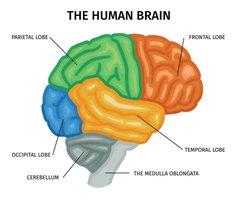
Frontal | Voluntary movement (motor cortex), executive functions (prefrontal cortex), language (Broca's area) |
Parietal | Language, spatial orientation, attention, somatosensory processing |
Occipital | Visual processing (primary visual cortex) |
Temporal | Hearing, memory, higher-order visual processing, language comprehension (Wernicke's area) |
Cerebellum: Motor coordination, balance, movement learning.
Brainstem: Connects brain to spinal cord; includes midbrain (dopamine production, reward), pons (cerebellar communication), and medulla (vital functions).
Thalamus: Relay station for sensory information (except smell).
Hypothalamus: Regulates homeostasis, hunger, thirst, temperature, and hormone release via the pituitary gland.
Hippocampus: Converts short-term to long-term memory.
Amygdala: Processes emotions, especially fear and pleasure.
Corpus Callosum: Connects the two hemispheres, enabling communication.
Ventricles: Cavities producing cerebrospinal fluid (CSF) for protection and waste removal.
Brain Scans (Neural Imaging)
CT Scan: X-ray imaging for brain structure.
MRI: Magnetic imaging for detailed brain structure.
fMRI: Functional MRI for brain activity during tasks.
PET: Positron Emission Tomography for functional imaging (less common due to radioactivity).
Brain scans are crucial for understanding brain structure and function, though they are expensive to operate and maintain.
Sensation and Perception
Visual Perception
Visual perception involves both early (sensory registration) and later (interpretation) phases. Damage to specific brain areas can result in visual agnosia, where vision is intact but object recognition is impaired.
Primates devote up to 50% of their brains to visual processing.
Early phase: Detecting shapes and objects.
Later phase: Interpreting and labeling visual input.
Visual Pathways and the Eye
The eye's outer (sclera, cornea), middle, and inner layers focus light onto the retina.
Cornea and lens: Focus light onto the retina.
Pupil and iris: Regulate light entry.
Retina: Contains photoreceptors (rods for low light, cones for color and detail).
Photoreceptors convert light into electrochemical signals (phototransduction).
Other retinal cells (bipolar, ganglion, horizontal, amacrine) refine and transmit visual signals to the brain.
Primary Visual Cortex and Visual Streams
Ganglion cell axons form the optic nerve, which crosses at the optic chiasm.
Visual information is relayed to the lateral geniculate nucleus (LGN) of the thalamus, then to the primary visual cortex (V1) in the occipital lobe.
V1 neurons are specialized for features like orientation, movement, and depth.
Visual processing splits into two streams:
"What" pathway (ventral stream): Temporal cortex, object identification.
"Where" pathway (dorsal stream): Parietal cortex, spatial awareness and action.
Depth Perception
Texture Gradient: Elements appear smaller and closer together with distance.
Stereopsis: Each eye receives a slightly different view, enabling 3D perception.
Motion Parallax: Distant objects move more slowly across the retina than closer objects.
2½ D Sketch: Combines cues to represent spatial layout before full object recognition.
Object Segmentation and Pattern Recognition
Gestalt principles (proximity, similarity, good continuation, closure) help the brain group visual elements into objects.
Pattern recognition models include template matching, feature analysis, and deep convolutional networks (for object and face recognition).
Face recognition is associated with the right fusiform gyrus.
Speech Recognition and Categorical Perception
Speech recognition involves segmenting words and phonemes from continuous speech.
Phonemes: Minimal units of speech that distinguish meaning.
Categorical perception: Listeners perceive abrupt shifts between speech sounds, even if physical changes are gradual.
Context and Pattern Recognition: Bottom-Up vs. Top-Down Processing
Bottom-up processing: Perception is driven by sensory input, without prior knowledge.
Top-down processing: Perception is influenced by expectations, experience, and knowledge.
Examples include recognizing familiar patterns or searching for specific objects in complex scenes.
Context Effects
Word Superiority Effect: Letters are recognized more easily in the context of words.
Phoneme-Restoration Effect: Listeners "hear" missing phonemes in contextually appropriate places.
Change Blindness: Failure to notice changes in a visual scene when they match the context.
Attention and Performance
Nature of Attention
Attention: Allocation of cognitive resources among ongoing processes.
Bottlenecking: Only some information passes through to further processing due to limited capacity.
Serial Bottlenecks: Points where information must be selected for further processing.
Types of Attention
Goal-directed (endogenous): Driven by internal goals.
Stimulus-driven (exogenous): Captured by external stimuli.
Auditory and Visual Attention
Auditory Attention: Early selection (Broadbent's filter theory, Treisman's attenuation theory) vs. later selection (Deutsch's theory).
Visual Attention: Fovea provides highest acuity; attention can shift to non-foveal regions.
Inattentional Blindness: Failure to notice unattended stimuli.
Visual Search: Goal-directed (object search) vs. stimulus-driven (feature search).
Binding Problem: How the brain integrates features into coherent objects (feature-integration theory, illusory conjunctions).
Parietal Cortex: Controls direction of attention (space-based vs. object-based).
Inhibition of Return: Reduced tendency to return attention to previously attended locations or objects.
Central Attention and Executive Control
Central attention determines which thoughts to pursue; multitasking is limited by bottlenecking.
Automaticity: With practice, tasks become automatic, requiring less conscious effort.
Stroop Effect: Demonstrates interference in attention (e.g., naming the color of a word when the word itself is a different color).
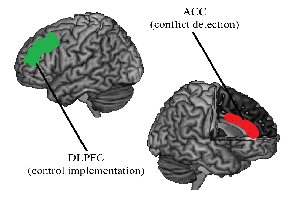
Executive Control: Directed by the dorsolateral prefrontal cortex (DLPFC) and monitored by the anterior cingulate cortex (ACC).
Mental Imagery
Nature of Mental Imagery
Mental imagery involves processing perceptual-like information without external stimuli.
Visual and verbal imagery activate similar brain regions as actual perception and attention.
Verbal imagery: Prefrontal and parietal-temporal regions.
Visual imagery: Parietal, occipital, and temporal cortices.
The closer the imagined task is to reality (in time and space), the more effective the imagery.
Types and Functions of Visual Imagery
Mental Rotation: Anticipating how objects look from different perspectives (parietal region involvement).
Image Scanning: Mentally scanning images for information, analogous to scanning a physical picture.
Magnitude Comparison: Judging size differences between imagined objects; more difficult with similar-sized objects.
Spatial vs. Visual Components: Spatial (location, parietal regions) vs. visual (color, temporal regions) attributes.
Individual Differences: People vary in vividness and perspective of imagery; attention to detail activates more brain areas.
Cognitive Maps: Mental representations of spatial environments; route maps (sequential paths) vs. survey maps (spatial layouts).
Egocentric vs. Allocentric Representations: Egocentric (viewer-centered) vs. allocentric (map-like, fixed coordinates).
Practical Implications: Mental imagery and perception share substantial overlap in brain systems; practice improves visualization skills.
