 Indietro
Introduction to Psychology: Foundations, Methods, and Perspectives
Guida di studio - Note intelligenti
 Appunti personalizzati basati sui tuoi materiali, ampliati con definizioni chiave, esempi e contesto.
What Is Psychology?
Definition and Scope
Psychology is the scientific study of behavior and mental processes. It uses systematic methods to observe, measure, and analyze both observable actions and internal experiences such as thoughts, feelings, and motives. Psychologists apply the scientific method to ensure objectivity and reliability in their research, aiming to understand how psychological principles affect real-world situations and individual lives.

Behavior: Any observable action by an organism.
Mental Processes: Internal experiences including thoughts, emotions, and motives.
Scientific Method: A systematic approach to research and analysis.
Application: Psychological research informs practices in education, health, business, and more.
Correcting Common Misconceptions About Psychology
Misconceptions and Reality
Many people mistakenly believe psychologists only treat mental illness or that psychology is not a science. In reality, most psychologists hold doctorate degrees, conduct scientific research, and use theories to explain behavior. Theories are comprehensive explanations based on evidence and observation.
Psychologists: Trained professionals who use scientific methodology.
Theory: An explanation of why and how a behavior occurs, based on systematic research.
Critical Thinking in Psychology
Developing a Scientific Mindset
Psychology teaches students to think critically, analyze information, and distinguish between scientifically validated findings and pseudopsychology (claims not tested by scientific methods). Critical thinking involves skepticism, evaluating evidence, and assessing conclusions.
Critical Thinking: Analyzing and evaluating information for validity.
Pseudopsychology: Claims or conclusions not based on scientific testing.
Skepticism: Questioning explanations and seeking evidence.
Contemporary Approaches in Psychology
Major Perspectives
Modern psychology is shaped by several key perspectives, each focusing on different aspects of behavior and mental processes. These approaches provide diverse frameworks for understanding psychological phenomena.
Biological
Behavioral
Psychodynamic
Humanistic
Cognitive
Evolutionary
Sociocultural
Biological Approach
Neuroscience and Behavior
The biological approach emphasizes the role of the nervous system, genetics, and biochemistry in behavior and mental processes. Neuroscience studies the structure, function, and development of the brain and spinal cord, considering how these physical systems underpin thoughts and emotions.
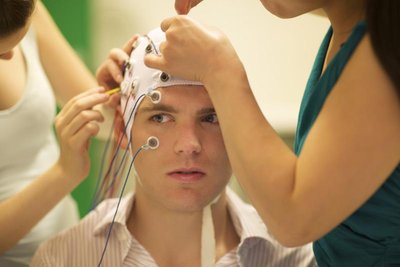
Nervous System: Includes the brain and spinal cord.
Genetics: Influence on behavior and mental traits.
Biochemistry: Chemical processes affecting the brain.
Behavioral Approach
Environmental Determinants
The behavioral approach focuses on observable behaviors and the environmental factors that shape them. It rejects explanations referencing internal thoughts and emphasizes learning through conditioning. Notable behaviorists include Ivan Pavlov, John Watson, and B.F. Skinner.


Observable Behavior: Actions that can be seen and measured.
Conditioning: Learning through association and reinforcement.
Key Figures: Pavlov (classical conditioning), Watson (behaviorism), Skinner (operant conditioning).
Psychodynamic Approach
Unconscious Drives and Conflicts
The psychodynamic approach, pioneered by Sigmund Freud, explores how unconscious thoughts, childhood experiences, and internal conflicts influence behavior. Psychoanalysis examines the mind's defenses and the interplay between biological drives and societal demands.
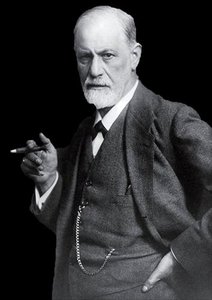
Unconscious Mind: Hidden motives and desires.
Personality Structure: Id, Ego, and Superego.
Early Childhood: Lasting impact on adult behavior.
Humanistic Approach
Self, Fulfillment, and Growth
The humanistic approach emphasizes positive human qualities, personal growth, free will, and the capacity for fulfillment. It focuses on subjective experience and the self, with notable theorists including Carl Rogers and Abraham Maslow.

Self-Actualization: Realizing one's potential.
Free Will: Ability to make choices.
Positive Qualities: Love, acceptance, and growth.
Cognitive Approach
Mental Processes and Information Processing
The cognitive approach studies how people encode, process, store, and retrieve information. It examines how humans interpret incoming information, weigh it, store it, and apply it to solve problems and make decisions.

Information Processing: Steps in handling mental information.
Memory, Reasoning, Problem-Solving: Key cognitive functions.
Evolutionary Approach
Adaptation and Natural Selection
The evolutionary approach investigates how evolutionary principles such as adaptation, reproduction, and natural selection influence behavior and mental processes. It considers how traits that promote survival and reproduction are favored over time.
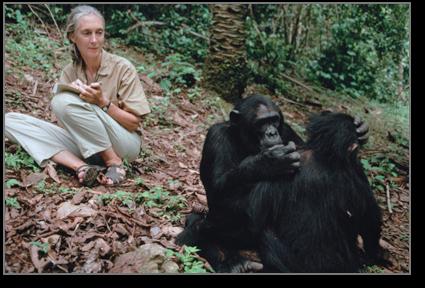

Adaptation: Behavioral and mental changes for survival.
Natural Selection: Traits that enhance reproductive success.
Key Figures: Charles Darwin, David Buss.
Sociocultural Approach
Social and Cultural Influences
The sociocultural approach examines how social and cultural environments shape behavior and thinking. It explores differences between ethnic and cultural groups, and how shared ideas and behaviors are passed from one generation to the next.

Culture: Shared ideas, behaviors, and traditions.
Social Environment: Influence of people and society.
WEIRD Cultures: Western, Industrial, Rich, Democratic.
The Science of Psychology: Goals, Hypotheses, and Methods
Main Goals of Psychological Research
Psychological research aims to describe, predict, explain, and control or change behavior. These goals guide the scientific investigation of human and animal behavior.
Describe: Observe and record behavior.
Predict: Anticipate future behavior based on patterns.
Explain: Identify causes of behavior.
Control/Change: Influence behavior through interventions.
The Scientific Method
The scientific method is a structured process for gathering and analyzing information to test hypotheses. It ensures research is systematic and objective.
Define and describe the issue.
Formulate a testable hypothesis.
Choose a research strategy.
Conduct the study.
Analyze the data.
Replication in Research
Replicating studies is essential for reliability. The "replication crisis" refers to difficulties in reproducing research findings, often due to questionable practices or confirmation bias. Solutions include sharing data, larger samples, and meta-analyses.
Meta-Analysis: Combines results from multiple studies.
Hypotheses in Psychology
Predictive vs. Causal Hypotheses
Psychologists use two main types of hypotheses:
Predictive Hypothesis: Suggests relationships between variables; tested through observation.
Causal Hypothesis: Suggests one variable affects another; tested through experiments.
Sampling and Research Methods
Types of Research Methods
Psychologists use various methods to study behavior:
Naturalistic Observation: Observing behavior in its natural environment.
Case Study: In-depth study of individuals or groups.
Survey: Collecting data from large groups about attitudes and behaviors.
Correlational Research: Examining relationships between variables.
Experimental Research: Manipulating variables to test causal hypotheses.
Sampling is crucial for research validity. Random sampling ensures representativeness, but convenience samples are often used when random sampling is not feasible.
Descriptive Methods
Observational, Case Study, and Survey Methods
Descriptive methods provide detailed information about behavior but may lack generalizability. Reactivity can affect naturalistic observations, and case studies may not apply to broader populations. Surveys are useful for making predictions and testing hypotheses.
Longitudinal Study: Observes participants over time.
Cross-Sectional Study: Observes different participants at one point in time.
Correlational Studies
Understanding Relationships Between Variables
Correlational studies measure the strength and direction of relationships between variables using a correlation coefficient, which ranges from -1.00 to +1.00. Positive correlations indicate both variables increase together, while negative correlations indicate one increases as the other decreases.
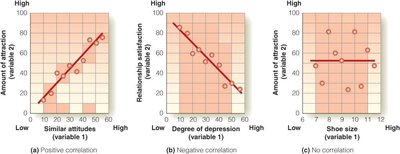
Correlation Coefficient: Statistic indicating relationship strength.
Positive Correlation: Both variables increase together.
Negative Correlation: One variable increases as the other decreases.
Correlation vs. Causation
Correlation does not imply causation. While variables may change together, only experiments can determine if one variable causes changes in another.
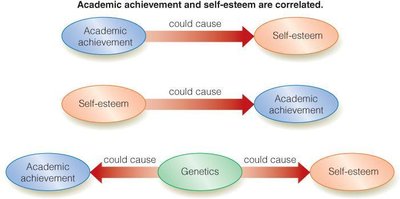
Correlation: Statistical association between variables.
Causation: Direct relationship where one variable causes change in another.
Experimental Methods
Testing Causal Hypotheses
Experiments manipulate an independent variable to observe its effect on a dependent variable. Participants are assigned to experimental or control groups, with random assignment ensuring group equivalence. Placebos and double-blind studies control for expectations and confounding variables.
Independent Variable: Manipulated factor.
Dependent Variable: Measured outcome.
Experimental Group: Receives manipulation.
Control Group: Does not receive manipulation.
Placebo Effect: Changes due to expectations.
Double-Blind Study: Neither participants nor experimenters know group assignments.
Confounding Variables: Other factors affecting results.
Random Assignment: Ensures group equivalence.
Quasi-Experiment: Lacks random assignment.
Advantages and Disadvantages of Experiments
Advantages: Determine cause-and-effect, explain and change behavior.
Disadvantages: May not describe or generalize behavior; ethical limitations.
Comparing Research Methods
Descriptive, Correlational, and Experimental Methods
The following table summarizes the main purposes, procedures, manipulated variables, and weaknesses of each research method:
Research Method | Basic Purpose | How Conducted | What Is Manipulated | Weaknesses |
|---|---|---|---|---|
Descriptive | To observe and record behavior | Case studies, naturalistic observations, surveys | Nothing | No control of variables; single cases may be misleading |
Correlational | To detect relationships; assess prediction | Collect data on variables; no manipulation | Nothing | Cannot specify cause and effect |
Experimental | To explore cause and effect | Manipulate factors; random assignment | Independent variable(s) | May not generalize; ethical limits; not always feasible |
Ethical Principles of Psychological Research
Ethical Guidance and Review Boards
Psychological research is governed by ethical principles to protect participants. Institutional Review Boards (IRB) and Human Research Ethics Committees (HREC) ensure research meets ethical standards.
IRB: Institutional Review Board for ethical oversight.
HREC: Human Research Ethics Committee (international equivalent).
Ethical Guidelines for Human Participants
Researchers must protect participants from harm, obtain informed consent, avoid coercion, allow withdrawal, maintain confidentiality, and respect privacy. Deception is permitted only when necessary, followed by debriefing.
Informed Consent: Participants are fully informed before agreeing.
Confidentiality: Protecting personal information.
Debriefing: Explaining the true purpose after deception.
Ethical Guidelines for Nonhuman Research
Research with animals must meet ethical standards, overseen by Institutional Animal Care and Use Committees (IACUC). Animals must be treated humanely and in accordance with laws and regulations.
IACUC: Institutional Animal Care and Use Committee.
Humane Treatment: Ethical and legal compliance.
Foundations and Growth of Psychology
Structuralism and Introspection
Structuralism, attributed to Wilhelm Wundt, focuses on the structure of thought and basic elements of mental experience. Introspection, developed by Edward Titchener, is a self-observation technique to identify mental processes.
Structuralism: Analyzing the structure of mental experiences.
Introspection: Self-observation of thoughts and sensations.
Functionalism
Functionalism, coined by William James, emphasizes the functions of thoughts and feelings and their interaction with the environment. It focuses on the wholeness of events and the natural flow of consciousness.
Function: Purpose of mental processes.
Stream of Consciousness: Continuous flow of thoughts.
Specialty Areas in Psychology
Diverse Fields of Study
Psychology encompasses various specialty areas, including:
Cross-cultural psychology
Developmental psychology
Educational psychology
Forensic psychology
Human factors psychology
Industrial/organizational psychology
Social psychology
Sports psychology
