 Indietro
Memory: Types, Processes, and Strategies
Guida di studio - Note intelligenti
 Appunti personalizzati basati sui tuoi materiali, ampliati con definizioni chiave, esempi e contesto.
Memory
Overview of Memory
Memory is the process by which information is encoded, stored, and retrieved. It is essential for learning, decision-making, and daily functioning. Memory can be categorized by duration and type, each with distinct characteristics and functions.
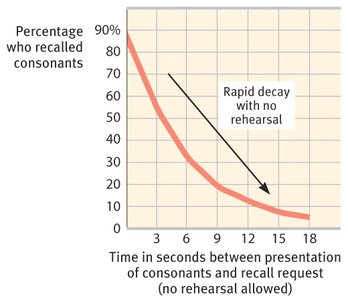
Short-term memory: Stores a limited amount of information for about 20 seconds without rehearsal.
Long-term memory: Stores an unlimited amount of information, potentially for a lifetime.
Types of Memory
Declarative (Explicit) Memory: Involves conscious recollection of facts and events.
Episodic Memory: Autobiographical memory for specific events and experiences (e.g., your last birthday party).
Semantic Memory: General knowledge about the world, including facts and concepts (e.g., knowing that Paris is the capital of France).
Non-declarative (Implicit) Memory: Does not require conscious recollection. Includes skills and conditioned responses (e.g., riding a bike, classical conditioning).
Sensory Memory: Briefly holds sensory information.
Echoic Memory: Auditory sensory memory.
Iconic Memory: Visual sensory memory.
Memory Processes
I. Encoding
Encoding is the process of transforming sensory input into a form that can be stored in memory. It can be automatic or effortful, and several strategies can enhance encoding.
Automatic Encoding: Occurs without conscious effort (e.g., remembering what you had for breakfast).
Effortful Encoding: Requires attention and conscious effort (e.g., studying for an exam).
Rehearsal: The amount learned is proportional to the time spent learning.
Spacing Effect: Distributed rehearsal (spacing out study sessions) improves long-term retention.
Serial Position Effect: Tendency to recall the first and last items in a list better than the middle items.
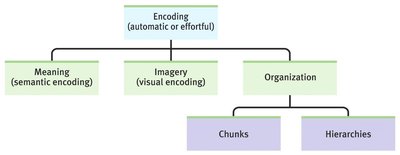
Encoding Strategies:
Meaning (Semantic Encoding): Relating new information to personal experiences or existing knowledge.
Imagery (Visual Encoding): Creating mental images to enhance memory (e.g., mnemonics).
Organization: Structuring information into chunks or hierarchies to improve recall.
Chunking Example: The brain can read jumbled words as long as the first and last letters are correct, demonstrating how we process words as wholes rather than individual letters.
II. Storage
Storage refers to maintaining encoded information over time. Memory is stored throughout the brain, with different regions supporting different types of memory.
Long-term potentiation (LTP): A long-lasting increase in synaptic efficiency, believed to be a neural basis for learning and memory. RNA synthesis increases during learning, and enriched environments enhance memory in animals.
Short-term memory capacity: Typically 7 ± 2 units; decays rapidly without rehearsal.
Brain regions involved in memory:
Hippocampus: Formation of new memories.
Amygdala: Emotional memories.
Cortex: Storage of long-term memories.
Cerebellum: Implicit memory (e.g., procedural skills like riding a bicycle).
III. Retrieval
Retrieval is the process of accessing stored information. It can be influenced by various factors and cues.
Recall: Retrieving information without cues (e.g., essay questions).
Recognition: Identifying information from a set of options (e.g., multiple-choice questions).
Factors affecting retrieval:
Distinctiveness: Unique or unusual events are more easily remembered (e.g., flashbulb memories, von Restorff effect).
Testing effects: Retrieval is improved by previous retrieval attempts.
Retrieval cues: Stimuli that help access memories (e.g., priming, associations).
Encoding specificity: Retrieval is more effective when conditions at retrieval match those at encoding (e.g., context, mood, state-dependent memory).
IV. Forgetting
Forgetting can occur due to several mechanisms, including ineffective encoding, interference, and memory distortion.
Ineffective coding: Information was never properly encoded.
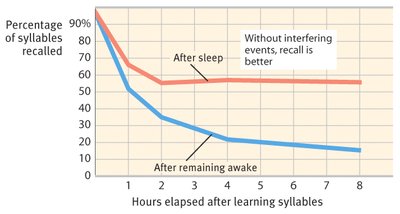
Interference:
Proactive interference: Old information interferes with new learning.
Retroactive interference: New information interferes with the recall of old information.
Misinformation effect: Incorporating misleading information into one's memory of an event.
Source amnesia: Attributing a memory to the wrong source.
False retrieval: Mistaken recall of events that did not occur (e.g., eyewitness testimony errors).
Time: Memories can fade over time if not retrieved or rehearsed.
Repressed memories: Controversial; memories from before age 3 or those recovered under hypnosis/drugs are generally unreliable.
Improving Your Memory
Study repeatedly over time (distributed practice).
Engage in active thinking about the material.
Make the material personally meaningful.
Use mnemonic devices to aid recall.
Activate retrieval cues (e.g., context, mood, priming).
Minimize interference (e.g., study before sleeping).
Test yourself, especially using recall-based methods.
Big Picture
Most memory requires effort and rehearsal to be stored in long-term memory.
Long-term memories can last a lifetime, but details may become mixed up due to interference and other factors.
Eyewitness testimony is often unreliable, and the criminal justice system may not fully account for the limitations of human memory.
