 Indietro
Money Supply and Demand: Key Concepts in Monetary Economics
Guida di studio - Note intelligenti
 Appunti personalizzati basati sui tuoi materiali, ampliati con definizioni chiave, esempi e contesto.
Introduction to Money Supply
Meaning and Functions of Money
Money is defined as anything that is generally accepted as a means of exchange and acts as a measure and store of value. It facilitates the purchase of goods and services and the settlement of debts. Key economists such as Crowther, Alfred Marshall, and D.H. Robertson have emphasized the acceptability and utility of money in economic transactions.
Medium of Exchange: Money is used to buy and sell goods and services.
Measure of Value: It provides a common standard for valuing goods and services.
Store of Value: Money can be saved and retrieved in the future, retaining its value over time.
Standard of Deferred Payment: It enables credit transactions and future payments.
Transfer of Value: Money allows value to be transferred from one person to another.
Money Supply and Its Constituents
Traditional and Modern Approaches
The money supply refers to the total stock of money available to the public for spending in an economy. It excludes money held by the central bank, commercial banks, and the state treasury, as these are money-creating agencies.
Traditional (Narrow) Money (M1): Includes currency (coins and notes) and demand deposits (chequable deposits). Formula: Where C = Currency, DD = Demand Deposits.
Modern (Broad) Money: Expands the definition to include close substitutes such as time deposits, post office savings, government securities, and credit. Formula: Where a = post office savings, b = time deposits, c = government securities, d = credit.
Broad money can be further subdivided as:
Determinants of Money Supply
The main determinants of money supply include:
Central Bank (e.g., RBI): Controls monetary policy and the issuance of currency.
Depository Institutions: Banks that accept deposits and provide loans.
The Public: Individuals and firms holding money as currency or deposits.
High Powered Money (Reserve Money)
High powered money, also known as base money or reserve money, consists of currency held by the public and reserves held by banks.
Formula: Where H = High powered money, C = Currency, R = Reserves.
Money Multiplier
The money multiplier shows how an initial deposit leads to a greater final increase in the total money supply due to the banking system's ability to lend.
Formula:
Velocity of Circulation of Money
The velocity of money refers to the number of times money changes hands in an economy over a period. It is classified as:
Transaction Velocity: How quickly money is used for transactions.
Income Velocity: How quickly money circulates in relation to income generation.
Factors influencing velocity include production and trade volume, institutional arrangements, savings, price level changes, and regularity of income receipts.
Cryptocurrency: Concept and Limitations
Cryptocurrency is a digital or virtual currency secured by cryptography and typically operates on decentralized blockchain technology. It is not issued by central authorities.
Advantages: Decentralization, lower transaction fees, transparency, security, financial inclusion, fast transactions, limited supply, accessibility.
Limitations: High volatility, regulatory uncertainty, security risks, environmental impact, limited adoption, market manipulation, risk of financial loss, dependence on technology.
While cryptocurrencies offer innovation and accessibility, they face challenges such as volatility, cybersecurity risks, and regulatory uncertainty.
Demand for Money
Classical Approach (Quantity Theory of Money)
Classical economists like David Hume, J.S. Mill, and Irving Fisher emphasized the transactions demand for money. Fisher's equation of exchange is:
Equation: Where M = Money Supply, V = Velocity of Money, P = Price Level, T = Transactions.
Demand for money is proportional to the value of transactions and inversely related to velocity.
Formula for Demand for Money:
Neo-Classical Approach (Cambridge Cash Balance Approach)
This approach, developed by Cambridge economists, focuses on the portion of income people wish to hold as cash balances.
Equation: Where k = proportion of income held as money, P = average price, Y = real national income.
Keynesian Approach: Liquidity Preference Theory
Keynes emphasized the store of value function of money and introduced the concept of liquidity preference, which is the desire to hold cash due to uncertainty about the future. The motives for holding money are:
Transactions Motive: For day-to-day expenses (includes income and business motives).
Precautionary Motive: For unforeseen emergencies or opportunities.
Speculative Motive: To take advantage of future changes in interest rates or bond prices.
The demand for money for transactions and precautionary motives depends on income, while speculative demand depends on the interest rate.
Equation: (Transaction and precautionary motives)
Equation: (Speculative motive, inversely related to interest rate)
Total Demand for Money:
Liquidity Trap
At very low interest rates, the speculative demand for money becomes perfectly elastic. People prefer to hold cash rather than bonds, making monetary policy less effective.
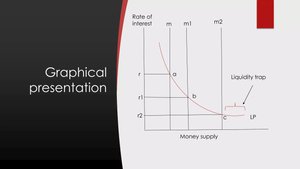
Keynes Liquidity Preference Theory of Interest
According to Keynes, the interest rate is determined by the demand for and supply of money. The supply of money is fixed by the central bank and is represented as a vertical line, while the demand for money is downward sloping with respect to the interest rate.
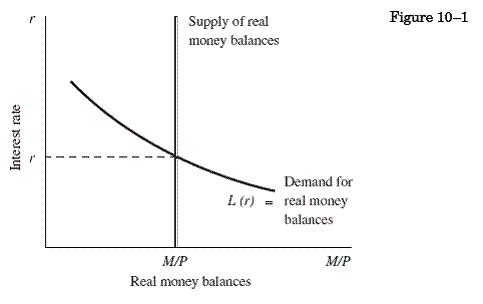
Friedman's Restatement of the Demand for Money
Milton Friedman modernized the quantity theory of money, arguing that money is an asset and individuals hold it as part of their wealth. The demand for money depends on permanent income and the returns on alternative assets (bonds, equities, expected inflation). Friedman believed that the demand for money is stable and predictable, making monetary policy effective for economic stabilization.
Significance: Revived the quantity theory, influenced monetarism, and shaped monetary policy in the late 20th century.
Criticisms: Permanent income is hard to measure, financial innovation can destabilize money demand, and the model may not perform well during crises.
Summary Table: Approaches to the Demand for Money
Approach | Main Contributors | Key Equation | Determinants |
|---|---|---|---|
Classical (Quantity Theory) | Fisher, Hume, Mill | Transactions, Price Level, Velocity | |
Neo-Classical (Cambridge) | Marshall, Pigou, Robertson | Cash Balances, Income, Price Level | |
Keynesian | Keynes | Income, Interest Rate, Motives | |
Monetarist (Friedman) | Friedman | Asset Demand Function | Permanent Income, Returns on Assets |
Graphical Representations
The following diagrams illustrate the relationship between money supply, demand, and interest rates in different theoretical frameworks:
Figure 1: Supply and demand for real money balances (Keynesian framework).
Figure 2: Liquidity trap and money supply (Keynesian theory).
Figure 3: Shifts in money demand and interest rates (various approaches).
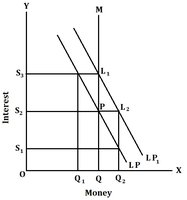
Additional info: The diagrams reinforce the theoretical explanations of money demand, supply, and the effects of interest rates, including the concept of the liquidity trap and the role of monetary policy.
