 Indietro
CH 9: Pain Management
Guida di studio - Note intelligenti
 Appunti personalizzati basati sui tuoi materiali, ampliati con definizioni chiave, esempi e contesto.
CH 9: Pain Management
Fundamental Concepts of Pain
Pain is a multidimensional experience that affects physical, emotional, and psychosocial functioning. Understanding its definition, effects, and types is essential for effective assessment and management.
Pain is defined by the International Association for the Study of Pain (IASP) as an unpleasant sensory and emotional experience associated with actual or potential tissue damage.
Pain is subjective and best assessed by patient self-report, which is the most reliable indicator.
Pain can affect individuals of all ages, genders, and backgrounds, and is a leading reason for seeking healthcare.
Effects of Pain
Pain can have widespread effects on multiple body systems, especially if unrelieved. These effects can be acute or chronic and may persist throughout life.
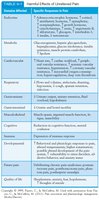
System Affected | Specific Responses to Pain |
|---|---|
Endocrine | Increased stress hormones (cortisol, ACTH), altered metabolism, hyperglycemia, poor wound healing. |
Metabolic | Catabolism, muscle protein breakdown, impaired glucose use, negative nitrogen balance. |
Cardiovascular | Tachycardia, hypertension, increased cardiac workload, risk of ischemia, DVT, and arrhythmias. |
Respiratory | Shallow breathing, decreased lung expansion, risk of atelectasis and pneumonia. |
Genitourinary | Urinary retention, fluid overload, electrolyte imbalance. |
Gastrointestinal | Decreased motility, nausea, constipation, ileus. |
Cognitive | Impaired cognition, confusion, mental status changes. |
Immune | Suppression of immune response. |
Functional/Quality of Life | Reduced physical activity, sleep disturbance, depression, anxiety, impaired social relationships. |
Types and Categories of Pain
Pain is classified by duration and by inferred pathology, which guides assessment and treatment strategies.
Acute pain: Short-term, often from surgery, trauma, or procedures.
Chronic pain: Lasts beyond normal healing, may be cancer or noncancer in origin.
Nociceptive pain: Results from tissue damage and normal pain processing.
Neuropathic pain: Caused by lesion or disease of the somatosensory system.
Mixed pain: Involves both nociceptive and neuropathic mechanisms.
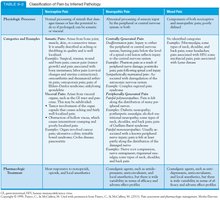
Pathologic Process | Nociceptive Pain | Neuropathic Pain | Mixed Pain |
|---|---|---|---|
Examples | Somatic (bone, joint, muscle, skin) or visceral (organ) pain; e.g., surgical incision, arthritis. | Central or peripheral nerve injury; e.g., diabetic neuropathy, post-stroke pain. | Combination; e.g., low back pain with nerve involvement, cancer pain. |
Pharmacologic Treatment | Nonopioids, opioids, adjuvants. | Adjuvant analgesics (antidepressants, anticonvulsants), sometimes opioids. | Multimodal therapy tailored to components. |
Nociceptive Pain: The Four Processes
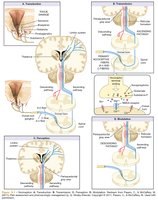
Nociceptive pain involves a sequence of neural processes: transduction, transmission, perception, and modulation.
Transduction: Nociceptors are activated by noxious stimuli (mechanical, thermal, chemical, infectious). Excitatory compounds (serotonin, bradykinin, histamine, substance P, prostaglandins) are released. Prostaglandins initiate inflammation; NSAIDs inhibit COX enzymes to reduce pain.
Transmission: Action potentials travel along A-delta (fast, sharp pain) and C-fibers (slow, dull pain) to the spinal cord, where modulation occurs.
Perception: Pain becomes conscious through activation of higher brain centers (thalamus, cortex), involving awareness and emotional response.
Modulation: Neurochemicals (serotonin, norepinephrine, endogenous opioids) alter pain signals at every level from periphery to cortex.
Neuropathic Pain
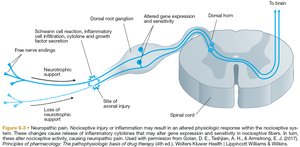
Neuropathic pain arises from injury or disease affecting the somatosensory nervous system, leading to abnormal pain processing.
May result from traumatic or nontraumatic nerve injuries.
Common symptoms include allodynia (pain from non-painful stimuli) and hyperalgesia (increased pain from painful stimuli).
Peripheral mechanisms: Damaged nerve endings, maladaptive neuroplasticity, increased sodium channel activity (peripheral sensitization).
Central mechanisms: Hyperexcitability of central neurons, central sensitization, NMDA receptor activation, windup, CNS reorganization.
Pain Assessment
Because pain is subjective, assessment relies primarily on patient self-report, supported by observation and clinical judgment.
Self-report is the gold standard for pain assessment (recommended by The Joint Commission).
Clinicians must avoid letting personal opinions interfere with patient care.
When self-report is not possible, use a hierarchy of pain measures: consider pathology, observe behaviors, evaluate physiologic indicators, and conduct analgesic trials.
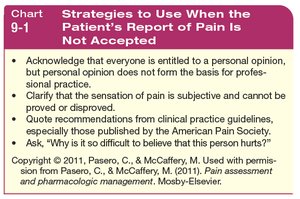
Comprehensive Pain Assessment: Patient Interview
A thorough pain assessment should be conducted at admission, with each new pain report, or when the patient's condition changes.
Assess location, intensity (using validated scales), quality, onset, duration, aggravating/relieving factors, and impact on function and quality of life.
Consider cultural background, past pain experiences, comorbidities, and diagnostic data.
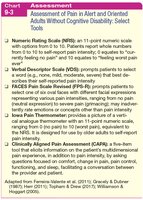
Assessment Tools for Pain
Validated tools are used to assess pain in different populations, including those unable to self-report.
Numeric Rating Scale (NRS), Verbal Descriptor Scale (VDS), Faces Pain Scale-Revised (FPS-R), and Critical-Care Pain Observation Tool (CPOT) are examples.
For adults unable to self-report, use Adult Nonverbal Pain Score (NVPS), CPOT, or Pain Assessment in Advanced Dementia Scale (PAINAD).
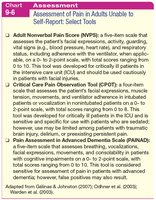
Nonpharmacologic Pain Management Methods
Nonpharmacologic interventions can complement medication and are especially important in multimodal pain management.
Type | Examples | Nursing Considerations |
|---|---|---|
Physical modalities | Heat/cold, massage, TENS, acupuncture | Assess for contraindications, monitor for adverse effects |
Cognitive-behavioral | Relaxation, distraction, imagery, hypnosis | Evaluate cognitive ability to participate |
Movement therapy | Yoga, Tai Chi | Assess physical ability to perform |
Psycho/spiritual | Therapeutic touch, faith, healing rituals | Obtain permission before using interventions |
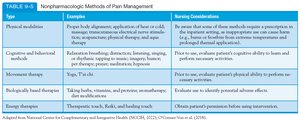
Reassessing Pain
Pain should be reassessed regularly to evaluate the effectiveness of interventions. The timing depends on the route of analgesic administration and patient status.
Reassess at least every 15–30 minutes after parenteral analgesics and every 1–2 hours after oral analgesics.
In post-anesthesia care, reassessment may be as frequent as every 10 minutes during IV opioid titration.
Special Populations: Veterans
Veterans have a high prevalence of pain-associated disorders, such as headaches and orthopedic conditions. Multimodal and multidisciplinary approaches are recommended, and nonpharmacologic treatments are commonly used in the Veterans Health Administration.
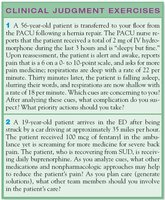
Clinical Judgment Exercises
Applying knowledge of pain management in clinical scenarios is essential for safe and effective patient care.
Sample Exam Questions
What is the most reliable indicator of pain? Self-report by the patient.
Does increased sodium channel activity result in central sensitization? False. It results in peripheral sensitization.
What is the recommended minimum frequency for reassessing pain after oral analgesic administration? Every 1 to 2 hours.
