 Indietro
Preoperative Nursing Management: Comprehensive Study Notes
Guida di studio - Note intelligenti
 Appunti personalizzati basati sui tuoi materiali, ampliati con definizioni chiave, esempi e contesto.
Chapter 14: Preoperative Nursing Management
Overview of Perioperative Nursing
Perioperative nursing encompasses the care provided before, during, and after surgery. It is essential for ensuring patient safety, optimal outcomes, and effective communication among the healthcare team. The perioperative period is divided into three main phases:
Preoperative: From the decision to proceed with surgery until transfer to the operating room (OR) bed.
Intraoperative: From transfer to the OR bed until admission to the postanesthesia care unit (PACU).
Postoperative: From admission to the PACU until follow-up evaluation.
Nursing activities are guided by standards from the Association of periOperative Registered Nurses (AORN) and the American Society of PeriAnesthesia Nurses (ASPAN).
Conceptual Model of Patient Care (AORN)
The AORN model outlines the relationship between nursing practice and patient outcomes, focusing on four domains:
Safety
Physiologic responses
Behavioral responses
Health care systems (structural data elements)
This model emphasizes the importance of nursing diagnoses, interventions, and outcomes in achieving optimal patient results.
Preoperative Phase
Preadmission Testing and Assessment
Preadmission testing (PAT) is conducted to ensure the patient is prepared for surgery. It includes:
Initial preoperative assessment and education
Verification of diagnostic testing and preoperative therapies
Review of advance directives and initiation of discharge planning
During admission to the surgical center, nurses complete assessments, verify consent, and reinforce education. In the preoperative area, they confirm patient identity, assess status, review records, and ensure comfort and psychological support.
Intraoperative and Postoperative Phases
During surgery, nurses maintain safety, monitor physiologic status, and provide emotional support. Postoperatively, they communicate intraoperative information, monitor recovery, manage pain, and assist with discharge planning and follow-up care.
Advances in Surgery and Anesthesia
Technological and Methodological Advances
Minimally invasive and robotic surgeries reduce morbidity and recovery time.
Modern anesthesia methods improve safety and patient experience.
Short-acting anesthetics and effective antiemetics reduce complications.
Robotic surgery offers enhanced precision, range of motion, and visualization, with applications in cardiac, gastrointestinal, urologic, gynecologic, ENT, thoracic, and orthopedic procedures.
Surgical Classifications
Types and Urgency of Surgery
Diagnostic: Biopsy, exploratory laparotomy
Curative: Tumor excision, appendectomy
Repair: Multiple wound repair
Reconstructive/Cosmetic: Mammoplasty, facelift
Palliative: Tumor debulking
Rehabilitative: Joint replacement
Classified by urgency as emergent, urgent, required, elective, or optional.
Categories of Surgery Based on Urgency
Emergent: Immediate, life-threatening (e.g., severe bleeding)
Urgent: Within 24–30 hours (e.g., closed fractures)
Required: Within weeks or months (e.g., prostatic hyperplasia)
Elective: Not catastrophic if delayed (e.g., scar repair)
Optional: Personal preference (e.g., cosmetic surgery)
Preadmission Testing and Ambulatory Surgery
Ambulatory (outpatient) surgery does not require an overnight stay. PAT reduces hospital stays and costs, and involves education, assessment, and planning for discharge and follow-up care.
Preoperative Risk Factors for Surgical Complications
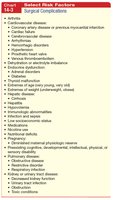
Identifying risk factors is essential for minimizing complications. Common risk factors include:
Cardiovascular disease
Respiratory disorders
Renal or hepatic dysfunction
Diabetes
Obesity or malnutrition
Advanced age or very young age
Immunosuppression
Substance use (alcohol, tobacco, drugs)
Medication use (anticoagulants, corticosteroids, etc.)
Psychological or cognitive impairment
Special Patient Populations
Older Adults
Increased risk due to comorbidities and altered physiology
Comprehensive assessment of cardiovascular, respiratory, and renal systems
Monitor for temperature sensitivity and skin integrity
Bariatric Patients
Obesity increases surgical risk and complicates care
Assess for obstructive sleep apnea and cardiovascular issues
Monitor for delayed wound healing and increased infection risk
Patients With Disabilities
Ensure assistive devices are available and secure
Address communication needs and special positioning
Optimize respiratory status and develop a comprehensive care plan
Ambulatory and Emergency Surgery Patients
Quick, comprehensive assessment and education for ambulatory patients
Calm, effective communication and rapid assessment for emergency cases
Obtain essential information from family if patient is unconscious
Preoperative Documentation and Consent
Informed consent is a legal and ethical requirement
Surgeon explains procedure, risks, and benefits; nurse verifies understanding and signature
Consent must be obtained before administering psychoactive medications
Comprehensive Preoperative Assessment
Health history, allergies, previous anesthesia complications
Physical examination and laboratory/diagnostic tests as indicated
Assessment of nutritional, respiratory, cardiovascular, hepatic, renal, endocrine, and immune function
Medication history and management of current medications
Psychosocial, Spiritual, and Cultural Considerations
Assess emotional reactions, anxiety, and coping strategies
Respect cultural, spiritual, and religious beliefs
Use effective communication and provide individualized education
Preoperative Nursing Interventions
Provide patient education using multiple strategies
Teach deep breathing, coughing, and incentive spirometry
Promote mobility and active body movement
Educate on pain management and anxiety reduction techniques
Maintain patient safety and manage nutrition, fluids, bowel, and skin preparation
Administer preoperative medications and maintain accurate records
Prevent hypothermia and attend to family needs
Expected Patient Outcomes
Reduced anxiety and fear
Increased knowledge and understanding of the surgical process
Active participation in preoperative preparation and postoperative exercises
Safe and effective transition to the intraoperative phase
