 Indietro
PSYC 2301 General Psychology: Course Structure, Themes, and Study Guide
Guida di studio - Note intelligenti
 Appunti personalizzati basati sui tuoi materiali, ampliati con definizioni chiave, esempi e contesto.
Course Overview
Introduction to General Psychology
PSYC 2301 is a foundational course that surveys the science of behavior and mental processes. The course covers a wide range of psychological topics, from basic neurological processes to learning, development, personality, mental health, and treatment. Students will learn how psychologists build evidence, explain behavior and mental processes, and apply psychological knowledge in practical contexts.

Course Structure and Learning Cycle
How Class Works
Class meetings combine lectures, slides, multimedia, discussion, demonstrations, and guided activities. Students are responsible for engaging with the textbook, class sessions, and the Canvas course site. The learning cycle emphasizes active engagement and repeated practice to build understanding and retention.
Preview: Read assigned ideas before class.
Attend: Participate in class to build meaning.
Retrieve: Recall information without notes.
Apply: Use examples to deepen understanding.
Check: Identify and correct gaps in knowledge.

Course Themes
Integrative Themes in Psychology
The course is organized around several key themes that connect psychological science across biological, psychological, social, and cultural levels. These themes help students understand the complexity and interconnectedness of psychological phenomena.
Empirical Evidence: Psychological science relies on data and adapts as new findings emerge.
General Principles and Individual Differences: Psychology explains broad principles while recognizing unique individual experiences.
Multifactorial Influences: Behavior and mental processes are shaped by psychological, biological, social, and cultural factors.
Diversity and Inclusion: Psychology values diversity, equity, and inclusion in pursuit of a just society.
Perception and Bias: Our experiences are filtered through personal perceptions and biases.
Application: Psychological principles can positively impact lives, organizations, and communities.
Ethics: Ethical principles guide research and practice in psychology.
Course Sequence and Major Units
Planned Sequence of Topics
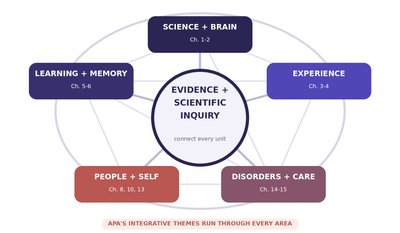
The course follows a structured sequence, with each unit focusing on specific chapters and psychological domains. Evidence and scientific inquiry are central to every unit, and integrative themes run throughout the course.
Unit | Chapters | Primary Focus | Exam Date |
|---|---|---|---|
Exam 1 | 1-2 | Psychological science, research, brain and nervous system | Sept. 9 |
Exam 2 | 5-6 | Learning and memory | Sept. 28 |
Exam 3 | 3-4 | Sensation, perception, and consciousness | Oct. 14 |
Exam 4 | 8, 10, 13 | Development, gender, and personality | Nov. 11 |
Exam 5 | 14-15 | Psychological disorders and evidence-based treatments | Finals week |
Assessment and Grading
Course Points and Grade Breakdown
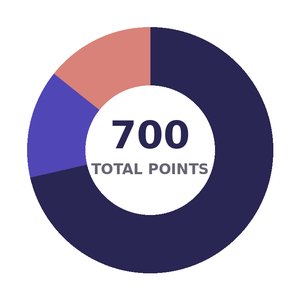
Students earn up to 700 points through exams, chapter question sets, and assignments. The grading system emphasizes comprehension, application, and explanation of psychological concepts.
Exams: 500 points (71.4%) – Five exams, each worth 100 points.
Chapter Question Sets: 100 points (14.3%) – Ten sets, one dropped, full credit for 80%+ completion.
Assignments: 100 points (14.3%) – In-class and Canvas assignments.
Letter Grade | Percentage | Point Equivalent |
|---|---|---|
A | 89.5% or higher | 626.5-700 |
B | 79.5% to below 89.5% | 556.5 to below 626.5 |
C | 69.5% to below 79.5% | 486.5 to below 556.5 |
D | 59.5% to below 69.5% | 416.5 to below 486.5 |
F | Below 59.5% | Below 416.5 |
Academic Integrity and Responsible AI Use
Ethical Principles in Psychology
Academic honesty is essential in psychology and higher education. Students must avoid cheating, plagiarism, unauthorized collaboration, and misrepresentation. AI use is strictly regulated and only permitted when explicitly authorized by the instructor. When AI is used, students must disclose their process and verify output accuracy.
Exams and quizzes: No AI or unauthorized assistance allowed.
Chapter Question Sets: Must be completed individually without AI.
Assignments: Follow specific directions for AI use.
Privacy: Do not enter personal or sensitive information into AI systems.
Classroom Community and Support
Respectful Discussion and Accessibility
Psychology includes topics that may be controversial or emotionally charged. Students are expected to engage respectfully, critique ideas with evidence, and avoid personal attacks. Accommodations and support are available for students with disabilities or other needs. Early communication with the instructor and support offices is encouraged to address challenges.
Student Accessibility Resources: Contact SAR for disability-related accommodations.
Confidential Support: Counseling services are available for personal and academic support.
Title IX: Report or seek support for sex- and gender-based discrimination or misconduct.
Summary Table: Course Topics and Chapters
Main Topic | Chapters |
|---|---|
The Science of Psychology | 1 |
The Biological Perspective | 2 |
Sensation and Perception | 3 |
Consciousness | 4 |
Learning | 5 |
Memory | 6 |
Development Across the Life Span | 8 |
Motivation and Emotion | 10 |
Theories of Personality | 13 |
Psychological Disorders | 14 |
Psychological Therapies | 15 |
Additional Info
Continuous access to the required textbook (Psychology, 7th edition by Ciccarelli & White) is necessary for success in the course.
Canvas is the primary platform for assignments, instructions, and updates.
Attendance, punctuality, and device-free engagement are required for optimal learning.
