 Indietro
Psychological Foundations: History, Perspectives, and Domains in Psychology
Guida di studio - Note intelligenti
 Appunti personalizzati basati sui tuoi materiali, ampliati con definizioni chiave, esempi e contesto.
Module 1: Psychological Foundations
Introduction to Psychology
Psychology is the scientific study of the mind and behavior. Understanding its history and foundational concepts helps explain why psychologists ask certain questions and how the field has evolved over time.
Definition: Psychology systematically investigates mental processes and behavior using scientific methods.
Value of History: Studying psychology's history reveals how its questions, methods, and theories have changed, providing context for current practices.
Applications: Insights from psychology are used in education, health, business, and many other fields.
Early History & Schools of Thought
Structuralism and Functionalism
The earliest schools of psychology focused on understanding consciousness and its functions.
School | Description | Key People |
|---|---|---|
Structuralism | Understanding conscious experience through introspection—breaking it into basic elements. | Wilhelm Wundt, Edward Titchener |
Functionalism | Emphasized how mental activities help an organism adapt to its environment. | William James, John Dewey, G. Stanley Hall, James McKeen Cattell |
Structuralism: Used introspection to analyze sensations, images, and feelings.
Functionalism: Focused on the purpose of consciousness and behavior, influenced by Darwin's theory of evolution.
Key Figures:
Wilhelm Wundt: Founded the first psychology laboratory in Leipzig, Germany (1879).
Edward Titchener: Brought structuralism to the U.S.; trained Margaret Floy Washburn, the first woman PhD in psychology.
William James: Authored Principles of Psychology (1890); emphasized the mind's adaptive functions.
G. Stanley Hall: Established the first U.S. psychology lab; first president of the APA.




Psychoanalytic Theory
Developed by Sigmund Freud in the late 1800s–early 1900s, psychoanalytic theory emphasized the influence of the unconscious mind and childhood experiences on behavior.
Key Concepts: Id, ego, superego; psychosexual stages of development (oral, anal, phallic, latency, genital).
Influence: Though controversial, Freud's ideas remain influential in clinical psychology and popular culture.
Gestalt Psychology
Gestalt psychology, developed in early 1900s Germany and Austria, focused on perception and how people organize sensory information into meaningful wholes.
Key Figures: Max Wertheimer, Kurt Koffka, Wolfgang Köhler.
Principle: "The whole is different from the sum of its parts." Perception is shaped by how we integrate and organize information.
Example: The ability to read jumbled words as whole words demonstrates Gestalt principles.
Developments Through the 20th Century
Behaviorism
Behaviorism emerged in the early-to-mid 1900s, focusing on observable behavior and the principles of learning.
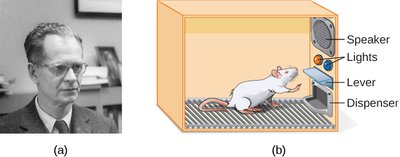
Key Figures: John Watson, B.F. Skinner.
Focus: Observable behavior, conditioning, reinforcement, and punishment.
Skinner Box: An operant conditioning chamber used to study animal learning.

Humanism
Humanistic psychology arose in the 1950s, emphasizing human potential, self-actualization, and the importance of free will.
Key Figures: Abraham Maslow, Carl Rogers.
Focus: The whole person, personal growth, and self-directed therapy.
Maslow's Hierarchy of Needs: A model describing the progression of human needs from basic physiological needs to self-actualization.
Cognitive Revolution
The cognitive revolution in the mid-1900s shifted psychology's focus back to mental processes such as perception, memory, language, and thinking.
Scientific Method: Emphasized rigorous scientific methods and rejected introspection as unreliable.
Internal Mental States: Accepted the existence of mental processes that influence behavior.

Other Contemporary Perspectives
Perspective | Focus |
|---|---|
Biological | Connection between body, brain, and behavior; advances in neuroscience. |
Evolutionary | How natural selection of traits and genes perpetuates certain behaviors. |
Sociocultural | How social situations, culture, and experience shape our lives. |
The "WEIRD" Problem in Psychology
Much early psychological research was conducted on Western, Educated, Industrialized, Rich, and Democratic (WEIRD) populations, leading to limited generalizability and cultural bias.
Implications: Findings may not apply to non-WEIRD populations; highlights the need for greater diversity in research.
Ethical Concerns: Cultural bias can perpetuate injustice and limit the field's relevance.

The Five Domains of Psychology
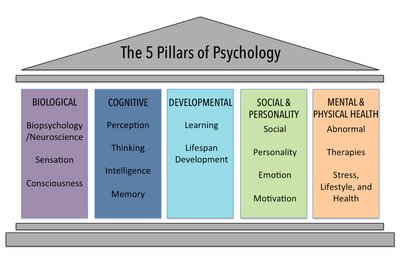
Contemporary psychology is organized into five major domains, each focusing on different aspects of behavior and mental processes.
Domain | Focus |
|---|---|
Biological | Biopsychology, neuroscience, evolutionary psychology, sensation & perception. |
Cognitive | Thinking, perception, memory, intelligence, language. |
Developmental | Learning, conditioning, development across the lifespan. |
Social & Personality | How others influence us; traits that make us unique. |
Mental & Physical Health | Abnormal, clinical, and health psychology. |
Biological & Cognitive Domains
The biological domain explores how biology influences behavior, while the cognitive domain studies mental processes such as memory, intelligence, and language.
Biopsychology: Examines the role of the nervous system, hormones, and genetics in behavior.
Cognitive Psychology: Investigates how we perceive, remember, think, and use language.
Developmental Domain
Developmental psychology studies how people grow and change throughout life, including learning and behavioral conditioning.
Focus: Stages of development, milestones, and the effects of learning experiences.
Social & Personality Domain
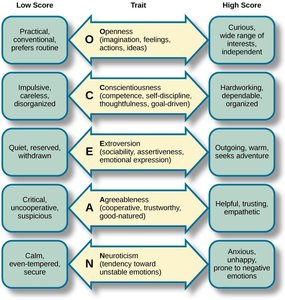
Social psychology examines how individuals are influenced by others, while personality psychology studies the traits that make each person unique.
Five Factor Model (OCEAN): Openness, Conscientiousness, Extraversion, Agreeableness, Neuroticism.

Mental & Physical Health Domain
This domain includes abnormal psychology (atypical thoughts and behaviors), clinical psychology (diagnosis and treatment of disorders), and health psychology (how biological, psychological, and sociocultural factors affect health).
Modern Psychology: Value & Careers
Applied Subfields
Industrial-Organizational (I/O) Psychology: Applies psychological principles to workplace settings.
Forensic Psychology: Applies psychology to legal and criminal justice systems.
Sport & Exercise Psychology: Studies the interaction of mental and emotional factors with physical performance.
Why Study Psychology?
Builds critical thinking and communication skills.
Develops understanding of complex factors shaping behavior.
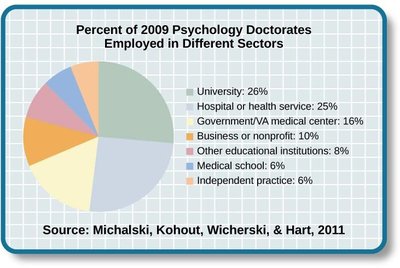
Opens doors to diverse career paths, including management, sales, social work, human resources, and healthcare.
Why Research Matters
Psychology relies on systematic research to support its claims, rather than intuition or tradition. Research skills developed in psychology include critical thinking, clear communication, and analytical reasoning.
Historical Example: Trephination was once used to "treat" mental illness without scientific evidence, sometimes causing harm.
Diversity Drives Discovery: Research shows that diversity in science leads to more novel and impactful ideas.
The Process of Scientific Research
Inductive Reasoning: Real-world observations lead to new ideas.
Deductive Reasoning: Ideas are tested in the real world.
Hypothesis: A testable prediction, often in "if–then" form. Must be falsifiable.
Case Study: Phineas Gage
Phineas Gage survived a severe brain injury in 1848, providing early evidence that the frontal lobe is involved in personality, decision-making, and impulse control. His case shaped modern neuropsychology.
Summary Table: Major Schools and Domains of Psychology
School/Domain | Focus | Key Figures |
|---|---|---|
Structuralism | Conscious experience, introspection | Wundt, Titchener |
Functionalism | Purpose of consciousness, adaptation | James, Dewey, Hall |
Psychoanalytic | Unconscious mind, childhood | Freud |
Behaviorism | Observable behavior, conditioning | Watson, Skinner |
Humanism | Human potential, self-actualization | Maslow, Rogers |
Cognitive | Mental processes | Chomsky, Piaget |
Biological | Brain, genetics, neuroscience | Various |
Developmental | Lifespan development | Piaget, Erikson |
Social & Personality | Social influence, traits | Allport, Bandura |
Mental & Physical Health | Disorders, therapy, health | Beck, Ellis |
Additional info: This guide covers foundational topics for an Introduction to Psychology course, including history, major schools of thought, contemporary domains, research methods, and career applications. It is suitable for exam preparation and as a reference for further study.
