 Indietro
Research Approaches and Methods of Data Collection in Psychology
Guida di studio - Note intelligenti
 Appunti personalizzati basati sui tuoi materiali, ampliati con definizioni chiave, esempi e contesto.
Research Approaches and Methods of Data Collection
Experimental vs. Non-Experimental Research
Psychological research utilizes both experimental and non-experimental approaches to investigate phenomena. Understanding the distinction between these approaches is fundamental to evaluating evidence and drawing conclusions.
Experimental Research: Involves manipulation of variables to establish cause-and-effect relationships. The researcher actively intervenes by introducing a causal condition.
Non-Experimental Research: Lacks manipulation and studies the world as it naturally occurs. Often used when manipulation is impractical or unethical.
Quantitative Research: Relies on numerical data (e.g., ratings, counts).
Qualitative Research: Uses non-numerical data (e.g., words, pictures, documents) to provide deeper understanding.
Mixed Methods Research: Combines quantitative and qualitative approaches in a single study or set of related studies.
Variables in Quantitative Research
Variables are central to quantitative research, representing characteristics or phenomena that can vary across organisms, situations, or environments.
Variable: A characteristic that can vary (e.g., political party).
Constant: Something that does not vary (e.g., only one political party).
Categorical Variable: Varies by type or category (e.g., gender, religion).
Quantitative Variable: Varies in amount or degree (e.g., reaction time, height).
Independent Variable (IV): Presumed cause, manipulated by researcher.
Dependent Variable (DV): Outcome variable, influenced by IV.
Mediating Variable: Intervening variable in the causal chain (e.g., cognitive distraction between anxiety and memory).
Moderator Variable: Changes the relationship between IV and DV under certain conditions (e.g., gender moderating therapy effectiveness).
Extraneous Variable: Competes with IV in explaining the outcome; also called confounding variable.
Experimental Research Approach
Experimental research is the benchmark for establishing causation in psychology. It involves systematic manipulation of the IV and measurement of the DV under controlled conditions.
Key Features: Manipulation of IV, control of extraneous variables, random assignment to groups.
Settings: Laboratory (high control), field (natural setting, less control), internet (access to diverse populations, but less control).
Criteria for Establishing Cause-and-Effect
To claim causation, three criteria must be met:
IV and DV are related.
Changes in IV occur before changes in DV.
The relationship is not due to another variable (extraneous/confounding).
Advantages and Limitations of Psychological Experiments
Experiments are powerful for demonstrating causality but have limitations.
Advantages: Causal inference, ability to manipulate variables, control over extraneous variables.
Disadvantages: Cannot test effects of non-manipulated variables (e.g., age), artificiality, limited window into subjective meanings, sometimes weak on causal explanation.
Nonexperimental Quantitative Research (Correlational Research)
Nonexperimental quantitative research, often called correlational research, describes relationships among variables without manipulation.
Goal: Accurate description of situations, prediction, and explanation of relationships.
Strengths: Useful for variables that cannot be manipulated, greater generalizability, easier with large samples.
Weaknesses: Difficult to establish causation, vulnerable to third variable problem.
Important Note: Correlation does not equal causation. Relationships observed may be due to confounding variables.
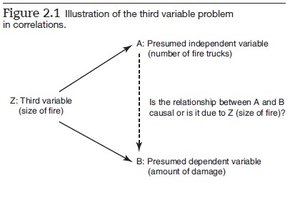
Example: The number of fire trucks (A) and amount of fire damage (B) are correlated, but the size of the fire (Z) is the true causal factor. This illustrates the third variable problem.
Qualitative Research
Qualitative research is interpretive, multimethod, and conducted in natural settings. It seeks to understand phenomena from participants' perspectives.
Components: Interpretive (subjective data), multimethod (interviews, observations, documents), field-based.
Strengths: Rich description, theory generation, exploration of new phenomena, detailed context.
Limitations: Difficult to generalize, conflicting interpretations, lack of objective hypothesis testing.
Mixed Methods Research
Mixed methods research combines quantitative and qualitative approaches to capitalize on their respective strengths.
Quantitative Driven: Primarily quantitative, with qualitative data for context.
Qualitative Driven: Primarily qualitative, with quantitative data for additional insight.
Equal Status/Integrative: Both approaches are used equally to understand phenomena.
Major Methods of Data Collection
Data collection methods are techniques for obtaining data in research studies. Six major methods are commonly used:
Tests: Standardized instruments for measuring personality, aptitude, achievement, and performance. Strengths: Standardization, reliability, comparability. Weaknesses: Expense, potential bias, limited open-ended responses.
Questionnaires: Self-report instruments for opinions, perceptions, demographics. Strengths: Inexpensive, quick, anonymity, both closed and open-ended items. Weaknesses: Short length, reactive effects, low response rates.
Interviews: Series of questions asked by interviewer. Strengths: In-depth information, probing, high response rates. Weaknesses: Expensive, time-consuming, potential bias.
Focus Groups: Moderator-led group discussions. Strengths: In-depth exploration, participant interaction. Weaknesses: Expense, dominance by some participants, limited generalizability.
Observation: Recording behavior patterns. Strengths: Direct measurement, firsthand experience, realism. Weaknesses: Unclear reasons for behavior, reactive effects, limited sampling.
Existing or Secondary Data: Use of documents, physical data, archived research. Strengths: Insight, unobtrusive, historical data, corroboration. Weaknesses: Incomplete, limited access, outdated, lack of qualitative data.
Summary Table: Types of Variables in Quantitative Research
Variable Type | Key Characteristics | Example |
|---|---|---|
Categorical Variable | Varies by type, kind, or category | Political party, gender, religion |
Quantitative Variable | Varies in amount or degree | Reaction time, height, age |
Independent Variable (IV) | Presumed cause, manipulated | Drug treatment, anxiety level |
Dependent Variable (DV) | Outcome, influenced by IV | Anxiety levels, memory performance |
Mediating Variable | Intervening process | Cognitive distraction |
Moderator Variable | Changes relationship under conditions | Fatigue, gender |
Extraneous Variable | Competes with IV, confounding | Smoking in coffee-heart attack study |
Key Takeaways
Experimental research is the gold standard for establishing causality.
Correlational research describes relationships but cannot establish causation without meeting strict criteria.
Qualitative and mixed methods research provide rich, contextual understanding and complement quantitative approaches.
Multiple data collection methods exist, each with unique strengths and limitations.
