 Indietro
Stress and Disease: The Biological and Psychological Response
Guida di studio - Note intelligenti
 Appunti personalizzati basati sui tuoi materiali, ampliati con definizioni chiave, esempi e contesto.
Stress and Disease
Acute vs Chronic Stress
Stress is a physiological and psychological response to perceived threats or challenges. It can be classified as acute (short-term) or chronic (long-term), each affecting the body differently.
Acute Stress: Short-lived, often triggered by immediate threats. The body quickly returns to baseline after the stressor is removed.
Chronic Stress: Persistent stress over time, leading to prolonged activation of stress pathways and potential health consequences.
Example: Acute stress may occur during an exam, while chronic stress may result from ongoing financial difficulties.
Allostasis and Allostatic Overload
Allostasis refers to the process by which the body achieves stability through physiological or behavioral change. Allostatic overload occurs when adaptive systems are overactivated, leading to negative health outcomes.
Allostasis: The brain anticipates future needs and adjusts neuroendocrine and autonomic systems accordingly.
Allostatic Overload: Chronic stress causes overactivation, which is highly individualized and can result in disease.
Example: Chronic stress from caregiving can lead to allostatic overload and increased risk of illness.
General Adaptation Syndrome (GAS)
The General Adaptation Syndrome (GAS) describes the body's response to chronic stress in three stages, as proposed by Hans Selye.
Alarm Stage: The stressor activates the hypothalamic-pituitary-adrenal (HPA) axis and the sympathetic nervous system, preparing the body for "fight-or-flight."
Resistance/Adaptation Stage: Adrenal hormones mobilize energy and resources to cope with the stressor.
Exhaustion Stage (Allostatic Overload): If stress persists and adaptation fails, the body enters exhaustion, leading to stress-related disorders.
Example: Prolonged workplace stress can progress through all three stages, resulting in burnout and illness.
Triad of Structural Changes
Chronic stress induces three main structural changes in the body:
Hypertrophy of the Adrenal Cortex: Due to continuous cortisol production, the adrenal cortex enlarges.
Atrophy of the Thymus: Suppressed immune function leads to reduced T-cell production and thymus shrinkage.
Increased Gastric Acid: Both acute and chronic stress increase gastric acid, raising the risk of peptic ulcers.
Example: Chronic stress in medical students may result in frequent stomach ulcers and weakened immunity.
Biological Mechanisms of Stress
HPA Axis
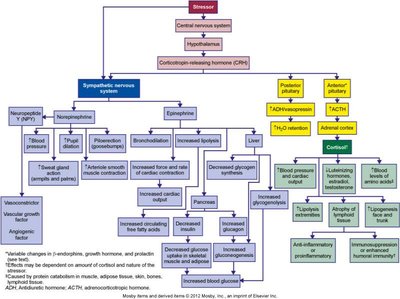
The Hypothalamic-Pituitary-Adrenal (HPA) axis is central to the stress response. It involves a cascade of hormone releases:
Hypothalamus: Releases corticotropin-releasing hormone (CRH).
Pituitary: Releases adrenocorticotropic hormone (ACTH).
Adrenal Cortex: Releases cortisol.
Example: During a stressful event, the HPA axis increases cortisol to mobilize energy.
Cortisol
Cortisol is a steroid hormone released during stress, affecting multiple tissues and systems.
Stimulates Gluconeogenesis: Increases blood glucose levels.
Affects Protein Metabolism: Promotes protein breakdown.
Anti-inflammatory and Immunosuppressive: Reduces inflammation and suppresses immune responses.
Abnormal Elevations: Linked to obesity, sleep deprivation, lipid abnormalities, hypertension, diabetes, atherosclerosis, and bone density loss.
Therapeutic Use: Used as anti-inflammatory and immunosuppressive agents.
Example: Cortisol injections are used to treat autoimmune diseases.
Key formula:
$\text{Gluconeogenesis:} \, \text{2 Pyruvate} \rightarrow \text{Glucose}$
Catecholamines
Catecholamines (epinephrine and norepinephrine) are released from the adrenal medulla during stress, mimicking sympathetic stimulation.
Increases Heart Rate and Blood Pressure: Prepares the body for action.
Bronchodilation: Expands airways for increased oxygen intake.
Decreased Insulin Release: Conserves glucose for immediate energy needs.
Increased Proinflammatory Cytokines: May contribute to inflammation.
Example: During a stressful encounter, catecholamines increase heart rate and alertness.
Stress and the Immune System
Role of Immune System
Stress affects immune function through neuroendocrine pathways, linking stress to disease and cancer.
Decreased T-cell Cytotoxicity: Reduces ability to fight infections and abnormal cells.
Decreased B-cell Function: Impairs antibody production.
Example: Chronic stress can increase susceptibility to viral infections.
Stress, Personality, Coping, and Illness
Psychosocial Distress
Psychosocial distress manifests as physiological, emotional, cognitive, and behavioral changes, increasing risk for immunological deficits and chronic disorders.
Aggression: Associated with changes in T- and B-cell numbers.
Clinical Importance: Identifying and reducing stress can help prevent disease.
Example: Aggressive behavior in stressed individuals may signal immune dysfunction.
Coping Strategies
Coping strategies can be adaptive or maladaptive, influencing health outcomes.
Adaptive Coping: Problem-focused strategies and seeking social support are beneficial.
Maladaptive Coping: Behaviors like increased smoking or poor eating habits can worsen health.
Example: Seeking social support during stress is an adaptive coping response.
Aging and Stress
Stress–Age Syndrome
Stress–age syndrome describes changes in stress response with aging, affecting hormone levels and immune function.
Increased Catecholamines, ADH, ACTH, and Cortisol: Heightened stress response.
Decreased Testosterone, Thyroxine, and Other Hormones: Alters metabolism and immunity.
Immunosuppression and Chronic Inflammation: Increased risk of disease.
Alterations in Lipoproteins and Hypercoagulation: Increased cardiovascular risk.
Free Radical Damage: Accelerates cellular aging.
Example: Elderly individuals may experience more pronounced effects of chronic stress.
