 Indietro
Motivational Predictors of Academic Cheating: Achievement Goals, Engagement, and Self-Efficacy
Guida di studio - Note intelligenti
 Appunti personalizzati basati sui tuoi materiali, ampliati con definizioni chiave, esempi e contesto.
Academic Cheating: Definitions and Types
Definition and Prevalence
Academic cheating refers to any intentional action or behavior that violates established rules governing tests or assignments, gives a student unfair advantage, or decreases the accuracy of performance inferences. Common types include copying answers, using cheat notes, fabricating bibliographies, and plagiarism. Cheating rates vary by country and are influenced by cultural attitudes toward collectivism and individualism.
Active Cheating: Cheating to improve one's own success (e.g., copying answers).
Second-Party Cheating: Helping others cheat (e.g., letting others copy).
Example: In Croatia, over 90% of secondary school students admitted to cheating at least once.
Predictors of Academic Cheating
Individual and Motivational Factors
Several individual predictors influence academic cheating, including gender, achievement goals, self-efficacy, and engagement. Gender differences are explained by socialization theory, with males typically reporting more positive attitudes toward cheating. Motivational constructs, such as achievement goals and self-efficacy, are subject-specific and can predict cheating behaviors.
Gender: Males cheat more often; females have higher moral standards.
Motivation: Achievement goals, self-efficacy, and outcome expectations are key predictors.
Subject-Specific: Cheating rates differ across subjects, with STEM subjects showing higher prevalence.
Achievement Goals
Types and Effects
Achievement goals determine students' academic activities and interpretations. The 2 × 2 framework identifies four main types, with a fifth added by recent research:
Mastery-Approach Goals (MAp): Desire to understand course content.
Mastery-Avoidance Goals (MAv): Concern about not mastering tasks.
Performance-Approach Goals (PAp): Focus on demonstrating competence relative to others.
Performance-Avoidance Goals (PAv): Concern about performing worse than others.
Work-Avoidance Goals (WA): Indifference and minimal effort in learning activities.
Mastery goals are negative predictors of cheating, while performance and work-avoidance goals are positive predictors. Gender differences exist, with girls more mastery-oriented and boys more work-avoidant.
Engagement in Learning
Dimensions and Impact
Engagement is a multidimensional construct with cognitive, behavioral, and emotional components. It overlaps with motivation and is a positive predictor of academic outcomes.
Cognitive Engagement: Investment in cognitive strategies and self-regulation.
Behavioral Engagement: Participation in academic and extracurricular activities.
Emotional Engagement: Positive or negative affect in interactions with school environment.
Example: Higher engagement is associated with better grades and lower cheating rates.
Self-Efficacy for Self-Regulated Learning (SESRL)
Definition and Role
SESRL refers to students' belief in their ability to plan, monitor, and regulate their learning. It is a strong predictor of achievement goals and academic outcomes.
High SESRL: Associated with mastery and performance-approach goals.
Low SESRL: Linked to performance-avoidance and work-avoidance goals.
Negative Relationship: High SESRL reduces likelihood of cheating.
Relationships Between Motivation, Engagement, and Cheating
Mediational Models
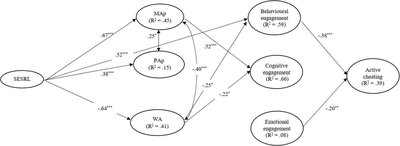
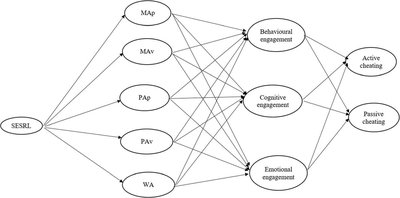
The hierarchical model of achievement motivation posits that SESRL predicts achievement goals, which in turn predict engagement and academic cheating. Three mediation models were tested:
Model 1: SESRL predicts engagement and cheating only indirectly via achievement goals.
Model 2: SESRL directly predicts engagement; engagement predicts cheating.
Model 3: SESRL directly predicts both engagement and cheating.
Achievement goals and engagement dimensions mediate the relationship between SESRL and active cheating, with behavioral engagement playing a key role.
Gender Differences in Motivation and Cheating
Findings and Explanations
Girls exhibited higher SESRL, mastery goals, and engagement, while boys had higher work-avoidance goals. No significant gender differences were found in academic cheating rates, possibly due to changing socialization patterns and subject-specific factors.
Girls: Higher reading competencies and positive attitudes toward biology.
Boys: More likely to endorse work-avoidance goals.
Socialization: Parental and teacher expectations influence gender differences.
Correlations and Mediating Effects
Summary of Relationships
Mastery-approach goals, SESRL, and engagement dimensions are negatively related to active cheating, while work-avoidance goals are positively related. Behavioral engagement mediates the effect of SESRL on active cheating. Second-party cheating is common and less influenced by motivational beliefs.
Practical Implications
Strategies for Reducing Cheating
Teachers should foster mastery-approach goals, collaborative learning, and self-regulatory skills. Emphasizing learning processes over grades and reducing social comparisons can enhance engagement and reduce cheating. School climate and contextual factors, such as supervision and seating arrangements, also play a role.
Mastery Orientation: Encourage collaborative and interactive learning.
Self-Regulation: Teach goal-setting and planning skills.
School Climate: Promote academic honesty and discourage cheating opportunities.
Conclusion
Motivational beliefs and engagement are important predictors of academic cheating. Mastery-approach and performance-approach goals, SESRL, and engagement dimensions reduce active cheating, while work-avoidance goals increase it. Behavioral engagement mediates the relationship between SESRL and cheating, highlighting the importance of achievement motivation in understanding academic dishonesty.
