 Indietro
Introduction to Variables and Data Classification in Statistics
Guida di studio - Note intelligenti
 Appunti personalizzati basati sui tuoi materiali, ampliati con definizioni chiave, esempi e contesto.
Introduction to Statistics and Collecting Data
Understanding the Role of Data in Decision Making
Statistics is the science of collecting, analyzing, and interpreting data to make informed decisions. The process begins with a research objective—a specific question or problem that requires data to answer. Data can be collected from various sources, such as surveys, experiments, or observations, and is essential for addressing questions in social concerns, business, government, and consumer decisions.
Research Objective: The main question that guides the data collection process.
Variables: Characteristics or properties measured for individuals in a group (population) to answer the research objective.
Data: The values or responses obtained when variables are measured.
Example: A student deciding which college to transfer to may consider variables such as enrollment size, housing availability, degree programs, tuition cost, class size, and location.
Describing and Classifying Variables
Types of Variables
Variables are classified based on the type of data they produce. Understanding these classifications is fundamental to statistical analysis.
Qualitative (Categorical) Variables: Describe qualities or categories. Data are word responses or labels.
Quantitative (Numerical) Variables: Measure or count quantities. Data are numerical values.
Example Classification:
Q1. Number of students: Quantitative
Q2. On-campus housing: Qualitative
Q3. Degree program offered: Qualitative
Q4. Tuition cost: Quantitative
Q5. Class size: Quantitative
Q6. College location: Qualitative
Further Classification of Variables
Variables can be further classified based on their properties:
Discrete Variables: Quantitative variables with countable values (e.g., number of students).
Continuous Variables: Quantitative variables with measurable values that can take any value within a range (e.g., tuition cost).
Nominal Variables: Qualitative variables with categories that have no natural order (e.g., college location).
Ordinal Variables: Qualitative variables with categories that have a natural order (e.g., class year: freshman, sophomore, etc.).
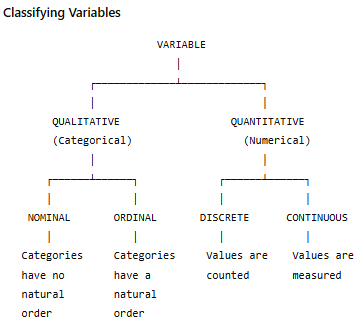
Summary Table: Classification of Variables
Variable | Type | Subtype | Description |
|---|---|---|---|
Student's major | Qualitative | Nominal | Categories with no natural order |
Number of courses | Quantitative | Discrete | Counted values |
ZIP code | Qualitative | Nominal | Labels with no meaningful order |
Hours of sleep | Quantitative | Continuous | Measured values |
Class year | Qualitative | Ordinal | Categories with a natural order |
Number of siblings | Quantitative | Discrete | Counted values |
Height | Quantitative | Continuous | Measured values |
Course rating | Qualitative | Ordinal | Ordered categories (e.g., poor, fair, good, excellent) |
Key Concepts and Definitions
Population: The entire group of individuals or items of interest.
Sample: A subset of the population selected for analysis.
Variable: A characteristic or property that can take on different values among individuals in a population.
Data: The actual values collected for variables.
Formulas and Notation
Population size:
Sample size:
Variable notation: (for a generic variable)
Classification Decision Tree
To classify a variable, ask the following:
Does the variable describe a category or measure/count a quantity?
If it describes a category, is there a natural order? (Nominal vs. Ordinal)
If it measures/counts a quantity, are the values counted or measured? (Discrete vs. Continuous)
Practice: Classifying Variables
Nominal: Student's major, ZIP code
Ordinal: Class year, course rating
Discrete: Number of courses, number of siblings
Continuous: Hours of sleep, height
Additional info: Understanding the classification of variables is foundational for selecting appropriate statistical methods and interpreting data correctly. This knowledge is essential for all subsequent topics in introductory statistics.
