 Indietro
Introductory Probability Concepts and Laws
Guida di studio - Note intelligenti
 Appunti personalizzati basati sui tuoi materiali, ampliati con definizioni chiave, esempi e contesto.
Probability: Basic Concepts
Definition of Probability
Probability is a numerical measure of the likelihood or chance of an event occurring. It quantifies uncertainty and is fundamental in statistics for predicting outcomes. The probability of any event A must lie between 0 and 1 inclusive:
P(A) = 1: The event is certain.
P(A) = 0: The event is impossible.
The formal definition is:
Experiment: Any action or sequence of actions that produces a result (e.g., tossing a coin, rolling a die).
Outcome: A result of any experiment.
Sample Space (S): The set of all possible outcomes.
Event: A subset of the sample space, representing a particular situation of interest.
Simple Event: An event that includes only one outcome.
Compound Event: An event that includes more than one outcome.


Probability Formula
The probability of an event A occurring is calculated as the ratio of the number of ways A can occur to the total number of possible outcomes in the sample space:
Equally likely outcomes: Each outcome has the same probability of occurring.
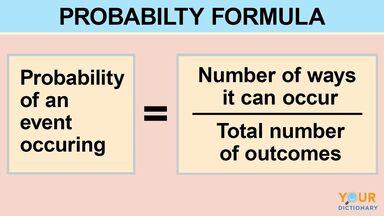
Example: Rolling a Die
Consider the experiment of rolling a die once:
Outcomes: 1, 2, 3, 4, 5, 6
Sample Space: S = {1, 2, 3, 4, 5, 6}
Event A: Choosing a number less than 4, A = {1, 2, 3}
Probability:

Probability Laws
Probability Law I – Additive Law
The additive law is used to find the probability that either event A or event B (or both) occurs. For two events A and B:
Union (A ∪ B): The event that either A or B or both occur.
Intersection (A ∩ B): The event that both A and B occur.

Probability Law II – Special Rule of Addition
If two events A and B are mutually exclusive (cannot occur together), the probability that either occurs is:
Mutually exclusive events: Events that cannot occur at the same time.

Probability Law III – Multiplicative Law
The multiplicative law is used to find the joint probability that two events will occur. For dependent events:
Dependent events: The occurrence of one event affects the probability of the other.
Joint probability: Probability of both events occurring.
Conditional probability: Probability of one event given that another has occurred.
Probability Law IV – Conditional Probability
Conditional probability is the probability of event A occurring given that event B has already occurred:

Probability Law V – Independent Events
Events A and B are independent if the occurrence of one does not affect the probability of the other. For independent events:

Worked Examples and Applications
Example: Blood Groups
Suppose the blood groups of 200 people are distributed as follows: 50 have type A, 65 have type B, 70 have type O, and 15 have type AB. The probability that a randomly selected person has type O blood is:
Example: Package Weights
The following table shows the probability distribution for package weights:
Weight | Event | Number of Packages | Probability of Occurrence |
|---|---|---|---|
Underweight | A | 100 | 0.025 |
Satisfactory | B | 3600 | 0.900 |
Overweight | C | 300 | 0.075 |
Total | 4000 | 1.000 |
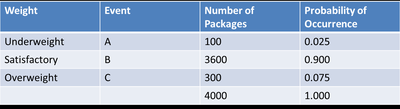
Example: Survey on Legalization
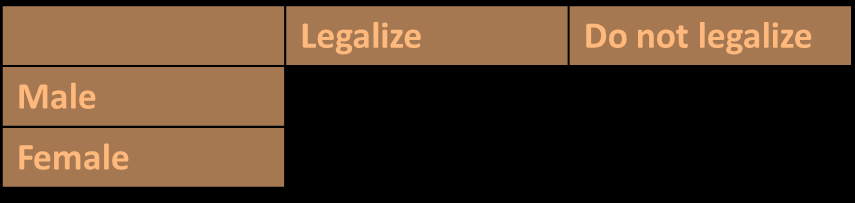
The following table shows the proportions of young adults' stance on cannabis legalization by gender:
Legalize | Do not legalize | |
|---|---|---|
Male | 0.32 | 0.18 |
Female | 0.28 | 0.22 |
Example: Sports vs. Opera Preferences
A random sample of 250 adults was asked about their preference for watching sports or opera. The two-way classification is as follows:
Prefers Sports | Prefers Opera | Total | |
|---|---|---|---|
Male | 96 | 24 | 120 |
Female | 45 | 85 | 130 |
Total | 141 | 109 | 250 |
Sample questions:
What is the probability that a randomly selected adult prefers watching sports?
What is the probability that a randomly selected adult is a female?
What is the probability that an adult prefers opera given that the adult is male?
What is the probability that an adult is female given that they prefer sports?
What is the probability that an adult is male and prefers sports?
Summary Table: Key Probability Laws
Law | Formula | Condition |
|---|---|---|
Additive Law | General | |
Special Rule of Addition | Mutually exclusive events | |
Multiplicative Law | Dependent events | |
Conditional Probability | Given B has occurred | |
Independent Events | Independent events |
Additional info:
These notes cover the foundational probability concepts relevant to introductory statistics, including definitions, laws, and practical examples. All formulas are provided in LaTeX format for clarity. Tables are recreated for comparison and classification purposes. Images included are directly relevant to the explanation of probability concepts and laws.
