 Indietro
Introductory Statistics Study Guide: Probability, Counting, and Conditional Probability
Guida di studio - Note intelligenti
 Appunti personalizzati basati sui tuoi materiali, ampliati con definizioni chiave, esempi e contesto.
Q1. How is the number of different combinations (unordered sets) of r objects from n distinct objects represented?
Background
Topic: Counting Principles – Combinations
This question tests your understanding of how to calculate the number of ways to select a subset of objects from a larger set, where the order does not matter.
Key Terms and Formulas
Combination: A selection of items where order does not matter.
Formula:
Where is the factorial of , is the factorial of , and is the factorial of .

Step-by-Step Guidance
Identify the total number of objects () and the number to be selected ().
Recall that combinations are used when the order of selection does not matter.
Write the formula for combinations: .
Set up the formula with your values for and , but do not compute the final value yet.
Try solving on your own before revealing the answer!
Final Answer:
This is the standard formula for combinations, representing the number of ways to choose objects from distinct objects without regard to order.
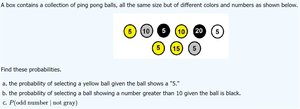
Q2. A box contains ping pong balls of different colors and numbers. Find these probabilities:
a. The probability of selecting a yellow ball given the ball shows a "5".
b. The probability of selecting a ball showing a number greater than 10 given the ball is black.
Background
Topic: Conditional Probability
This question tests your ability to use conditional probability to find the likelihood of an event given additional information.
Key Terms and Formulas
Conditional Probability: The probability of event given event is .
Formula:
Step-by-Step Guidance
For part (a), identify all balls that show a "5" and determine how many of those are yellow.
Calculate using the formula: .
For part (b), identify all black balls and determine how many of those show a number greater than 10.
Calculate using the formula: .
Try solving on your own before revealing the answer!
Final Answer:
a.
b.
These probabilities are calculated by dividing the number of favorable outcomes by the total number of outcomes in the given condition.
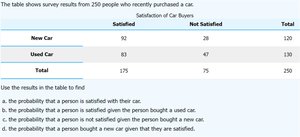
Q3. The table shows survey results from 250 people who recently purchased a car. Use the results to find:
a. The probability that a person is satisfied with their car.
b. The probability that a person is satisfied given the person bought a used car.
c. The probability that a person is not satisfied given the person bought a new car.
d. The probability that a person bought a new car given that they are satisfied.
Background
Topic: Probability and Conditional Probability using Contingency Tables
This question tests your ability to interpret and use contingency tables to calculate probabilities, including conditional probabilities.
Key Terms and Formulas
Contingency Table: A table showing the frequency distribution of variables.
Conditional Probability Formula:
Step-by-Step Guidance
For part (a), find the total number of satisfied people and divide by the total number surveyed.
For part (b), use the number of satisfied used car buyers divided by the total number of used car buyers.
For part (c), use the number of not satisfied new car buyers divided by the total number of new car buyers.
For part (d), use the number of satisfied new car buyers divided by the total number of satisfied people.
Try solving on your own before revealing the answer!
Final Answer:
a.
b.
c.
d.
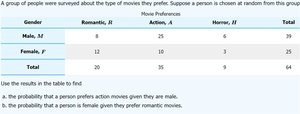
Q4. Movie Preferences Survey: Find these probabilities
a. The probability that a person prefers action movies given they are male.
b. The probability that a person is female given they prefer romantic movies.
Background
Topic: Conditional Probability and Contingency Tables
This question tests your ability to use a contingency table to find conditional probabilities based on survey data.
Key Terms and Formulas
Conditional Probability Formula:
Step-by-Step Guidance
For part (a), find the number of males who prefer action movies and divide by the total number of males.
For part (b), find the number of females who prefer romantic movies and divide by the total number of people who prefer romantic movies.
Set up the conditional probability formulas for each part.
Try solving on your own before revealing the answer!
Final Answer:
a.
b.
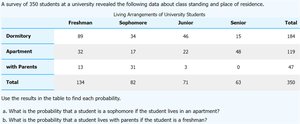
Q5. Living Arrangements of University Students: Find these probabilities
a. What is the probability that a student is a sophomore if the student lives in an apartment?
b. What is the probability that a student lives with parents if the student is a freshman?
Background
Topic: Conditional Probability and Contingency Tables
This question tests your ability to use a contingency table to find conditional probabilities based on class standing and place of residence.
Key Terms and Formulas
Conditional Probability Formula:
Step-by-Step Guidance
For part (a), find the number of sophomores living in apartments and divide by the total number of students living in apartments.
For part (b), find the number of freshmen living with parents and divide by the total number of freshmen.
Set up the conditional probability formulas for each part.
Try solving on your own before revealing the answer!
Final Answer:
a.
b.
Q6. What are distinctly ordered sets called?
Background
Topic: Counting Principles – Permutations
This question tests your understanding of the terminology used in counting and arrangements.
Key Terms
Arrangement: An ordered set of objects.
Permutation: Another term for an ordered arrangement.

Step-by-Step Guidance
Recall that when the order of selection matters, the set is called an arrangement or permutation.
Understand that permutations are used for ordered sets, while combinations are for unordered sets.
Try solving on your own before revealing the answer!
Final Answer: Arrangements or permutations
Distinctly ordered sets are called arrangements or permutations.
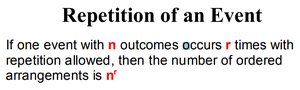
Q7. Repetition of an Event: If one event with n outcomes occurs r times with repetition allowed, what is the number of ordered arrangements?
Background
Topic: Counting Principles – Repetition and Ordered Arrangements
This question tests your understanding of how to count the number of ordered arrangements when repetition is allowed.
Key Terms and Formulas
Ordered Arrangements with Repetition: Each selection can be any of the n outcomes, repeated r times.
Formula:
Step-by-Step Guidance
Identify the number of possible outcomes for each event ().
Determine how many times the event occurs ().
Recall that with repetition, each event is independent and can be any of the outcomes.
Set up the formula for ordered arrangements with repetition: .
Try solving on your own before revealing the answer!
Final Answer:
The number of ordered arrangements with repetition allowed is .
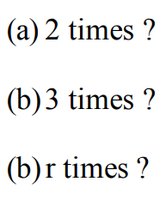
Q8. How many ordered arrangements are possible if an event occurs:
(a) 2 times?
(b) 3 times?
(c) r times?
Background
Topic: Counting Principles – Repetition
This question tests your ability to apply the formula for ordered arrangements with repetition for different values of .
Key Terms and Formulas
Formula:
Step-by-Step Guidance
For (a), substitute into the formula: .
For (b), substitute into the formula: .
For (c), use the general formula: .
Try solving on your own before revealing the answer!
Final Answer:
(a)
(b)
(c)
These represent the number of ordered arrangements for each case.
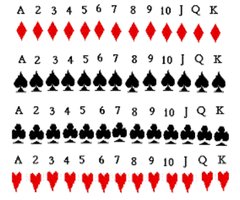
Q9. What is the probability of selecting a King, a red card, or a King of red card from a deck?
Background
Topic: Probability with Playing Cards
This question tests your understanding of basic probability concepts using a standard deck of cards.
Key Terms and Formulas
Standard Deck: 52 cards, 4 suits (hearts, diamonds, clubs, spades), 13 cards per suit.
Probability Formula:
Step-by-Step Guidance
Count the number of Kings in the deck (4).
Count the number of red cards (26: hearts and diamonds).
Count the number of Kings that are red (2: King of hearts and King of diamonds).
Set up the probability formulas for each scenario, but do not compute the final values yet.
Try solving on your own before revealing the answer!
Final Answer:
a)
b)
c)
