Indietro
Probability: Basic Concepts, Rules, and Applications
Guida di studio - Note intelligenti
 Appunti personalizzati basati sui tuoi materiali, ampliati con definizioni chiave, esempi e contesto.
Probability: Basic Concepts and Rules
Basic Concepts of Probability
Probability is a measure of how likely an event is to occur. In statistics, probability quantifies uncertainty and is used to predict outcomes in random experiments. The most basic possible results of an experiment are called outcomes. An event consists of one or more outcomes that share a property of interest.
Outcome: The result of a single trial of an experiment (e.g., tossing a coin yields heads or tails).
Event: A set of outcomes (e.g., getting at least one head when tossing two coins).

Sample Spaces and Outcomes
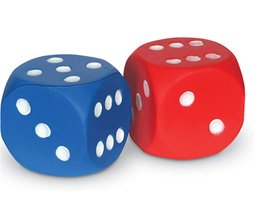
The sample space is the set of all possible outcomes of an experiment. For example, when rolling a die, the sample space is {1, 2, 3, 4, 5, 6}. When tossing a coin, the sample space is {Heads, Tails}.
Example: Tossing two coins: Possible outcomes are HH, HT, TH, TT.
Example: Rolling a die: Possible outcomes are 1, 2, 3, 4, 5, 6.
Classical Probability Formula
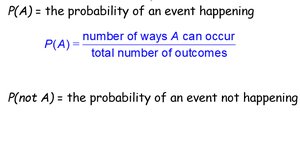
If all outcomes are equally likely, the probability of an event A is calculated as:
Probability Properties
The probability of any event is a number between 0 and 1 inclusive.
The probability of an impossible event is 0.
The probability of a certain event is 1.
Notation: P(A) denotes the probability of event A.
Complementary Events
The complement of an event A, denoted as "not A", is the event that A does not occur. The probability of the complement is:
Types of Probability Approaches
Classical Approach
Assumes all outcomes are equally likely. Used for games of chance.
Example: Probability of rolling a 5 on a fair die:
Empirical (Relative Frequency) Approach
Uses observed data from repeated experiments to estimate probability.
Example: Probability of rain based on historical weather data.
Subjective Approach
Based on intuition, expert opinion, or estimates when data is unavailable.
Example: Probability of a new product's success estimated by a marketing expert.
Law of Large Numbers
As an experiment is repeated many times, the relative frequency probability of an event approaches the actual probability.
Rules of Probability
Addition Rule
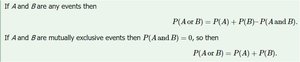
The addition rule is used to find the probability that at least one of two events occurs.
If A and B are any events:
If A and B are mutually exclusive: , so
Multiplication Rule
The multiplication rule is used to find the probability that two events both occur.
If A and B are independent:
If A and B are dependent:
Mutually Exclusive and Non-Mutually Exclusive Events
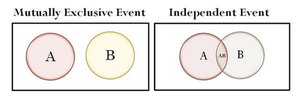
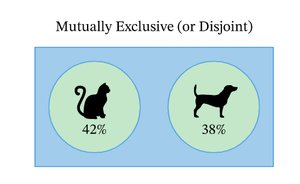
Mutually Exclusive Events
Events are mutually exclusive if they cannot occur at the same time. For example, drawing a card that is both a heart and a club is impossible.
Non-Mutually Exclusive Events
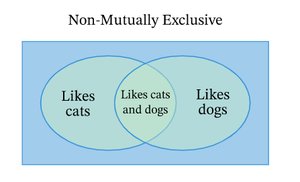
Events are non-mutually exclusive if they can occur together. For example, a person may like both cats and dogs.
Independent and Dependent Events
Independent Events
Events are independent if the occurrence of one does not affect the probability of the other.
Example: Tossing a coin and rolling a die.
Dependent Events
Events are dependent if the occurrence of one affects the probability of the other.
Example: Drawing two cards from a deck without replacement.
Applications and Examples
Probability with Cards
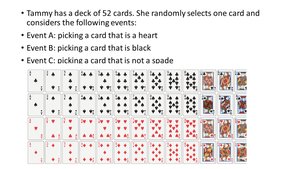
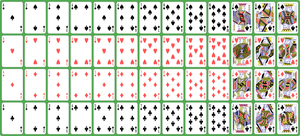
A standard deck has 52 cards: 4 suits (spades, clubs, hearts, diamonds), 2 colors (red, black), 10 number cards (Ace to 10), and 4 face cards (Jack, Queen, King).
Example: Probability of drawing a Jack:
Example: Probability of drawing a red card:
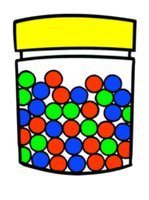
Probability with Marbles
A jar contains 36 marbles: 10 green, 12 blue, 14 red.
Example: Probability of picking a green marble:
Probability with Cars (Table Example)
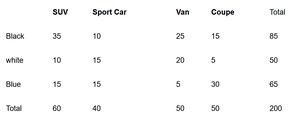
The table below shows the distribution of cars by type and color. It can be used to calculate probabilities for various events, such as selecting a black or white car, or a blue car or a coupe.
SUV | Sport Car | Van | Coupe | Total | |
|---|---|---|---|---|---|
Black | 35 | 10 | 25 | 15 | 85 |
White | 10 | 15 | 20 | 5 | 50 |
Blue | 15 | 15 | 5 | 30 | 65 |
Total | 60 | 40 | 50 | 50 | 200 |
Probability with Multiple Events
Example: Probability of drawing a club or a face card from a deck:
Example: Probability of tossing a coin and rolling a die, and getting heads or a five:
Summary Table: Probability Approaches
Approach | Description | Example |
|---|---|---|
Classical | All outcomes equally likely | Rolling a die |
Empirical | Based on observed data | Weather prediction |
Subjective | Based on expert opinion | Estimating risk |
Practice Problems
List all possible outcomes for families with three children.
Calculate the probability of getting 2 boys and 1 girl.
Find the probability of picking a green marble and a blue marble with replacement.
Determine if events are mutually exclusive or independent.