 Indietro
Sampling Methods in Introductory Statistics
Guida di studio - Note intelligenti
 Appunti personalizzati basati sui tuoi materiali, ampliati con definizioni chiave, esempi e contesto.
Collecting Data
Sampling Methods
In statistics, sampling methods are essential for selecting a subset of individuals from a population to draw conclusions about the entire group. Understanding different sampling techniques helps ensure that data collected is representative and unbiased.
Simple Random Sample: Every member of the population has an equal chance of being selected. This method is often implemented using random number generators or drawing names from a hat.
Systematic Sample: Members are selected at regular intervals from an ordered list. For example, every 5th person on a list is chosen after a random starting point.
Stratified Sample: The population is divided into subgroups (strata) based on a shared characteristic, and random samples are taken from each stratum. This ensures representation from all key subgroups.
Cluster Sample: The population is divided into clusters, usually based on location or another natural grouping. Entire clusters are randomly selected, and all members within chosen clusters are surveyed.
Convenience Sample: Individuals are selected based on ease of access or availability. This method is quick but may introduce significant bias.
Example: If a university wants to survey student opinions, it could use:
Simple random sample: Randomly select 100 students from the entire student body.
Systematic sample: Select every 10th student from an alphabetical list.
Stratified sample: Divide students by major and randomly select from each major.
Cluster sample: Randomly select several classes and survey all students in those classes.
Convenience sample: Survey students found in the cafeteria at lunchtime.
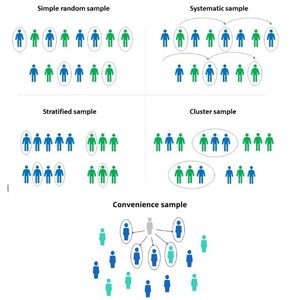
Additional info: Proper sampling methods reduce bias and increase the reliability of statistical inferences. Convenience sampling is generally discouraged for formal research due to its high risk of bias.
