 Indietro
Scope of Inference: Random Sampling and Random Assignment in Statistical Studies
Guida di studio - Note intelligenti
 Appunti personalizzati basati sui tuoi materiali, ampliati con definizioni chiave, esempi e contesto.
Scope of Inference in Statistical Studies
Introduction
Understanding the scope of inference is crucial in statistics, as it determines what conclusions can be drawn from a study. The ability to generalize results to a larger population and to establish causation depends on how the study is designed, specifically whether random sampling and random assignment are used.
Random Sampling and Random Assignment
Definitions
Random Sampling: Selecting individuals from a population in such a way that every individual has an equal chance of being chosen. This allows results to be generalized to the population from which the sample was drawn.
Random Assignment: Assigning study participants to different groups (such as treatment and control) using a random process. This allows for causal conclusions about the effect of the treatment.
Key Points
Generalization (Inference about Population): Possible only if random sampling is used.
Causation (Inference about Cause and Effect): Possible only if random assignment is used.
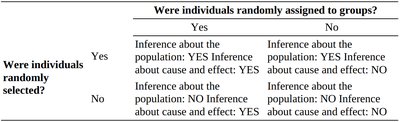
Table: Scope of Inference Based on Study Design
The following table summarizes when it is appropriate to make inferences about the population and/or causation based on whether random sampling and random assignment are used:
Were individuals randomly selected? | Were individuals randomly assigned to groups? | Inference about the population? | Inference about cause and effect? |
|---|---|---|---|
Yes | Yes | YES | YES |
Yes | No | YES | NO |
No | Yes | NO | YES |
No | No | NO | NO |
Types of Studies
Observational Study vs. Experiment
Observational Study: Researchers observe subjects and measure variables of interest without assigning treatments. No random assignment is used, so causation cannot be established.
Experiment: Researchers actively impose treatments on subjects and use random assignment to groups. This allows for causal conclusions.
Example: SAT Prep Course Study Designs
Suppose we want to determine if taking an SAT prep course improves SAT scores. Several study designs are possible:
Random Sample, No Random Assignment: Select a random sample of students and observe who took the course. Can generalize to the population, but cannot infer causation.
No Random Sample, Random Assignment: Use a convenience sample (e.g., one class) and randomly assign students to take or not take the course. Can infer causation for the sample, but cannot generalize to the population.
Random Sample and Random Assignment: Select a random sample and randomly assign to treatment. Can both generalize and infer causation.
Conclusion Choice Bank
Association: There is a relationship between the treatment and the outcome, but causation is not established.
Causation: The treatment causes changes in the outcome, which can only be concluded with random assignment.
Generalization: Results can be extended to the population only if random sampling is used.
Application Example: iPhone Battery Life Study
Study Description
A random sample of 20 new iPhones is split into two groups. One group is set to low screen brightness, the other to high. Battery life is measured for each phone.
Type of Study: Experiment (random assignment to treatment groups)
Explanatory Variable: Screen brightness (low or high)
Response Variable: Battery life (time until battery is dead)
Random Sample Used: Yes
Random Assignment Used: Yes
Conclusion: For all brand new iPhones from this store, setting screen brightness to low causes increased battery life.
Summary
Random sampling allows generalization to the population.
Random assignment allows inference about causation.
Both are needed to generalize causal conclusions to the population.
