Skip to main content
Analytical Chemistry
Il mio corso
Impara
Preparazione agli esami
AI Tutor
Guide di studio
Flashcard
Esplora
Prova l'app
Il mio corso
Impara
Preparazione agli esami
AI Tutor
Guide di studio
Flashcard
Esplora
Prova l'app
Indietro
Fundamentals of Electrolysis quiz
Puoi toccare per girare la carta.
What is electrolysis?
Puoi toccare per girare la carta.
👆
What is electrolysis?
Electrolysis is the process of passing an electrical current through a substance to produce chemical changes.
Avanzamenti del tracciato
I pulsanti di controllo sono stati cambiati in modalità "navigazione".
1/15
Flashcard correlate
Pratica correlata
Video consigliati
Fundamentals of Electrolysis definitions
Fundamentals of Electrolysis
15 Termini
Fundamentals of Electrolysis
16. Electroanalytical Techniques
5 Problemi
Argomento
Gravimetric Analysis
16. Electroanalytical Techniques
5 Problemi
Argomento
16. Electroanalytical Techniques
4 Argomenti
12 Problemi
Capitolo
VideoThumbView.guidedCourse
03:14
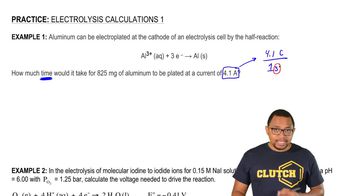
Electrolysis Calculations 1
379
views
1
rank
VideoThumbView.guidedCourse
02:50
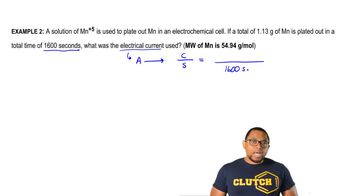
Fundamentals of Electrolysis Calculations 1
411
views
2
rank
VideoThumbView.guidedCourse
02:07
Electrolysis and Current Calculations 1
289
views
1
rank
Termini in questo insieme (15)
Nascondere definizioni
What is electrolysis?
Electrolysis is the process of passing an electrical current through a substance to produce chemical changes.
Are electrolysis reactions spontaneous or non-spontaneous?
Electrolysis reactions are non-spontaneous and require external energy to occur.
What is a common example of electrolysis?
A common example is the decomposition of water into oxygen and hydrogen gases using an electric current.
What unit is electrical current measured in?
Electrical current is measured in amperes (amps).
What is the relationship between amperes and coulombs per second?
One ampere is equal to one coulomb per second.
What is the formula relating current, charge, and time?
The formula is I = Q/T, where I is current, Q is charge, and T is time.
How do you calculate moles of electrons in an electrolysis reaction?
Moles of electrons = (current × time) / Faraday's constant.
What is Faraday's constant used for in electrolysis calculations?
Faraday's constant is used to relate the total charge passed to the number of moles of electrons.
What is the sign of the cell potential for non-spontaneous processes?
The cell potential is negative (less than 0) for non-spontaneous processes.
What is ohmic potential in electrolysis?
Ohmic potential is the voltage needed to overcome the resistance in the circuit when current is flowing.
How is current related to voltage and resistance in electrolysis?
Current (I) equals voltage (E) divided by resistance (R), or I = E/R.
What is overpotential in the context of electrolysis?
Overpotential is the extra voltage required to overcome the activation energy for a reaction at the electrode.
What is concentration polarization?
Concentration polarization occurs when there is a difference in reactant concentration at the electrode surface compared to the bulk solution.
How do ohmic potential, overpotential, and concentration polarization affect cell potential?
They make the overall cell potential more negative, increasing the energy required to drive the reaction.
Why is an external current necessary in electrolysis?
An external current is necessary because the process is non-spontaneous and will not occur naturally without added energy.
 IndietroIndietro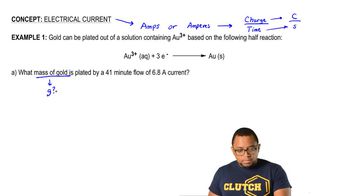
 03:14
03:14