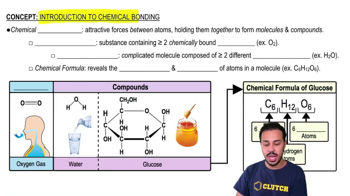
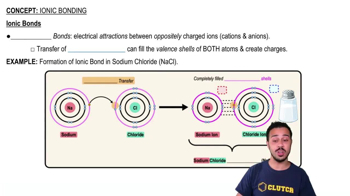
Fill in the blanks in this concept map to help you tie together the key concepts concerning elements, atoms, and molecules.
Guida verificata passo dopo passo
1
Identify the positively charged particles in an atom, which are protons, and fill in (a) with 'protons'.
Identify the neutral particles in an atom, which are neutrons, and fill in (b) with 'neutrons'.
Identify the negatively charged particles in an atom, which are electrons, and fill in (c) with 'electrons'.
Determine what number may differ in neutral atoms, which is the number of neutrons, and fill in (d) with 'neutrons'.
Identify the type of bond formed by unequal sharing of electrons, which is a polar covalent bond, and fill in (e) with 'polar covalent bonds'.
Risposta video verificata per un problema simile:
Questa soluzione video è stata consigliata dai nostri tutor come utile per risolvere questo problema.
Durata del video:
38s
Guarda un video:
0 Commenti
Concetti chiave
Ecco i concetti essenziali che devi comprendere per rispondere correttamente alla domanda.
Atoms
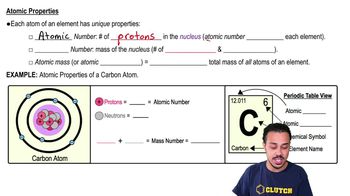
Atoms are the fundamental building blocks of matter, consisting of protons, neutrons, and electrons. The atomic number, which is the number of protons in the nucleus, defines each element. Atoms can be positively charged (cations), negatively charged (anions), or neutral, depending on the balance of protons and electrons.
Chemical bonds are the forces that hold atoms together in molecules. They can be formed through the transfer of electrons (ionic bonds) or the sharing of electrons (covalent bonds). The nature of these bonds influences the properties of the resulting compounds, such as polarity and reactivity.
Ionic bonds occur when electrons are transferred from one atom to another, resulting in the formation of charged ions that attract each other. Covalent bonds involve the sharing of electrons between atoms, which can be equal (nonpolar covalent bonds) or unequal (polar covalent bonds), affecting the molecule's polarity and interactions with other substances.

 0:38 minuti
 Guida verificata passo dopo passo
 07:43
07:43