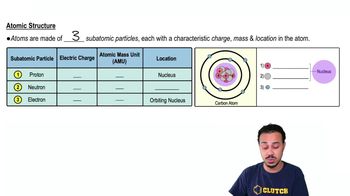
Add labels to the figure that follows, which illustrates the subatomic particles associated with a carbon atom.
Guida verificata passo dopo passo
1
Identify the subatomic particles in the nucleus of the carbon atom. These include protons (positively charged) and neutrons (neutral).
Label the protons in the nucleus with a '+' sign to indicate their positive charge.
Label the neutrons in the nucleus with a '0' or 'n' to indicate their neutral charge.
Identify the electrons (negatively charged) that orbit the nucleus in electron shells or clouds.
Label the electrons with a '-' sign to indicate their negative charge.
Risposta video verificata per un problema simile:
Questa soluzione video è stata consigliata dai nostri tutor come utile per risolvere questo problema.
Durata del video:
51s
Guarda un video:
0 Commenti
Concetti chiave
Ecco i concetti essenziali che devi comprendere per rispondere correttamente alla domanda.
Subatomic Particles
Subatomic particles are the fundamental components of atoms, which include protons, neutrons, and electrons. Protons are positively charged and reside in the nucleus, while neutrons are neutral and also found in the nucleus. Electrons are negatively charged and orbit the nucleus in electron shells. Understanding these particles is crucial for identifying the structure and behavior of an atom, such as carbon.
The atomic structure refers to the arrangement of subatomic particles within an atom. In a carbon atom, there are six protons and six neutrons in the nucleus, surrounded by six electrons in various energy levels. This structure determines the chemical properties of the element, including its reactivity and bonding behavior. Recognizing the atomic structure is essential for labeling the components in the provided figure.
Electron configuration describes the distribution of electrons in an atom's electron shells. For carbon, the electron configuration is 1s² 2s² 2p², indicating that it has two electrons in the first shell and four in the second. This configuration influences how carbon interacts with other elements, forming covalent bonds and contributing to its role in organic chemistry. Understanding electron configuration is vital for accurately labeling the electrons in the figure.