What type of information is used to direct different polypeptides to fold into different shapes?
Guida verificata passo dopo passo
1
Understand that polypeptide folding is directed by the sequence of amino acids, which is determined by the genetic code.
Recognize that the primary structure, or the linear sequence of amino acids, dictates the folding pattern due to chemical interactions.
Consider the role of secondary structures, such as alpha helices and beta sheets, which form through hydrogen bonding between backbone atoms.
Acknowledge the influence of tertiary structure, where interactions between side chains (R groups) further stabilize the 3D shape.
Explore the impact of quaternary structure, where multiple polypeptide chains may interact to form a functional protein complex.
Risposta video verificata per un problema simile:
Questa soluzione video è stata consigliata dai nostri tutor come utile per risolvere questo problema.
Durata del video:
1m
Guarda un video:
0 Commenti
Concetti chiave
Ecco i concetti essenziali che devi comprendere per rispondere correttamente alla domanda.
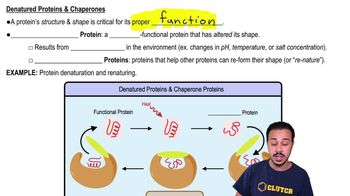
Polypeptide Folding
Polypeptide folding refers to the process by which a linear chain of amino acids acquires its functional three-dimensional structure. This folding is crucial for the protein's functionality and is influenced by various factors, including the sequence of amino acids and the chemical environment. Misfolded proteins can lead to diseases, highlighting the importance of proper folding.
Chaperone proteins are specialized molecules that assist in the proper folding of polypeptides. They help prevent misfolding and aggregation by providing a conducive environment for folding and sometimes facilitating the refolding of denatured proteins. Chaperones are essential for maintaining cellular protein homeostasis.
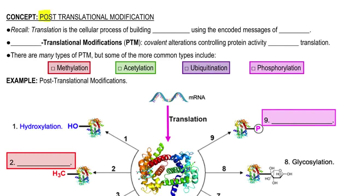
Post-translational modifications (PTMs) are chemical changes that occur to a polypeptide after its synthesis, which can significantly influence its final shape and function. Common PTMs include phosphorylation, glycosylation, and methylation, which can alter the protein's stability, activity, and interactions with other molecules, directing it to fold into specific shapes.

 1:27 minuti
 Guida verificata passo dopo passo
 03:15
03:15