Skip to main content
Anatomy & Physiology
Il mio corso
Impara
Preparazione agli esami
AI Tutor
Guide di studio
Soluzioni per libri di testo
Flashcard
Esplora
Prova l'app
Il mio corso
Impara
Preparazione agli esami
AI Tutor
Guide di studio
Soluzioni per libri di testo
Flashcard
Esplora
Prova l'app
Indietro
Introduction To Blood definitions
4 Gli studenti hanno trovato questo utile
Puoi toccare per girare la carta.
Erythrocytes
Puoi toccare per girare la carta.
👆
Erythrocytes
The most numerous cells in blood, responsible for oxygen and carbon dioxide transport, giving blood its red color.
Avanzamenti del tracciato
I pulsanti di controllo sono stati cambiati in modalità "navigazione".
1/15
Flashcard correlate
Pratica correlata
Video consigliati
Introduction To Blood quiz #1
Introduction To Blood
40 Termini
Introduction To Blood quiz #2
Introduction To Blood
39 Termini
Introduction To Blood quiz #3
Introduction To Blood
38 Termini
Introduction To Blood
17. The Blood
7 Problemi
Argomento
Jason
Erythrocytes
17. The Blood
2 Problemi
Argomento
17. The Blood
5 Argomenti
12 Problemi
Capitolo
Jason
VideoThumbView.guidedCourse
2:36
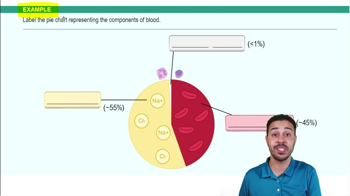
Introduction to Blood Example 1
10596
views
320
rank
VideoThumbView.guidedCourse
7:49
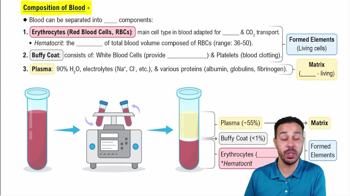
Composition of Blood
11213
views
326
rank
VideoThumbView.guidedCourse
1:55
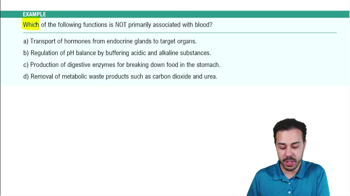
Introduction to Blood Example 2
8785
views
212
rank
Termini in questo insieme (15)
Nascondere definizioni
Erythrocytes
The most numerous cells in blood, responsible for oxygen and carbon dioxide transport, giving blood its red color.
Leukocytes
White blood cells found in the buffy coat, crucial for immune response and fighting infections.
Thrombocytes
Cell fragments in the buffy coat, essential for blood clotting and reducing blood loss after injury.
Plasma
The liquid extracellular matrix of blood, comprising 90% water, electrolytes, and proteins, making up 55% of blood volume.
Hematocrit
The percentage of blood volume composed of red blood cells, indicating overall health, typically 36-50%.
Cardiovascular System
Comprises the heart, blood, and blood vessels, responsible for circulating blood throughout the body.
Connective Tissue
A type of tissue in the body, with blood being the only liquid form, involved in support and transport functions.
pH
A measure of acidity or alkalinity, with blood being slightly alkaline, ranging from 7.35 to 7.45.
Buffy Coat
A thin layer in blood containing leukocytes and thrombocytes, making up less than 1% of blood volume.
Albumin
A protein in plasma that helps maintain fluid balance and transport substances in the blood.
Globulins
Proteins in plasma involved in immune functions and transport of lipids and fat-soluble vitamins.
Fibrinogen
A plasma protein essential for blood clot formation, converting to fibrin during the clotting process.
Extracellular Matrix
The nonliving component of blood, primarily plasma, providing a medium for cellular components.
Vasoconstriction
The narrowing of blood vessels to reduce blood flow and heat loss, aiding in temperature regulation.
Vasodilation
The widening of blood vessels to increase blood flow and heat loss, aiding in cooling the body.
 IndietroIndietro
 2:36
2:36