Skip to main content
Anatomy & Physiology
Il mio corso
Impara
Preparazione agli esami
AI Tutor
Guide di studio
Soluzioni per libri di testo
Flashcard
Esplora
Prova l'app
Il mio corso
Impara
Preparazione agli esami
AI Tutor
Guide di studio
Soluzioni per libri di testo
Flashcard
Esplora
Prova l'app
Indietro
Introduction To Blood quiz #3
Puoi toccare per girare la carta.
Which plasma component is not present in serum?
Puoi toccare per girare la carta.
👆
Which plasma component is not present in serum?
Fibrinogen is not present in serum.
Avanzamenti del tracciato
I pulsanti di controllo sono stati cambiati in modalità "navigazione".
1/38
Flashcard correlate
Pratica correlata
Video consigliati
Introduction To Blood definitions
Introduction To Blood
15 Termini
Introduction To Blood quiz #1
Introduction To Blood
40 Termini
Introduction To Blood quiz #2
Introduction To Blood
39 Termini
Introduction To Blood
17. The Blood
7 Problemi
Argomento
Jason
Erythrocytes
17. The Blood
2 Problemi
Argomento
17. The Blood
5 Argomenti
12 Problemi
Capitolo
Jason
VideoThumbView.guidedCourse
2:36
Introduction to Blood Example 1
10621
views
321
rank
VideoThumbView.guidedCourse
7:49
Composition of Blood
11239
views
326
rank
VideoThumbView.guidedCourse
1:55
Introduction to Blood Example 2
8805
views
213
rank
Termini in questo insieme (38)
Nascondere definizioni
Which plasma component is not present in serum?
Fibrinogen is not present in serum.
What does myeloid tissue produce?
Red blood cells
What is the first procoagulant that the extrinsic and intrinsic pathways have in common?
The first procoagulant that the extrinsic and intrinsic pathways have in common is Factor X.
What is the correct sequence of blood flow in birds and mammals?
Heart -> Lungs -> Body
What percentage of the blood is liquid plasma?
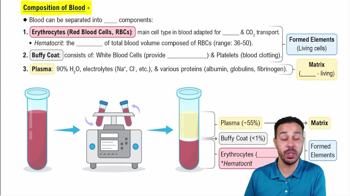
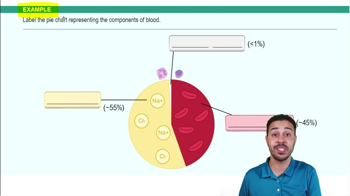
Approximately 55% of the blood is liquid plasma.
What is a formed element of blood?
Red blood cells
Which blood vessels carry oxygen-poor blood?
Veins
When testing for blood, what is typically measured?
When testing for blood, components such as red blood cell count, white blood cell count, hemoglobin levels, and hematocrit are typically measured.
What are the three most abundant plasma proteins and their functions?
The three most abundant plasma proteins are albumin (maintains osmotic pressure), globulins (immune function), and fibrinogen (blood clotting).
What components make up blood?
Plasma, Red blood cells, White blood cells
What are two terms associated with myeloid tissue?
Two terms associated with myeloid tissue are red bone marrow and hematopoiesis.
When assessing a client with anemia, what should be evaluated?
When assessing a client with anemia, hemoglobin levels, hematocrit, and red blood cell count should be evaluated.
What begins the intrinsic pathway of coagulation?
The intrinsic pathway of coagulation begins with the activation of Factor XII.
Which serum biomarker is highly specific for myocardial tissue?
Troponin is a serum biomarker highly specific for myocardial tissue.
Which type of stem cells give rise to red blood cells and platelets?
Myeloid stem cells give rise to red blood cells and platelets.
What initiates the extrinsic pathway of blood clotting?
It is initiated by tissue factor
What are the most common cells in the blood?
The most common cells in the blood are red blood cells (erythrocytes).
Which component of blood helps fight infection?
White blood cells (leukocytes) help fight infection.
To which substances is the blood-brain barrier most permeable?
Lipid-soluble substances
What is the typical central venous pressure (CVP) reading in hypovolemic shock?
Decreased
What component of blood helps fight disease?
White blood cells (leukocytes) help fight disease.
Plasma makes up about what percentage of blood volume?
Plasma makes up about 55% of blood volume.
Which blood cells fight infections?
White blood cells
What is the role of the blood-brain barrier?
Protects the brain from harmful substances
What is a function of blood?
A function of blood is to transport oxygen and nutrients to cells and remove waste products.
Nutrient-rich blood from the intestine is carried to the liver via which vessel?
Nutrient-rich blood from the intestine is carried to the liver via the hepatic portal vein.
Which function is not performed by blood?
Producing hormones
Which component is not considered a formed element of blood?
Plasma
What type of formed element is most abundant?
Red blood cells (erythrocytes) are the most abundant formed element.
What plasma protein is most important for the blood's colloid osmotic pressure?
Albumin is the plasma protein most important for the blood's colloid osmotic pressure.
Plasma makes up approximately what percentage of whole blood in a healthy person?
Plasma makes up approximately 55% of whole blood in a healthy person.
What are formed elements?
Formed elements are the cellular components of blood, including red blood cells, white blood cells, and platelets.
Which vitamin is needed for the formation of clotting factors?
Vitamin K
Which plasma protein is not found in blood?
Hemoglobin
What is the function of the blood-testis barrier?
It protects sperm from immune attack
What makes up the formed elements of blood?
The formed elements of blood are made up of red blood cells, white blood cells, and platelets.
What type of tissue is blood classified as?
Blood is a liquid connective tissue
What are the three formed elements in the blood?
The three formed elements in the blood are erythrocytes (red blood cells), leukocytes (white blood cells), and thrombocytes (platelets).
 IndietroIndietro
 2:36
2:36