 Indietro
BIOL 2010: Human Anatomy & Physiology I – Course Syllabus and Study Guide
Guida di studio - Note intelligenti
 Appunti personalizzati basati sui tuoi materiali, ampliati con definizioni chiave, esempi e contesto.
Course Overview
This course, BIOL 2010: Human Anatomy & Physiology I, provides a foundational study of the structure and function of the human body. Emphasis is placed on basic organization, the integumentary, skeletal, muscular, and nervous systems, as well as cellular structure and energetics. The course includes both lecture and laboratory components, designed to develop scientific reasoning and laboratory skills essential for further study in health and biological sciences.
Course Information
Credit Hours: 4 (3 hours lecture, 1 hour laboratory)
Format: Face-to-face instruction
Instructor: Dr. Stephen Hays
Required Textbooks:
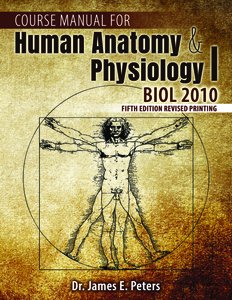
Course Manual for Human Anatomy & Physiology I by Dr. James Peters (XanEdu Publishing, 5th Edition)
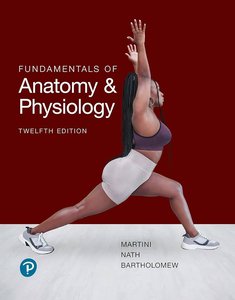
Fundamentals of Anatomy & Physiology by Martini, Nath, Bartholomew (Pearson, 12th Edition)

Course Description
This course explores the structure and function of the human body with a focus on the following systems and concepts:
Basic organization of the body
Integumentary system
Skeletal system
Muscular system
Nervous system
Cellular structure and energetics
Prerequisites include completion of required reading and writing courses and a recent course in chemistry.
Course Learning Outcomes
Apply scientific principles and experimental techniques
Describe the natural and physical world using scientific language
Address problems in the natural/physical world using scientific principles
Analyze the impact of scientific discoveries on society
Course Learning Objectives
Use the scientific method in laboratory settings
Operate basic laboratory equipment
Utilize the internet as a learning tool
Describe the relationship between anatomy and physiology
Discuss the organization and characteristics of life
Use anatomical terminology for location and function
Explain the role of homeostasis
Trace energy flow in living organisms
Discuss the structure and function of biologically important chemicals
Describe cell structure and organelles
Identify and describe the four types of animal tissue
Describe the structure and function of the integumentary, skeletal, muscular, and nervous systems
Course Outline & Schedule
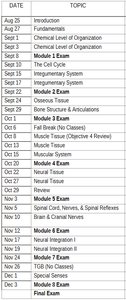
The course is organized into modules, each focusing on a major topic in anatomy and physiology. Exams are scheduled at the end of each module. The following table summarizes the weekly topics and exam schedule:
Date | Topic |
|---|---|
Aug 25 | Introduction |
Aug 27 | Fundamentals |
Sept 1 | Chemical Level of Organization |
Sept 3 | Chemical Level of Organization |
Sept 8 | Module 1 Exam |
Sept 10 | The Cell Cycle |
Sept 15 | Integumentary System |
Sept 17 | Integumentary System |
Sept 22 | Module 2 Exam |
Sept 24 | Bone Structure & Articulations |
Sept 29 | Bone Structure & Articulations |
Oct 1 | Module 3 Exam |
Oct 6 | Muscle Tissue (Chapter 4 Review) |
Oct 8 | Muscle Tissue |
Oct 13 | Muscular System |
Oct 15 | Muscular System |
Oct 20 | Module 4 Exam |
Oct 22 | Nervous Tissue |
Oct 27 | Nervous Tissue |
Oct 29 | Module 5 Exam |
Nov 3 | Spinal Cord, Nerves, & Special Reflexes |
Nov 5 | Brain & Cranial Nerves |
Nov 10 | Module 6 Exam |
Nov 12 | Neural Integration I |
Nov 17 | Neural Integration II |
Nov 19 | TGB (No Classes) |
Nov 24 | Special Senses |
Dec 1 | Module 7 Exam |
Dec 3 | Module 8 Exam |
Dec 10 | Final Exam |
Assessment & Grading
Lecture Exams: 8 module exams (lowest dropped), each with multiple-choice, fill-in-the-blank, essay, study guide, and Mastering A&P® assignment components.
Final Exam: Comprehensive, 100 multiple-choice questions.
Laboratory Exams: 8 module exams (lowest dropped), each with fill-in-the-blank and assignment components.
Extra Credit: Up to 40 points available through instructor-provided opportunities.
Grading Scale:
A = 900–1000
B = 800–899
C = 675–799
D = 550–674
F = 0–549
Key Topics Covered
Introduction to Anatomy & Physiology: Definitions, scope, and importance of the field.
Chemical Level of Organization: Atoms, molecules, and chemical reactions essential for life.
Cell Structure and Function: Cell theory, organelles, and cellular processes.
Tissues: Classification and function of the four basic tissue types.
Integumentary System: Structure and function of skin, hair, nails, and glands.
Skeletal System: Bone structure, development, and articulations (joints).
Muscle Tissue and Muscular System: Types of muscle tissue, muscle contraction, and major muscle groups.
Nervous Tissue and Nervous System: Neurons, neuroglia, organization of the central and peripheral nervous systems, and special senses.
Laboratory Safety Rules
No food or drink in the laboratory.
Wear appropriate attire and personal protective equipment.
Perform your own work and participate in group activities.
Bring required materials to every lab session.
Clean and return all equipment after use.
Ask the instructor if in doubt about procedures or safety.
Additional Information
Attendance is required for all classes and labs.
Academic integrity and proper conduct are expected at all times.
Accommodations are available for students with disabilities.
Support services are available for mental health and academic success.
Summary Table: Major Systems and Topics
System/Topic | Main Focus |
|---|---|
Integumentary | Protection, temperature regulation, sensation |
Skeletal | Support, movement, mineral storage, blood formation |
Muscular | Movement, posture, heat production |
Nervous | Control, communication, integration of body functions |
Cellular Structure | Basic unit of life, organelles, cell processes |
Chemical Organization | Atoms, molecules, biochemical reactions |
Key Definitions
Anatomy: The study of the structure of body parts and their relationships to one another.
Physiology: The study of the function of the body’s structural machinery.
Homeostasis: The maintenance of a stable internal environment despite external changes.
Tissue: A group of similar cells that perform a common function.
Example: Homeostasis
Homeostasis is essential for maintaining the internal environment of the body. For example, body temperature is regulated through mechanisms such as sweating and shivering to keep it within a narrow range, ensuring optimal enzyme function and cellular processes.
Formula Example: Cellular Respiration
The process of cellular respiration, which provides energy for cellular activities, can be summarized by the following equation:
Additional info: This syllabus provides a comprehensive overview of the course structure, expectations, and major topics, serving as a foundational guide for students preparing for exams and laboratory work in Anatomy & Physiology I.
