 Indietro
The Integumentary System: Functions, Homeostasis, Skin Cancer, and Burns
Guida di studio - Note intelligenti
 Appunti personalizzati basati sui tuoi materiali, ampliati con definizioni chiave, esempi e contesto.
The Integumentary System: Functions, Homeostasis, Skin Cancer, and Burns
Overview
The integumentary system, primarily composed of the skin, serves as the body's first line of defense and plays a critical role in maintaining homeostasis. This section explores the functions of the skin, mechanisms of homeostasis, common abnormalities such as burns and skin cancers, and clinical assessment tools for skin injuries.
Functions of the Skin
Protection
The skin acts as a multifaceted barrier, protecting the body from environmental hazards, pathogens, and physical injury. Its protective mechanisms are categorized into three main barriers:
Chemical Barrier: Skin secretions such as sweat (containing antimicrobial proteins), sebum, and defensins inhibit microbial growth. The acid mantle (low pH) further retards bacterial multiplication. Melanin provides a chemical shield against ultraviolet (UV) radiation.
Physical Barrier: The stratum corneum, composed of flat, dead, keratinized cells surrounded by glycolipids, blocks most water and water-soluble substances. However, lipid-soluble substances (e.g., some drugs, organic solvents, heavy metal salts) can penetrate the skin.
Biological Barrier: The epidermis contains dendritic cells that engulf foreign antigens and activate the immune response. The dermis houses macrophages, which also present antigens to white blood cells. DNA in skin cells can absorb and dissipate harmful UV radiation as heat.
Body Temperature Regulation
The skin regulates body temperature through sweat production and blood flow adjustments:
Under normal conditions, insensible perspiration (about 500 ml/day) occurs unnoticed.
When body temperature rises, sensible perspiration increases (up to 12 L/day), promoting heat loss via evaporation.
In cold environments, dermal blood vessels constrict, reducing heat loss by decreasing skin temperature.
Cutaneous Sensations
The skin contains specialized sensory receptors (exteroreceptors) that detect external stimuli such as temperature, touch, and pain. Free nerve endings are responsible for sensing painful stimuli.
Metabolic Functions
The skin synthesizes vitamin D, essential for calcium absorption in the intestine.
Keratinocytes can detoxify some carcinogens and activate certain hormones (e.g., conversion of cortisone to hydrocortisone).
Production of collagenase aids in collagen turnover, helping to prevent wrinkles.
Blood Reservoir
The skin can store up to 5% of the body's total blood volume. During increased demand elsewhere (e.g., exercise), skin vessels constrict to redirect blood flow to vital organs.
Excretion
The skin excretes limited amounts of nitrogenous wastes (ammonia, urea, uric acid) and contributes to salt and water loss through sweating.
Homeostatic Mechanisms of the Integumentary System
Thermoregulation, Protection, and Water Conservation
Thermoregulation: Achieved through sweat production and vasodilation/vasoconstriction of dermal blood vessels.
Protection: Provided by chemical, physical, and biological barriers as described above.
Water Conservation: The stratum corneum and glycolipids prevent excessive water loss, maintaining internal hydration.
Abnormalities of the Integumentary System
Burns
Burns are injuries caused by heat, electricity, radiation, or chemicals, resulting in protein denaturation and cell death. The most immediate threats are dehydration and electrolyte imbalance, which can lead to renal shutdown and circulatory shock.
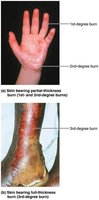
First-degree burns: Affect only the epidermis; symptoms include redness, swelling, and pain.
Second-degree burns: Involve the epidermis and upper dermis; blisters are present. Both first- and second-degree burns are termed partial-thickness burns.
Third-degree burns: Destroy the entire thickness of the skin (full-thickness burns); the area appears gray-white, cherry red, or blackened, with no pain due to nerve destruction. Skin grafting is usually required.
Life-Threatening Risks of Serious Burns
Dehydration and electrolyte imbalance
Renal shutdown
Circulatory shock
Infection (due to loss of protective barrier)
Classification and Assessment of Burns
Burns are classified by depth and extent. The Rule of Nines is used to estimate the percentage of body surface area affected, guiding fluid resuscitation and treatment decisions.
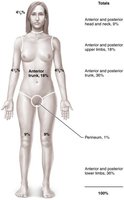
Critical burns: >25% of body with second-degree burns, >10% with third-degree burns, or third-degree burns on face, hands, or feet.
Treatment includes debridement, antibiotics, temporary coverings, and skin grafts.
Skin Cancer
Skin cancer is a less common but more serious abnormality of the integumentary system. Most tumors are benign, but some can metastasize and become life-threatening. Major risk factors include overexposure to UV radiation and frequent skin irritation.
Types of Skin Cancer
Type | Origin | Characteristics | Prognosis/Treatment |
|---|---|---|---|
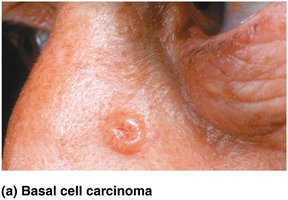
Basal cell carcinoma | Stratum basale cells | Most common, least malignant; slow-growing, rarely metastasizes | 99% cure rate with surgical excision |
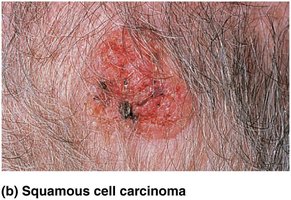
Squamous cell carcinoma | Keratinocytes of stratum spinosum | Scaly, reddened papule; can metastasize if untreated | Good prognosis with early removal or radiation therapy |
Melanoma | Melanocytes | Most dangerous; highly metastatic and resistant to chemotherapy | Wide surgical excision and immunotherapy; early detection critical |
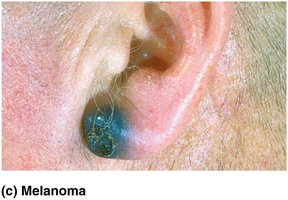
ABCD Rule for Early Detection of Melanoma
A: Asymmetry – two sides of the lesion do not match
B: Border irregularity – edges are indented or uneven
C: Color – contains multiple colors (black, brown, tan, red, or blue)
D: Diameter – larger than 6 mm (about the size of a pencil eraser)
Summary Table: Functions of the Skin
Function | Description |
|---|---|
Protection | Chemical, physical, and biological barriers defend against environmental hazards |
Thermoregulation | Sweat and blood flow adjustments maintain body temperature |
Cutaneous Sensation | Sensory receptors detect touch, temperature, and pain |
Metabolic Functions | Vitamin D synthesis, hormone activation, collagen turnover |
Blood Reservoir | Stores up to 5% of blood volume |
Excretion | Removes nitrogenous wastes, salt, and water |
Additional info: The notes above expand on the provided content with academic context, definitions, and clinical relevance to ensure a comprehensive, self-contained study guide for Anatomy & Physiology students.
