Would you expect to find larger motor units in the postural muscles of the back or the muscles of the hand? Explain your answer.
Ch. 11 Introduction to the Nervous System and Nervous Tissue
Amerman2nd EditionHuman Anatomy & PhysiologyISBN: 9780136873822Non è quello che usi tu?Cambia libro di testo
Tutti i libri di testo
Amerman 2nd Edition
Ch. 11 Introduction to the Nervous System and Nervous Tissue
Problema L2.4
Amerman 2nd Edition
Ch. 11 Introduction to the Nervous System and Nervous Tissue
Problema L2.4Capitolo 11, Problema L2.4
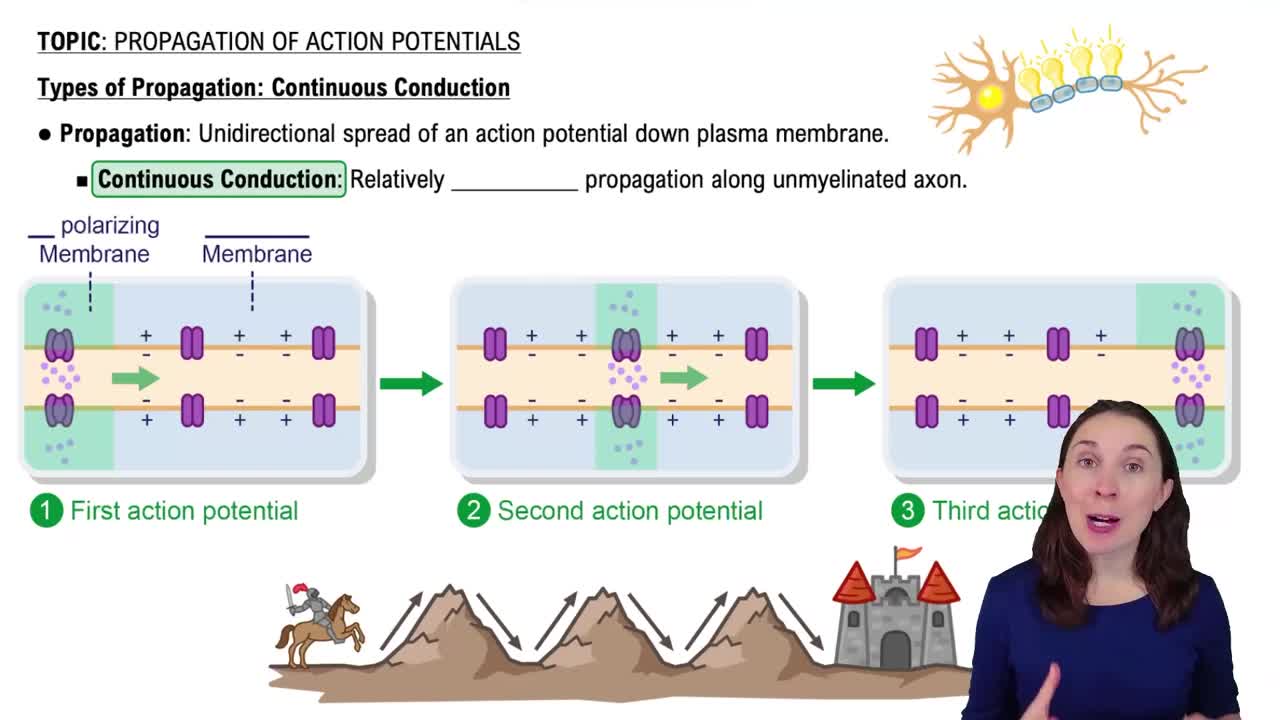
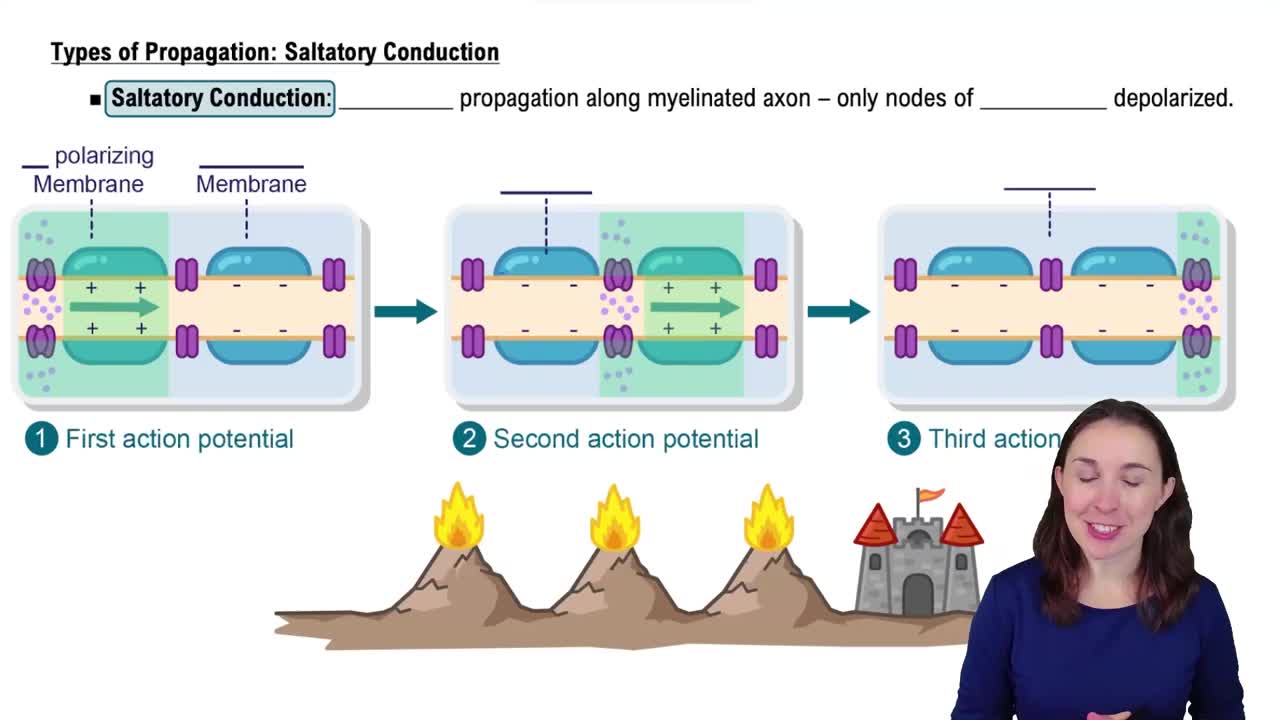
Explain how an action potential is propagated down an axon in continuous conduction. Why is saltatory conduction faster than continuous conduction?
Guida verificata passo dopo passo1
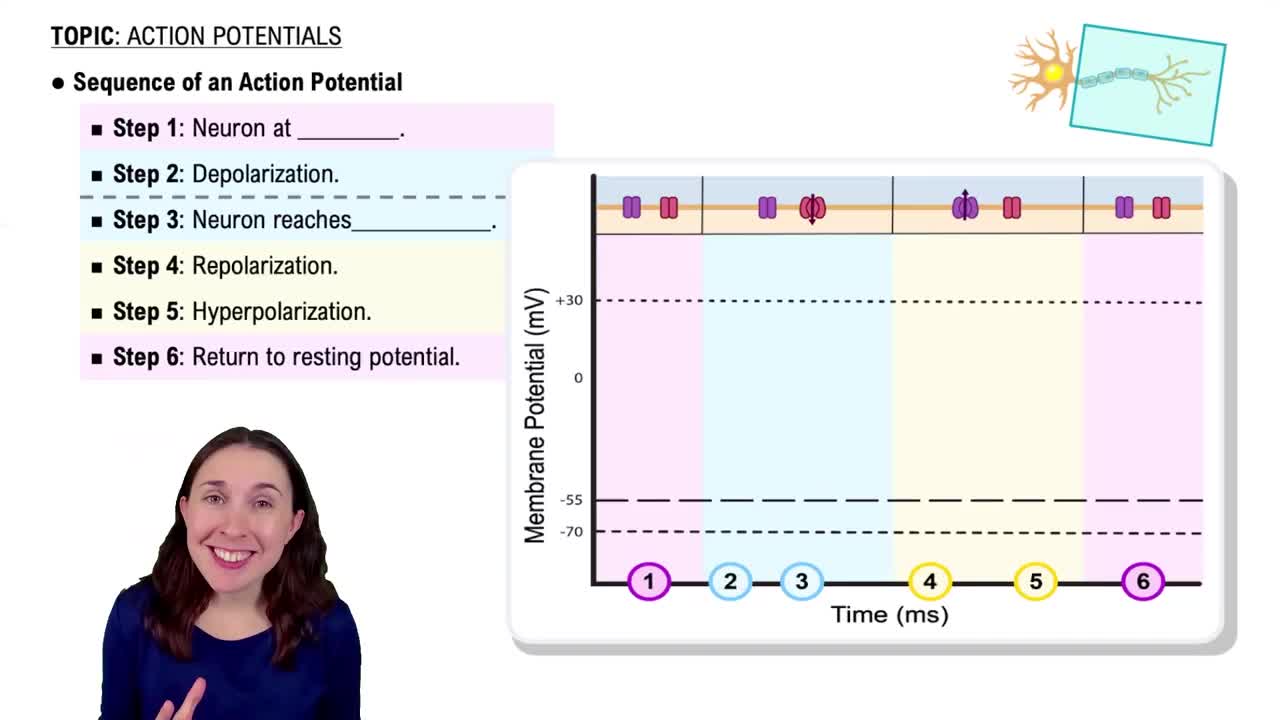
Understand that an action potential is a rapid change in membrane potential that travels along the axon of a neuron. Continuous conduction occurs in unmyelinated axons, where the action potential is propagated step-by-step along the entire length of the axon.
In continuous conduction, the action potential begins at the axon hillock. Sodium (Na⁺) channels open in response to a stimulus, allowing Na⁺ ions to enter the neuron, causing depolarization. This depolarization triggers adjacent voltage-gated Na⁺ channels to open, propagating the action potential down the axon.
As the action potential moves, the previously depolarized region undergoes repolarization. Voltage-gated potassium (K⁺) channels open, allowing K⁺ ions to exit the neuron, restoring the resting membrane potential. This ensures the action potential moves in one direction.
Saltatory conduction, in contrast, occurs in myelinated axons. The myelin sheath insulates the axon, preventing ion exchange along the myelinated segments. Action potentials 'jump' between the nodes of Ranvier, which are gaps in the myelin sheath where voltage-gated Na⁺ and K⁺ channels are concentrated.
Saltatory conduction is faster than continuous conduction because the action potential only needs to be regenerated at the nodes of Ranvier, rather than along the entire axon. This reduces the time and energy required for ion exchange and propagation, making the process more efficient.

Risposta video verificata per un problema simile:
Questa soluzione video è stata consigliata dai nostri tutor come utile per risolvere questo problema.
Concetti chiave
Ecco i concetti essenziali che devi comprendere per rispondere correttamente alla domanda.
Action Potential
An action potential is a rapid, temporary change in the electrical membrane potential of a neuron, allowing it to transmit signals. It occurs when a neuron reaches a threshold potential, leading to the opening of voltage-gated sodium channels, resulting in depolarization. This is followed by repolarization as potassium channels open, restoring the resting membrane potential.
Video consigliato:
Action Potential
Continuous Conduction
Continuous conduction refers to the slow propagation of action potentials along unmyelinated axons. In this process, the action potential is regenerated at every segment of the axon, leading to a gradual wave of depolarization. This method is less efficient and slower compared to saltatory conduction, as it requires more time for the ion channels to open and close along the entire length of the axon.
Video consigliato:
Types of Propagation: Continuous Conduction
Saltatory Conduction
Saltatory conduction is the rapid transmission of action potentials along myelinated axons, where the action potential jumps between nodes of Ranvier. This occurs because myelin sheaths insulate the axon, preventing ion flow except at these nodes. As a result, saltatory conduction is significantly faster than continuous conduction, as it reduces the time and energy required for the action potential to propagate.
Video consigliato:
Types of Propagation: Saltatory Conduction
Pratica correlata
Domanda del libro di testo
767
views
Domanda del libro di testo
Explain what would happen if depolarization of the trigger zone led to a negative feedback loop instead of a positive one.
684
views
Domanda del libro di testo
Explain why cardiac muscle cells and some smooth muscle cells will continue to contract even when their nerve supply has been removed
1039
views
Domanda del libro di testo
A hypothetical poison blocks K+ leak channels. How would this affect the resting membrane potential of skeletal muscle fibers? Explain your reasoning.
831
views
Domanda del libro di testo
What would happen if the drug blocked K+ channels instead?
1064
views
Domanda del libro di testo
A drug that blocks Na+ channels in neurons does so not only in the axon but also in the dendrites and cell body. What overall effect would this have on action potential generation?
868
views