Ch. 14 The Autonomic Nervous System and Homeostasis
Amerman - Human Anatomy & Physiology 2nd Edition
Amerman2nd EditionHuman Anatomy & PhysiologyISBN: 9780136873822Non è quello che usi tu?Cambia libro di testo
Capitolo 14, Problema 4

Differentiate between adrenergic and cholinergic receptors.

Guida verificata passo dopo passo
1
Understand that adrenergic and cholinergic receptors are types of receptors in the autonomic nervous system that respond to different neurotransmitters.
Learn that adrenergic receptors respond to catecholamines like norepinephrine and epinephrine, while cholinergic receptors respond to acetylcholine.
Explore the subtypes of adrenergic receptors: alpha (α) and beta (β) receptors, which are further divided into α1, α2, β1, β2, etc., each with specific functions in various tissues.
Examine the subtypes of cholinergic receptors: nicotinic receptors (found at neuromuscular junctions and autonomic ganglia) and muscarinic receptors (found in target organs of the parasympathetic nervous system).
Compare their physiological roles: adrenergic receptors are primarily involved in the 'fight or flight' response (sympathetic system), while cholinergic receptors are involved in 'rest and digest' activities (parasympathetic system).

Risposta video verificata per un problema simile:

Questa soluzione video è stata consigliata dai nostri tutor come utile per risolvere questo problema.

Concetti chiave

Ecco i concetti essenziali che devi comprendere per rispondere correttamente alla domanda.

Adrenergic Receptors

Adrenergic receptors are a class of G protein-coupled receptors that are activated by catecholamines, primarily norepinephrine and epinephrine. They are divided into two main types: alpha (α) and beta (β) receptors, each with subtypes that mediate various physiological responses such as vasoconstriction, increased heart rate, and bronchodilation. These receptors play a crucial role in the sympathetic nervous system, influencing the body's fight-or-flight response.
Video consigliato:
2:47
Sensory Receptors

Cholinergic Receptors

Cholinergic receptors are another class of receptors that respond to the neurotransmitter acetylcholine. They are categorized into two main types: nicotinic receptors, which are ionotropic and mediate fast synaptic transmission, and muscarinic receptors, which are metabotropic and involved in slower, longer-lasting responses. Cholinergic receptors are primarily associated with the parasympathetic nervous system, regulating functions such as digestion, salivation, and heart rate.
Video consigliato:
2:47
Sensory Receptors

Sympathetic vs. Parasympathetic Nervous System

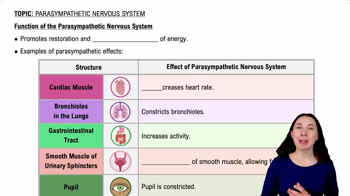
The sympathetic and parasympathetic nervous systems are two branches of the autonomic nervous system that have opposing effects on the body. The sympathetic system, associated with adrenergic receptors, prepares the body for 'fight or flight' responses, increasing heart rate and energy mobilization. In contrast, the parasympathetic system, linked to cholinergic receptors, promotes 'rest and digest' activities, slowing the heart rate and enhancing digestive processes, thus maintaining homeostasis.
Video consigliato:
1:56
Function of the Parasympathetic Nervous System
Pratica correlata
Domanda del libro di testo

Which neurotransmitter(s) is/are used by sympathetic postganglionic neurons?


a. Epinephrine

b. Norepinephrine

c. Acetylcholine

d. Both a and b

e. All of the above

773
views

Domanda del libro di testo

Many chemical warfare agents, such as the poisonous gas sarin, block the enzyme acetylcholinesterase in the synaptic cleft. What effects will this poison have on muscle contraction? What effects will it have on the autonomic nervous system? What symptoms would you expect to see from this poison?

642
views
Domanda del libro di testo

Which cranial nerves would be affected by a drug that stimulates the parasympathetic nervous system? Predict potential adverse effects that one might experience.

631
views
Domanda del libro di testo

Which of the following actions would you expect when sympathetic neurons release norepinephrine onto β1 receptors?

a. Decreased sweat production

b. Constriction of blood vessels serving the digestive, urinary, and integumentary systems

c. Adjustment of the shape of the lens

d. Increase in the rate and force of contraction of the heart.

700
views
Domanda del libro di testo

Explain what happens when sympathetic neurons stimulate the adrenal medulla. What purpose does this serve?

761
views
Domanda del libro di testo

The poison curare (kyoo-RAH-ray) blocks the binding of acetylcholine to its receptors at the neuromuscular junction. What effects would you predict from such a poison? Can you think of any useful applications for it? Why might an overdose of it be lethal?

847
views