
Ch. 17 The Cardiovascular System I: The Heart
Amerman - Human Anatomy & Physiology 2nd Edition
Amerman2nd EditionHuman Anatomy & PhysiologyISBN: 9780136873822Non è quello che usi tu?Cambia libro di testo
Capitolo 17, Problema 14c

Mark the following statements as true or false. If a statement is false, correct it to make a true statement.
Tissue perfusion to the heart decreases during systole and increases during diastole.

Guida verificata passo dopo passo
1
Step 1: Understand the concept of tissue perfusion in the heart. Tissue perfusion refers to the flow of blood through the capillaries to supply oxygen and nutrients to tissues. In the heart, this process is influenced by the phases of the cardiac cycle: systole (contraction) and diastole (relaxation).
Step 2: Analyze the relationship between systole and coronary blood flow. During systole, the heart muscle contracts, compressing the coronary arteries and reducing blood flow to the heart tissue. This is why tissue perfusion to the heart decreases during systole.
Step 3: Examine the relationship between diastole and coronary blood flow. During diastole, the heart muscle relaxes, allowing the coronary arteries to open and blood flow to increase. This is why tissue perfusion to the heart increases during diastole.
Step 4: Evaluate the statement provided in the problem. The statement 'Tissue perfusion to the heart decreases during systole and increases during diastole' is true based on the physiological mechanisms described.
Step 5: If the statement were false, the correction would involve reversing the relationship between systole and diastole in terms of tissue perfusion. However, in this case, no correction is needed as the statement is accurate.

Risposta video verificata per un problema simile:

Questa soluzione video è stata consigliata dai nostri tutor come utile per risolvere questo problema.

Concetti chiave

Ecco i concetti essenziali che devi comprendere per rispondere correttamente alla domanda.

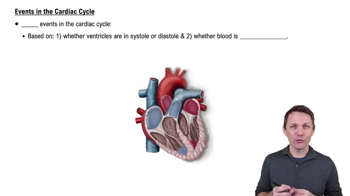
Cardiac Cycle

The cardiac cycle refers to the sequence of events that occur during one heartbeat, including systole (contraction) and diastole (relaxation) of the heart chambers. During systole, the heart pumps blood out, and during diastole, the heart fills with blood. Understanding this cycle is crucial for analyzing blood flow and perfusion to the heart.
Video consigliato:
9:44
Events in the Cardiac Cycle

Tissue Perfusion

Tissue perfusion is the process of delivering blood to the capillary beds in tissues, which is essential for providing oxygen and nutrients while removing waste products. Perfusion varies throughout the cardiac cycle, with different dynamics during systole and diastole, impacting how effectively the heart and other organs receive blood.
Video consigliato:
Percorso guidato
4:55
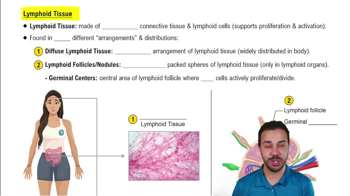
Lymphoid Tissue

Coronary Blood Flow

Coronary blood flow refers to the circulation of blood in the blood vessels that supply the heart muscle (myocardium). It is primarily influenced by the phases of the cardiac cycle, with increased flow during diastole when the heart muscle is relaxed and the coronary arteries are not compressed, making the original statement about perfusion during systole and diastole false.
Video consigliato:
Percorso guidato
6:40
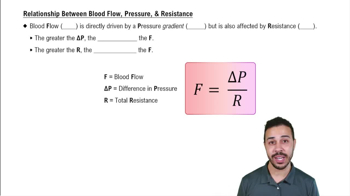
Relationship Between Blood Flow, Pressure, & Resistance
Pratica correlata
Domanda del libro di testo

An increase in preload causes a/an ________ in stroke volume in accordance with the ________ law. An increase in afterload causes a/an ________ in stroke volume. An increase in contractility causes a/an ________ in stroke volume.

1031
views
Domanda del libro di testo

Mark the following statements as true or false. If a statement is false, correct it to make a true statement.

The amount of blood in the ventricles at the end of the ventricular filling phase is the end-systolic volume.

773
views
Domanda del libro di testo

Mark the following statements as true or false. If a statement is false, correct it to make a true statement.

The ventricular ejection phase generally correlates with the S-T segment and the T wave on the ECG.

878
views
Domanda del libro di testo

The first heart sound is called ________ and it is caused by the closing of the ________ valves. It occurs at the beginning of the ________ phase of the cardiac cycle. The second heart sound is called ________ and it is caused by the closing of the ________ valves. It occurs at the beginning of the ________ phase of the cardiac cycle.

1169
views
Domanda del libro di testo

Cardiac output is equal to:

a. End-diastolic volume minus end-systolic volume.

b. Heart rate multiplied by stroke volume.

c. Stroke volume divided by end-diastolic volume.

d. Heart rate multiplied by preload.

904
views
Domanda del libro di testo

Which chamber generates the highest pressure during systole?

a. Right atrium

b. Right ventricle

c. Left atrium

d. Left ventricle

1350
views