Ch. 18 The Cardiovascular System II: The Blood Vessels
Amerman - Human Anatomy & Physiology 2nd Edition
Amerman2nd EditionHuman Anatomy & PhysiologyISBN: 9780136873822Non è quello che usi tu?Cambia libro di testo
Capitolo 18, Problema 9b

Mark the following statements as true or false. If a statement is false, correct it to make a true statement.
A sudden increase or decrease in blood pressure triggers the baroreceptor reflex, which is mediated by the medulla and the autonomic nervous system.

Guida verificata passo dopo passo
1
Step 1: Understand the baroreceptor reflex. The baroreceptor reflex is a mechanism that helps regulate blood pressure by detecting changes in the stretch of blood vessel walls, primarily in the carotid arteries and aortic arch. These stretch receptors send signals to the medulla oblongata in the brainstem.
Step 2: Analyze the role of the medulla oblongata. The medulla oblongata processes the signals from the baroreceptors and activates the autonomic nervous system to adjust heart rate, blood vessel diameter, and cardiac output to stabilize blood pressure.
Step 3: Evaluate the statement provided. The statement mentions that a sudden increase or decrease in blood pressure triggers the baroreceptor reflex, which is mediated by the medulla and the autonomic nervous system. This is accurate based on the physiological function of the baroreceptor reflex.
Step 4: Confirm the truthfulness of the statement. Since the statement correctly describes the baroreceptor reflex and its mediation by the medulla and autonomic nervous system, it is true.
Step 5: If the statement were false, the correction would involve clarifying the role of the baroreceptor reflex, medulla oblongata, and autonomic nervous system in blood pressure regulation. However, no correction is needed in this case.

Risposta video verificata per un problema simile:

Questa soluzione video è stata consigliata dai nostri tutor come utile per risolvere questo problema.
Durata del video:
3m

Concetti chiave

Ecco i concetti essenziali che devi comprendere per rispondere correttamente alla domanda.

Baroreceptor Reflex

The baroreceptor reflex is a physiological mechanism that helps regulate blood pressure. It involves specialized sensors called baroreceptors, located primarily in the carotid arteries and aorta, which detect changes in blood pressure. When blood pressure rises or falls, these receptors send signals to the central nervous system, prompting adjustments in heart rate and blood vessel diameter to maintain stable blood pressure.
Video consigliato:
3:37
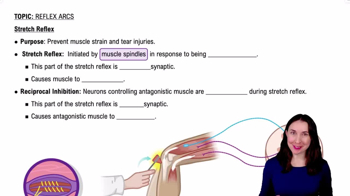
Stretch Reflex

Role of the Medulla Oblongata

The medulla oblongata is a critical part of the brainstem that plays a key role in autonomic functions, including the regulation of heart rate and blood pressure. It processes signals from baroreceptors and coordinates responses through the autonomic nervous system, influencing both sympathetic and parasympathetic pathways to restore homeostasis in blood pressure levels.
Video consigliato:
4:04
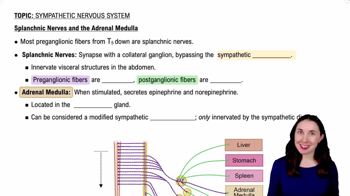
Splanchnic Nerves and the Adrenal Medulla

Autonomic Nervous System

The autonomic nervous system (ANS) is a component of the peripheral nervous system that controls involuntary bodily functions, such as heart rate, digestion, and respiratory rate. It is divided into the sympathetic and parasympathetic systems, which work together to maintain balance in the body. In the context of blood pressure regulation, the sympathetic system typically increases heart rate and constricts blood vessels, while the parasympathetic system has the opposite effect.
Video consigliato:
1:50
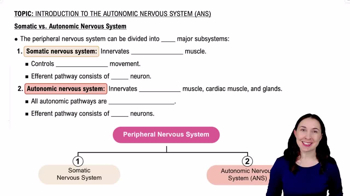
Somatic vs. Autonomic Nervous System