Ch. 2 The Chemistry of Life
Amerman - Human Anatomy & Physiology 2nd Edition
Amerman2nd EditionHuman Anatomy & PhysiologyISBN: 9780136873822Non è quello che usi tu?Cambia libro di testo
Capitolo 2, Problema 5

Identify each of the following molecules or compounds as ionic, polar covalent, or nonpolar covalent.
a. H2O _________
b. LiI _________
c. C10H22 _________
d. N2 _________
e. MgBr2 _________
f. H2S _________

Guida verificata passo dopo passo
1
Step 1: Understand the types of bonds. Ionic bonds occur between metals and nonmetals where electrons are transferred. Covalent bonds occur between nonmetals where electrons are shared. Polar covalent bonds involve unequal sharing of electrons, while nonpolar covalent bonds involve equal sharing of electrons.
Step 2: Analyze the molecule H2O. Oxygen is more electronegative than hydrogen, causing an unequal sharing of electrons. This makes H2O a polar covalent molecule.
Step 3: Analyze the compound LiI. Lithium is a metal and iodine is a nonmetal. Electrons are transferred from lithium to iodine, forming an ionic bond.
Step 4: Analyze the molecule C10H22. Carbon and hydrogen have similar electronegativities, leading to equal sharing of electrons. This makes C10H22 a nonpolar covalent molecule.
Step 5: Repeat the analysis for N2, MgBr2, and H2S. N2 involves equal sharing of electrons between two nitrogen atoms, making it nonpolar covalent. MgBr2 involves a metal (magnesium) and a nonmetal (bromine), forming an ionic bond. H2S involves sulfur being more electronegative than hydrogen, leading to unequal sharing of electrons, making it polar covalent.

Risposta video verificata per un problema simile:

Questa soluzione video è stata consigliata dai nostri tutor come utile per risolvere questo problema.

Concetti chiave

Ecco i concetti essenziali che devi comprendere per rispondere correttamente alla domanda.

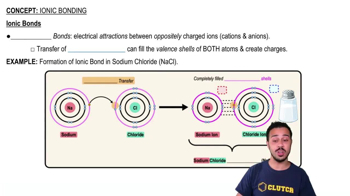
Ionic Bonds

Ionic bonds form when electrons are transferred from one atom to another, resulting in the creation of charged ions. These oppositely charged ions attract each other, creating a strong electrostatic force. Ionic compounds typically consist of a metal and a nonmetal, and they tend to have high melting and boiling points, as well as being soluble in water.
Video consigliato:

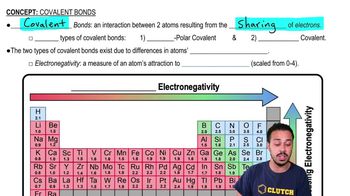
Covalent Bonds

Covalent bonds occur when two atoms share one or more pairs of electrons. This sharing can be equal or unequal, leading to different types of covalent bonds: nonpolar covalent bonds (equal sharing) and polar covalent bonds (unequal sharing). The polarity of a molecule affects its physical properties, such as solubility and boiling point.
Video consigliato:

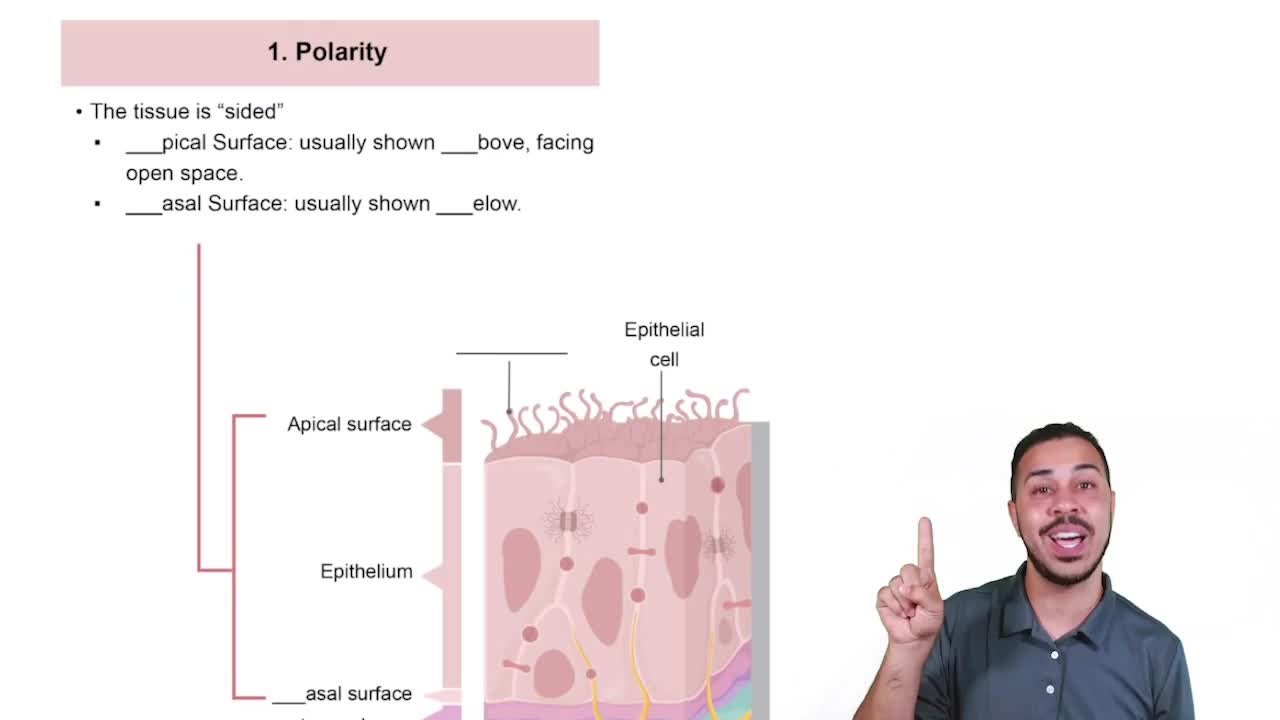
Molecular Polarity

Molecular polarity is determined by the distribution of electrical charge across a molecule. A molecule is polar if it has a significant difference in electronegativity between its atoms, leading to a dipole moment. Nonpolar molecules have an even distribution of charge, while polar molecules have regions of partial positive and negative charge, influencing their interactions with other substances.
Video consigliato:
04:15
Characteristic 1: Polarity