Considering that water is a main component of the juices in the stomach and intestines, explain why digestion of lipids is more complicated than digestion of carbohydrates and proteins.
Ch. 2 The Chemistry of Life
Amerman2nd EditionHuman Anatomy & PhysiologyISBN: 9780136873822Non è quello che usi tu?Cambia libro di testo
Capitolo 2, Problema L2.1
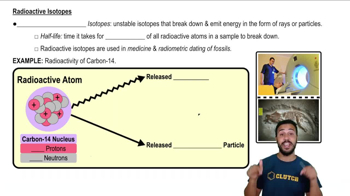
In certain types of radioactive decay, the isotope releases a particle called an alpha particle, which contains two protons and two neutrons. When this happens, is the product still the same element? Why or why not?
Guida verificata passo dopo passo1
Step 1: Begin by understanding what an alpha particle is. An alpha particle consists of two protons and two neutrons, which means it has a mass number of 4 and a charge of +2.
Step 2: Recognize that when an isotope undergoes alpha decay, it loses an alpha particle. This results in a decrease in the atomic number (number of protons) by 2 and the mass number (total number of protons and neutrons) by 4.
Step 3: Recall that the atomic number determines the identity of an element. If the atomic number changes, the element itself changes because the number of protons defines the element.
Step 4: Use the periodic table to confirm that a decrease in atomic number by 2 means the element shifts to a different position on the table, corresponding to a new element.
Step 5: Conclude that the product of alpha decay is not the same element as the original isotope because the loss of two protons changes the atomic number, thereby changing the element's identity.

Risposta video verificata per un problema simile:
Questa soluzione video è stata consigliata dai nostri tutor come utile per risolvere questo problema.
Concetti chiave
Ecco i concetti essenziali che devi comprendere per rispondere correttamente alla domanda.
Radioactive Decay
Radioactive decay is a process by which unstable atomic nuclei lose energy by emitting radiation. This can occur in various forms, including alpha decay, where an alpha particle (composed of two protons and two neutrons) is released. This process transforms the original element into a different element due to the loss of protons.
Video consigliato:
Percorso guidato
Radioactive Isotopes
Alpha Particle
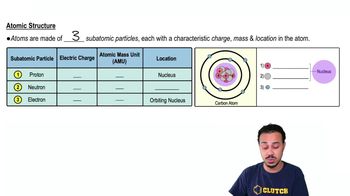
An alpha particle is a type of ionizing radiation consisting of two protons and two neutrons, essentially a helium nucleus. When an atom undergoes alpha decay, it emits this particle, resulting in a decrease in the atomic number of the original element by two. This change in atomic number is crucial for determining whether the product is the same element.
Video consigliato:
Percorso guidato
Atomic Structure
Element Identity
The identity of an element is defined by its atomic number, which is the number of protons in its nucleus. When an element emits an alpha particle, it loses two protons, thus changing its atomic number and transforming it into a different element. Therefore, the product of alpha decay is not the same element as the original.
Video consigliato:
Percorso guidato
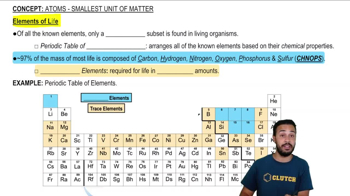
Elements of Life
Pratica correlata
Domanda del libro di testo
675
views
Domanda del libro di testo
Mark the following statements as true or false. If a statement is false, correct it to make a true statement.
Every element has a characteristic number of protons, which is called the element's mass number.
778
views
1
rank
Domanda del libro di testo
Isotopes are atoms with the same ______ number but different ______ numbers.
961
views
Domanda del libro di testo
Which of the following statements correctly describes a solution?
a. In a solution the solute is chemically dissolved by the solvent.
b. Solutions involve large particles suspended in another component.
c. The particles in a solution will settle out if left to sit.
d. The amount of solute in a solution is expressed as the solution's concentration.
704
views
Domanda del libro di testo
Explain why monosaccharides are polar and fatty acids are nonpolar even though they both contain the same atoms.
1243
views