Ch. 20 The Lymphatic System and Immunity
Amerman - Human Anatomy & Physiology 2nd Edition
Amerman2nd EditionHuman Anatomy & PhysiologyISBN: 9780136873822Non è quello che usi tu?Cambia libro di testo
Capitolo 20, Problema 6

Which of the following does not describe the relationship between the lymphatic and immune systems?
a. Lymphoid organs and tissues house cells of the immune system.
b. Lymphoid organs and tissues trap pathogens for the immune system.
c. Lymphoid organs activate cells of the immune system.
d. Lymphoid organs and tissues create the surface barriers of the immune system.

Guida verificata passo dopo passo
1
Step 1: Begin by understanding the roles of the lymphatic and immune systems. The lymphatic system is responsible for transporting lymph, a fluid containing infection-fighting white blood cells, while the immune system defends the body against pathogens.
Step 2: Review the functions of lymphoid organs and tissues. These include the lymph nodes, spleen, thymus, and tonsils, which house immune cells, trap pathogens, and activate immune responses.
Step 3: Analyze each option provided in the question. For example, options a, b, and c describe functions that align with the relationship between the lymphatic and immune systems.
Step 4: Evaluate option d. Surface barriers, such as skin and mucous membranes, are part of the innate immune system and are not created by lymphoid organs or tissues. This distinguishes option d from the other choices.
Step 5: Conclude that the correct answer is the option that does not describe the relationship between the lymphatic and immune systems, based on the analysis of the functions of lymphoid organs and tissues.

Risposta video verificata per un problema simile:

Questa soluzione video è stata consigliata dai nostri tutor come utile per risolvere questo problema.

Concetti chiave

Ecco i concetti essenziali che devi comprendere per rispondere correttamente alla domanda.

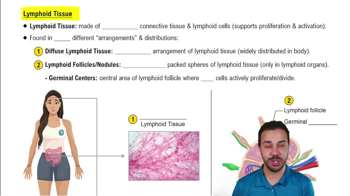
Lymphoid Organs and Tissues

Lymphoid organs and tissues, such as the spleen, thymus, and lymph nodes, are crucial components of the immune system. They serve as sites for the production and maturation of lymphocytes, which are essential white blood cells involved in immune responses. These organs also facilitate the trapping and processing of pathogens, thereby playing a vital role in the body's defense mechanisms.
Video consigliato:
Percorso guidato
4:55
Lymphoid Tissue

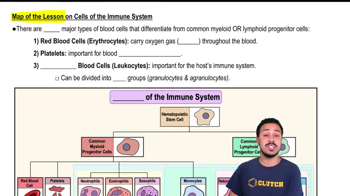
Immune System Function

The immune system is responsible for identifying and eliminating pathogens, such as bacteria and viruses, that invade the body. It comprises various cells, including lymphocytes, macrophages, and antibodies, which work together to recognize and destroy foreign invaders. Understanding how lymphoid organs contribute to this process is essential for grasping the overall function of the immune system.
Video consigliato:
Percorso guidato
6:08
Map of the Lesson on Cells of the Immune System

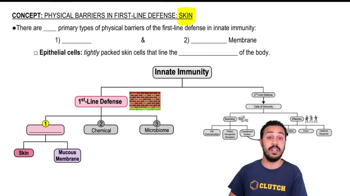
Surface Barriers of the Immune System

Surface barriers, such as the skin and mucous membranes, are the first line of defense in the immune system. They act as physical and chemical barriers to prevent pathogens from entering the body. Unlike lymphoid organs, which are involved in the immune response after pathogens have breached these barriers, surface barriers are not directly involved in the activation or housing of immune cells.
Video consigliato:
Percorso guidato
1:28
Physical Barriers
Pratica correlata
Domanda del libro di testo

Mark the following statements as true or false. If a statement is false, correct it to make a true statement.

NK cells are cytotoxic cells that lyse and kill cancer cells and cells infected with certain viruses.

1046
views

Domanda del libro di testo

Nonspecific immunity is also known as_____. Specific immunity is also known as_____. Specific immunity has the capacity for immunological ______ .

875
views
Domanda del libro di testo

Your friend tests her snake-wrangling skills on an eastern diamondback rattlesnake, and is bitten and envenomated (injected with the snake's venom). In the emergency department, doctors administer the antivenin CroFab, which contains antibodies to the toxins in snake venom. Is this an example of active or passive immunity? Will this confer any lasting protection to your friend?

1111
views
Domanda del libro di testo

Mark the following statements as true or false. If a statement is false, correct it to make a true statement.

Surface barriers contain substances in their secretions that kill pathogens and deter their growth.

773
views
Domanda del libro di testo

Which of the following make up the body's first line of defense?

a. Surface barriers

b. Cells and proteins of adaptive immunity

c. Cells and proteins of innate immunity

d. All of the above

801
views
Domanda del libro di testo

Mark the following statements as true or false. If a statement is false, correct it to make a true statement.

Phagocytic cells of innate immunity include NK cells and basophils.

1080
views