Ch. 21 The Respiratory System
Amerman - Human Anatomy & Physiology 2nd Edition
Amerman2nd EditionHuman Anatomy & PhysiologyISBN: 9780136873822Non è quello che usi tu?Cambia libro di testo
Capitolo 21, Problema 10d

Mark the following statements as true or false. If a statement is false, correct it to make a true statement.
The vital capacity is the total amount of exchangeable air.

Guida verificata passo dopo passo
1
Step 1: Understand the term 'vital capacity' in the context of respiratory physiology. Vital capacity refers to the maximum amount of air a person can exhale after a maximum inhalation. It is the sum of three lung volumes: inspiratory reserve volume (IRV), tidal volume (TV), and expiratory reserve volume (ERV).
Step 2: Compare the definition of vital capacity with the statement provided. The statement claims that vital capacity is the total amount of exchangeable air.
Step 3: Clarify the term 'total amount of exchangeable air.' Exchangeable air refers to the air that participates in gas exchange, which includes vital capacity but excludes residual volume (RV). Residual volume is the air remaining in the lungs after a forced exhalation and is not exchangeable.
Step 4: Determine whether the statement is true or false based on the comparison. Since vital capacity does not include residual volume, it is not the total amount of exchangeable air; the statement is false.
Step 5: Correct the false statement. A true statement would be: 'The vital capacity is the maximum amount of air a person can exhale after a maximum inhalation, and it is the sum of inspiratory reserve volume, tidal volume, and expiratory reserve volume.'

Risposta video verificata per un problema simile:

Questa soluzione video è stata consigliata dai nostri tutor come utile per risolvere questo problema.

Concetti chiave

Ecco i concetti essenziali che devi comprendere per rispondere correttamente alla domanda.

Vital Capacity

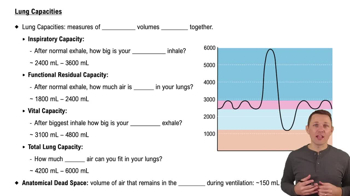
Vital capacity is the maximum amount of air a person can exhale after a maximum inhalation. It is a key measure in pulmonary function tests and includes the tidal volume, inspiratory reserve volume, and expiratory reserve volume, but does not encompass all the air in the lungs.
Video consigliato:
6:38
Lung Capacities

Total Lung Capacity

Total lung capacity is the total volume of air the lungs can hold, which includes vital capacity plus the residual volume (the air remaining in the lungs after a forced exhalation). This concept is essential for understanding lung function and respiratory health.
Video consigliato:
6:38
Lung Capacities

Exchangeable Air

Exchangeable air refers to the volume of air that can be inhaled and exhaled during normal breathing and forced breathing. It is crucial for gas exchange in the lungs, and understanding this helps clarify the distinction between vital capacity and total lung capacity.
Video consigliato:
03:59
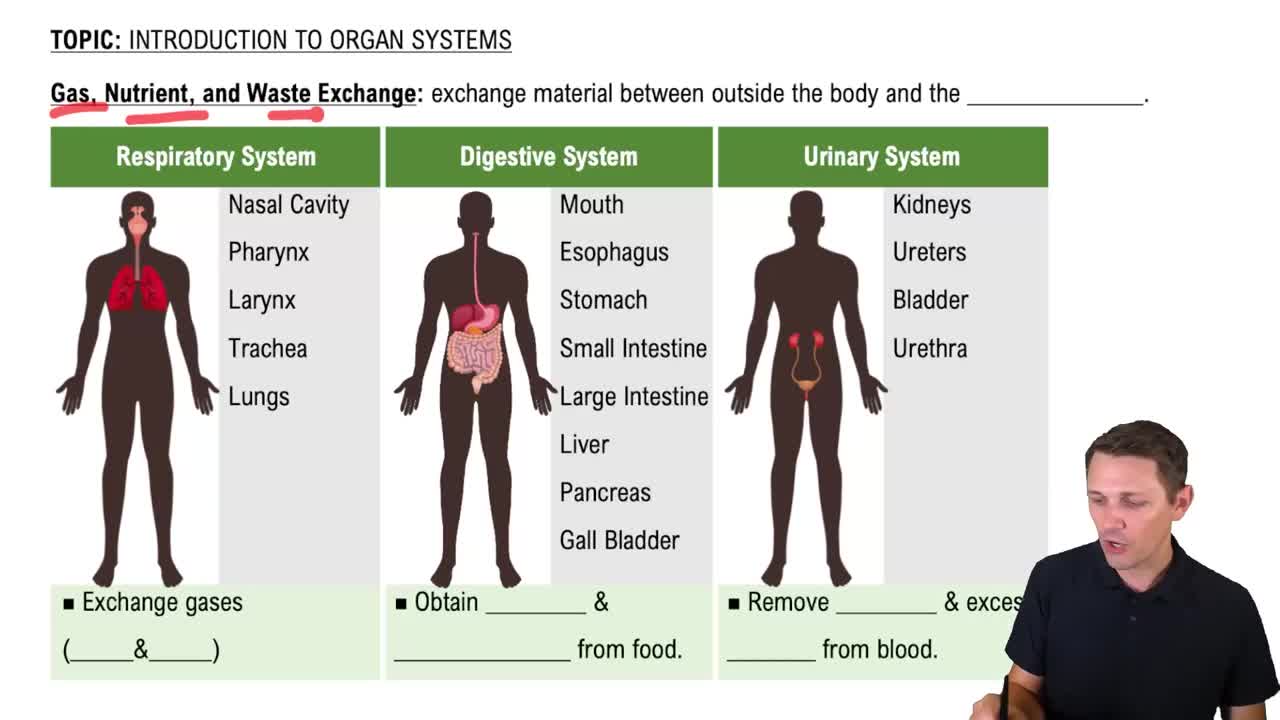
Gas, Nutrient and Waste Exchange