Ch. 24 The Urinary System
Amerman - Human Anatomy & Physiology 2nd Edition
Amerman2nd EditionHuman Anatomy & PhysiologyISBN: 9780136873822Non è quello che usi tu?Cambia libro di testo
Capitolo 24, Problema L2.4

Why must the kidneys establish a concentration gradient in the interstitial fluid of the renal medulla in order to produce concentrated urine?

Guida verificata passo dopo passo
1
Understand the role of the kidneys in maintaining homeostasis: The kidneys regulate water and electrolyte balance in the body by filtering blood and producing urine. Producing concentrated urine is essential to conserve water, especially in conditions of dehydration.
Recognize the importance of the renal medulla: The renal medulla is the innermost part of the kidney, and its interstitial fluid must have a high concentration of solutes (such as sodium and urea) to create a concentration gradient. This gradient is critical for water reabsorption.
Explain the countercurrent multiplier system: The nephron's loop of Henle, particularly the descending and ascending limbs, plays a key role in establishing the concentration gradient. The descending limb is permeable to water but not solutes, while the ascending limb actively transports solutes (like Na⁺ and Cl⁻) out but is impermeable to water. This creates a progressively higher solute concentration in the medulla.
Describe how the gradient facilitates water reabsorption: When filtrate reaches the collecting ducts, the high solute concentration in the medulla's interstitial fluid draws water out of the ducts via osmosis, provided antidiuretic hormone (ADH) is present to make the ducts permeable to water. This process concentrates the urine.
Summarize the necessity of the gradient: Without the concentration gradient in the renal medulla, the kidneys would not be able to reabsorb water efficiently, leading to the production of dilute urine and potential dehydration. The gradient ensures the body can conserve water when needed.

Risposta video verificata per un problema simile:

Questa soluzione video è stata consigliata dai nostri tutor come utile per risolvere questo problema.

Concetti chiave

Ecco i concetti essenziali che devi comprendere per rispondere correttamente alla domanda.

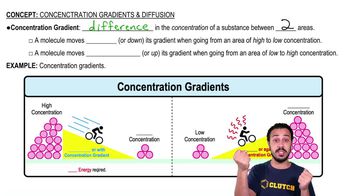
Concentration Gradient

A concentration gradient refers to the difference in the concentration of solutes in a solution between two areas. In the kidneys, a concentration gradient is established in the renal medulla, allowing for the movement of water and solutes. This gradient is crucial for the reabsorption of water, enabling the kidneys to concentrate urine and maintain fluid balance in the body.
Video consigliato:
Percorso guidato
04:51
Concentration Gradients and Diffusion

Countercurrent Multiplication

Countercurrent multiplication is a mechanism in the nephron that enhances the concentration gradient in the renal medulla. It involves the interaction between the descending and ascending limbs of the loop of Henle, where the descending limb is permeable to water but not to solutes, while the ascending limb is permeable to solutes but not to water. This process helps to create a high osmolarity in the medulla, facilitating the reabsorption of water from the collecting ducts.
Video consigliato:
02:41
Structural Naming of Epithelial Tissue Example 1

Antidiuretic Hormone (ADH)

Antidiuretic hormone (ADH), also known as vasopressin, plays a critical role in regulating water balance in the body. When the body is dehydrated, ADH is released, prompting the kidneys to reabsorb more water from the urine back into the bloodstream. This action relies on the established concentration gradient in the renal medulla, allowing for the production of concentrated urine and the conservation of water.
Video consigliato:
13:06
Review of Major Hormones
Pratica correlata
Domanda del libro di testo

Predict the effects the following scenarios would have on glomerular filtration:

c. Having high arterial blood pressure (hypertension)

700
views

Domanda del libro di testo

What might it mean if you found a high concentration of urobilinogen in your patient's urine? (Hint: Consider the source of urobilinogen.)

871
views
Domanda del libro di testo

Mr. Wu is a patient with kidney disease who presents to your clinic for monitoring. You notice on his chart that his GFR was estimated through inulin administration to be about 35 ml/min. What does this tell you about the health of his kidneys? Mr. Wu is taking a medication that is normally excreted from the body in the urine. You order blood work and find that the concentration of this medication in his plasma is much higher than normal. How does his decreased GFR explain the elevated level of medication in his plasma?

752
views
Domanda del libro di testo

Drugs that treat hypertension, or high blood pressure, have the following actions. Discuss the specific effect that each drug will have on the kidneys.

c. Blocking the Na+/Cl−/2K+ transport pumps in the thick ascending limb of the nephron loop

478
views
Domanda del libro di testo

Trace the pathway taken by a molecule of urea through the kidney from the glomerulus to the renal pelvis if the urea is recycled.

1057
views
Domanda del libro di testo

Explain why urinary tract infections, which involve the urethra and urinary bladder, are much more common in females than males.

889
views