
Ch. 25 Fluid, Electrolyte, and Acid-Base Homeostasis
Amerman - Human Anatomy & Physiology 2nd Edition
Amerman2nd EditionHuman Anatomy & PhysiologyISBN: 9780136873822Non è quello che usi tu?Cambia libro di testo
Capitolo 25, Problema L2.1

Your friend argues that all water conducts electricity, regardless of what it contains. You prepare three liquids to test this hypothesis: one with deionized water (with no solutes, only water molecules), one with 5% glucose in water, and one with 5% sodium chloride in water. Which of these solutions, if any, will conduct an electric current? Explain.

Guida verificata passo dopo passo
1
Understand the concept of electrical conductivity in liquids: Electrical conductivity depends on the presence of charged particles (ions) in a solution. Pure water (deionized water) has very few ions and is a poor conductor of electricity. Solutions with dissolved ionic compounds, like sodium chloride, can conduct electricity because they dissociate into ions.
Analyze the composition of deionized water: Deionized water contains only water molecules (H₂O) and lacks dissolved ions. Since there are no free ions to carry an electric current, deionized water does not conduct electricity effectively.
Examine the glucose solution: Glucose (C₆H₁₂O₆) is a covalent compound that dissolves in water but does not dissociate into ions. Therefore, a 5% glucose solution will not conduct electricity because it lacks free ions.
Evaluate the sodium chloride solution: Sodium chloride (NaCl) is an ionic compound. When dissolved in water, it dissociates into sodium ions (Na⁺) and chloride ions (Cl⁻). These ions are free to move and carry an electric current, making the 5% sodium chloride solution a good conductor of electricity.
Conclude the hypothesis test: Based on the analysis, only the sodium chloride solution will conduct electricity. Deionized water and the glucose solution will not conduct electricity because they lack free ions necessary for electrical conductivity.

Risposta video verificata per un problema simile:

Questa soluzione video è stata consigliata dai nostri tutor come utile per risolvere questo problema.

Concetti chiave

Ecco i concetti essenziali che devi comprendere per rispondere correttamente alla domanda.

Electrical Conductivity

Electrical conductivity refers to the ability of a substance to conduct electric current. This property is influenced by the presence of charged particles, such as ions, which can move freely within the solution. Pure water has very low conductivity because it lacks significant ions, while solutions containing electrolytes, like sodium chloride, can conduct electricity due to the dissociation of the salt into ions.
Video consigliato:
3:42
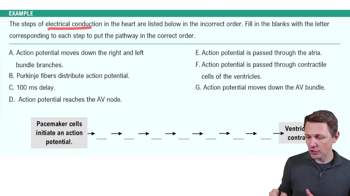
Electrical Conduction System of the Heart Example 2

Electrolytes

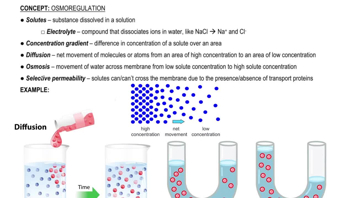
Electrolytes are substances that dissociate into ions when dissolved in water, allowing the solution to conduct electricity. Common examples include salts, acids, and bases. In the context of the question, sodium chloride (NaCl) is a strong electrolyte that fully dissociates into sodium (Na+) and chloride (Cl-) ions, while glucose is a non-electrolyte that does not dissociate into ions, thus affecting the conductivity of the solution.
Video consigliato:
Percorso guidato
07:59
Osmosis and Osmolarity

Deionized Water

Deionized water is water that has had its mineral ions removed, such as sodium, calcium, iron, and copper. This process results in a liquid that is very poor at conducting electricity because it lacks the ions necessary for current flow. In the experiment, deionized water will not conduct electricity, contrasting with the sodium chloride solution, which will demonstrate significant conductivity due to its ionic content.
Video consigliato:
Percorso guidato
01:54
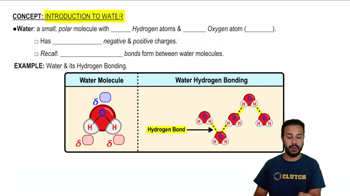
Introduction to Water