Ch. 27 Development and Heredity
Amerman - Human Anatomy & Physiology 2nd Edition
Amerman2nd EditionHuman Anatomy & PhysiologyISBN: 9780136873822Non è quello che usi tu?Cambia libro di testo
Capitolo 27, Problema L2.2

Certain diseases are transmitted via mitochondrial DNA. Which cell types do you think would be most affected by such diseases, and why?

Guida verificata passo dopo passo
1
Understand the role of mitochondria in the cell: Mitochondria are responsible for producing energy in the form of ATP through cellular respiration. They are especially important in cells with high energy demands.
Recognize that mitochondrial DNA is inherited maternally and encodes essential proteins for mitochondrial function. Mutations in mitochondrial DNA can impair energy production.
Identify cell types with high energy demands: Cells such as muscle cells (especially cardiac and skeletal muscle), neurons, and sensory cells (e.g., retinal cells) require large amounts of ATP to function properly.
Explain why these cells are most affected: Since these cell types rely heavily on mitochondrial energy production, any dysfunction in mitochondrial DNA can lead to significant impairments in their function, resulting in symptoms like muscle weakness, neurological issues, or vision problems.
Relate this to diseases: Examples of mitochondrial DNA-related diseases include mitochondrial myopathies, Leber's hereditary optic neuropathy, and MELAS syndrome, which primarily affect high-energy-demand tissues.

Risposta video verificata per un problema simile:

Questa soluzione video è stata consigliata dai nostri tutor come utile per risolvere questo problema.

Concetti chiave

Ecco i concetti essenziali che devi comprendere per rispondere correttamente alla domanda.

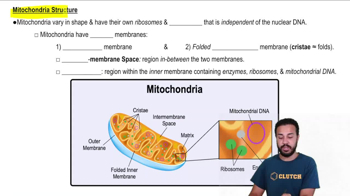
Mitochondrial DNA (mtDNA)

Mitochondrial DNA is a small circular DNA molecule found in mitochondria, the energy-producing organelles in cells. Unlike nuclear DNA, mtDNA is inherited maternally and encodes essential proteins for mitochondrial function. Mutations in mtDNA can lead to various mitochondrial diseases, affecting energy metabolism and cellular function.
Video consigliato:
Percorso guidato
04:45
Mitochondria Structure

Cell Types Affected by Mitochondrial Diseases

Cell types that rely heavily on energy production, such as muscle cells, neurons, and heart cells, are most affected by mitochondrial diseases. These cells have high energy demands, and dysfunction in mitochondrial function can lead to severe consequences, including muscle weakness, neurological disorders, and cardiac issues.
Video consigliato:
Percorso guidato
10:15
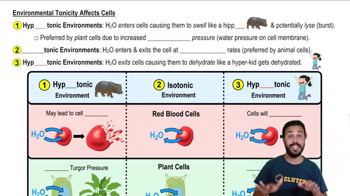
Environmental Tonicity Affects Cells

Inheritance Patterns of Mitochondrial Diseases

Mitochondrial diseases follow a unique inheritance pattern, as they are passed down from mother to offspring through the mitochondria in the egg cell. This maternal inheritance means that all children of an affected mother may inherit the condition, while children of affected fathers typically do not. Understanding this pattern is crucial for assessing risk and genetic counseling.
Video consigliato:
Percorso guidato
01:02
Autosomal Inheritance