Ch. 3 The Cell
Amerman - Human Anatomy & Physiology 2nd Edition
Amerman2nd EditionHuman Anatomy & PhysiologyISBN: 9780136873822Non è quello che usi tu?Cambia libro di testo
Capitolo 3, Problema L3A

A patient is admitted to the hospital and given intravenous (IV) fluids. Four hours later, the patient complains that his mouth and eyes feel dry. You notice that he displays signs of dehydration, and when you check his IV, you see that he was given the wrong kind of fluids. Were these fluids likely hypotonic, isotonic, or hypertonic? Explain.

Guida verificata passo dopo passo
1
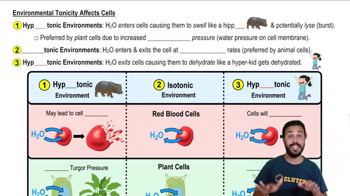
Step 1: Understand the definitions of hypotonic, isotonic, and hypertonic solutions. Hypotonic solutions have a lower solute concentration than the cells, causing water to move into the cells. Isotonic solutions have the same solute concentration as the cells, maintaining equilibrium. Hypertonic solutions have a higher solute concentration than the cells, causing water to move out of the cells.
Step 2: Analyze the symptoms of the patient. Dry mouth and eyes, along with signs of dehydration, suggest that water has been drawn out of the cells, leading to a loss of intracellular fluid.
Step 3: Relate the symptoms to the type of IV fluid. If water is moving out of the cells, the IV fluid is likely hypertonic, as hypertonic solutions create an osmotic gradient that pulls water out of the cells into the extracellular space.
Step 4: Consider the physiological effects of hypertonic fluids. Hypertonic fluids increase the osmolarity of the extracellular fluid, which can lead to dehydration symptoms as water leaves the cells to balance the solute concentration.
Step 5: Conclude that the IV fluids given to the patient were likely hypertonic, as they caused water to move out of the cells, leading to dehydration symptoms such as dry mouth and eyes.

Risposta video verificata per un problema simile:

Questa soluzione video è stata consigliata dai nostri tutor come utile per risolvere questo problema.

Concetti chiave

Ecco i concetti essenziali che devi comprendere per rispondere correttamente alla domanda.

Fluid Tonicity

Fluid tonicity refers to the concentration of solutes in a solution compared to the concentration of solutes in the blood. It is categorized into three types: hypotonic (lower solute concentration), isotonic (equal solute concentration), and hypertonic (higher solute concentration). Understanding these categories is crucial for determining how IV fluids affect a patient's hydration status.
Video consigliato:
Percorso guidato
10:15
Environmental Tonicity Affects Cells

Dehydration Signs

Dehydration occurs when the body loses more fluids than it takes in, leading to symptoms such as dry mouth, dry eyes, and decreased skin turgor. Recognizing these signs is essential for assessing a patient's fluid status and determining the appropriate interventions, including the type of IV fluids needed.
Video consigliato:
Percorso guidato
04:19
Building & Breaking-Down Polymers

IV Fluid Types

IV fluids are classified based on their tonicity and are used to manage a patient's fluid and electrolyte balance. Hypotonic fluids can exacerbate dehydration symptoms by diluting blood solutes, while isotonic fluids maintain balance, and hypertonic fluids can draw water out of cells. Identifying the type of fluid administered is critical for understanding the patient's current condition.
Video consigliato:
3:33
Serous Cavity and Fluid