
Ch. 5 The Integumentary System
Amerman - Human Anatomy & Physiology 2nd Edition
Amerman2nd EditionHuman Anatomy & PhysiologyISBN: 9780136873822Non è quello che usi tu?Cambia libro di testo
Capitolo 5, Problema 3

Which of the following is not a function of the integument?
a. Protection from mechanical trauma
b. Thermoregulation
c. Protection from acid-base imbalances
d. Vitamin D synthesis

Guida verificata passo dopo passo
1
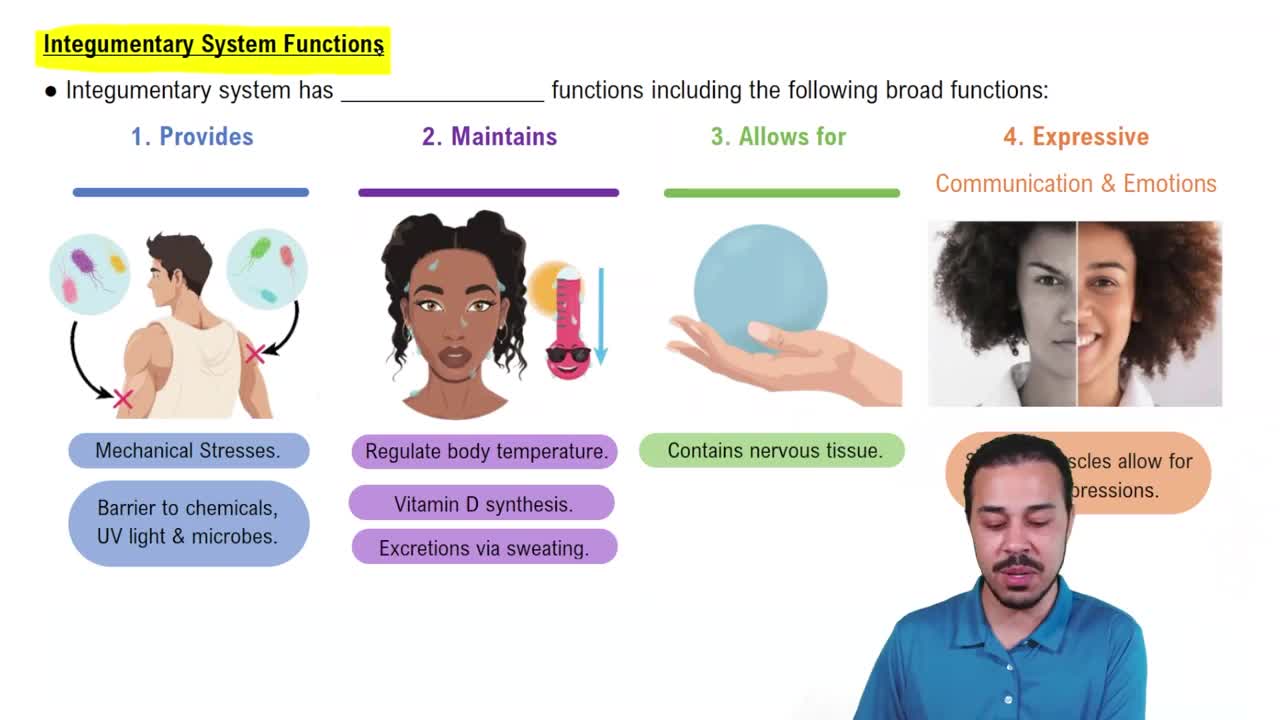
Step 1: Begin by understanding the primary functions of the integumentary system. The integumentary system includes the skin, hair, nails, and associated glands. Its main roles are protection, thermoregulation, sensation, excretion, and vitamin D synthesis.
Step 2: Analyze each option provided in the question. For example, 'Protection from mechanical trauma' is a valid function of the integumentary system, as the skin acts as a physical barrier against external forces.
Step 3: Evaluate 'Thermoregulation.' This is another key function of the integumentary system, as sweat glands and blood vessels in the skin help regulate body temperature.
Step 4: Consider 'Protection from acid-base imbalances.' This is not a primary function of the integumentary system. While the skin provides a barrier, it does not directly regulate acid-base balance, which is primarily managed by the respiratory and renal systems.
Step 5: Review 'Vitamin D synthesis.' The skin plays a crucial role in synthesizing vitamin D when exposed to sunlight, making this a valid function of the integumentary system.

Risposta video verificata per un problema simile:

Questa soluzione video è stata consigliata dai nostri tutor come utile per risolvere questo problema.

Concetti chiave

Ecco i concetti essenziali che devi comprendere per rispondere correttamente alla domanda.

Functions of the Integumentary System

The integumentary system, primarily composed of the skin, serves several vital functions including protection against mechanical trauma, thermoregulation, and synthesis of vitamin D. It acts as a barrier to pathogens and physical injuries, helps regulate body temperature through sweat and blood flow, and facilitates the production of vitamin D when exposed to sunlight.
Video consigliato:
Percorso guidato
03:40
Integumentary System Functions

Thermoregulation

Thermoregulation is the process by which the body maintains its core internal temperature. The integumentary system plays a crucial role in this by adjusting blood flow to the skin and through the evaporation of sweat, which cools the body. This function is essential for maintaining homeostasis and ensuring that enzymatic and metabolic processes occur optimally.
Video consigliato:
Percorso guidato
01:07
Introduction to Thermoregulation

Acid-Base Balance

Acid-base balance refers to the mechanisms the body uses to maintain the pH levels of bodily fluids within a narrow range. While the integumentary system does not directly protect against acid-base imbalances, it does play a role in overall homeostasis. The primary organs involved in regulating acid-base balance are the kidneys and lungs, rather than the skin.
Video consigliato:
Percorso guidato
01:29
Acids and Bases
Pratica correlata
Domanda del libro di testo

Which of the following correctly describes the structure of the skin?

a. It consists of the superficial epidermis, middle dermis, and deep hypodermis.

b. It consists of the superficial epidermis and deep dermis.

c. It consists of the superficial dermis and deep epidermis.

d. It consists of the superficial dermis and deep hypodermis.

1056
views
Domanda del libro di testo

Many antiaging skin creams contain collagen and hyaluronic acid. Manufacturers claim that the collagen and hyaluronic acid applied to the surface of the skin will be absorbed into the dermis, where they will be incorporated into dermal tissue.

What are collagen and hyaluronic acid, and what are their functions?

811
views
1
rank
Domanda del libro di testo

You are working in the emergency department when paramedics rush in with an unconscious patient. You notice that the patient is wearing athletic clothing and the skin on his face and elsewhere on his body is bright red. The paramedics tell you that he was picked up after collapsing during a bike race. What does the color of the patient's skin tell you about the probable cause of his illness? Explain.

752
views
Domanda del libro di testo

Explain why the skin is an organ.

1285
views
1
comments
Domanda del libro di testo

Nguyen comes to your clinic with a mole that has recently changed in appearance. You examine the mole and note that its borders are irregular, it has a deep blue-black color, and the color is unevenly distributed throughout the mole.

What is your immediate concern? Why?

43
views