Ch. 8 Articulations
Amerman - Human Anatomy & Physiology 2nd Edition
Amerman2nd EditionHuman Anatomy & PhysiologyISBN: 9780136873822Non è quello che usi tu?Cambia libro di testo
Capitolo 8, Problema L2.1a

Explain how the structure of each of the following joint types follows its function.
Fibrous joint

Guida verificata passo dopo passo
1
Understand the definition of a fibrous joint: Fibrous joints are connections between bones where the bones are held together by dense connective tissue, primarily collagen fibers. These joints are immovable or allow very limited movement.
Examine the structure of fibrous joints: The dense connective tissue in fibrous joints is designed to provide strength and stability. This structure ensures that the bones remain tightly bound together, which is essential for their function.
Relate the structure to the function: Fibrous joints are typically found in areas where movement is not required, such as the sutures of the skull. The immobility provided by the dense connective tissue protects vital organs (e.g., the brain) and maintains the integrity of the skeletal framework.
Identify examples of fibrous joints: Common examples include sutures in the skull, syndesmoses (e.g., the connection between the tibia and fibula), and gomphoses (e.g., the joint between teeth and their sockets). Each of these examples demonstrates how the structure supports the function of stability and minimal movement.
Summarize the relationship between structure and function: The structure of fibrous joints, with their dense connective tissue and lack of a joint cavity, is perfectly suited for their function of providing stability and protection in areas where movement is unnecessary or undesirable.

Risposta video verificata per un problema simile:

Questa soluzione video è stata consigliata dai nostri tutor come utile per risolvere questo problema.

Concetti chiave

Ecco i concetti essenziali che devi comprendere per rispondere correttamente alla domanda.

Fibrous Joint Structure

Fibrous joints are characterized by dense connective tissue that holds the bones tightly together. This structure provides stability and strength, allowing little to no movement between the bones. Examples include sutures in the skull, where the rigid structure protects the brain and maintains the shape of the head.
Video consigliato:
Percorso guidato
03:36
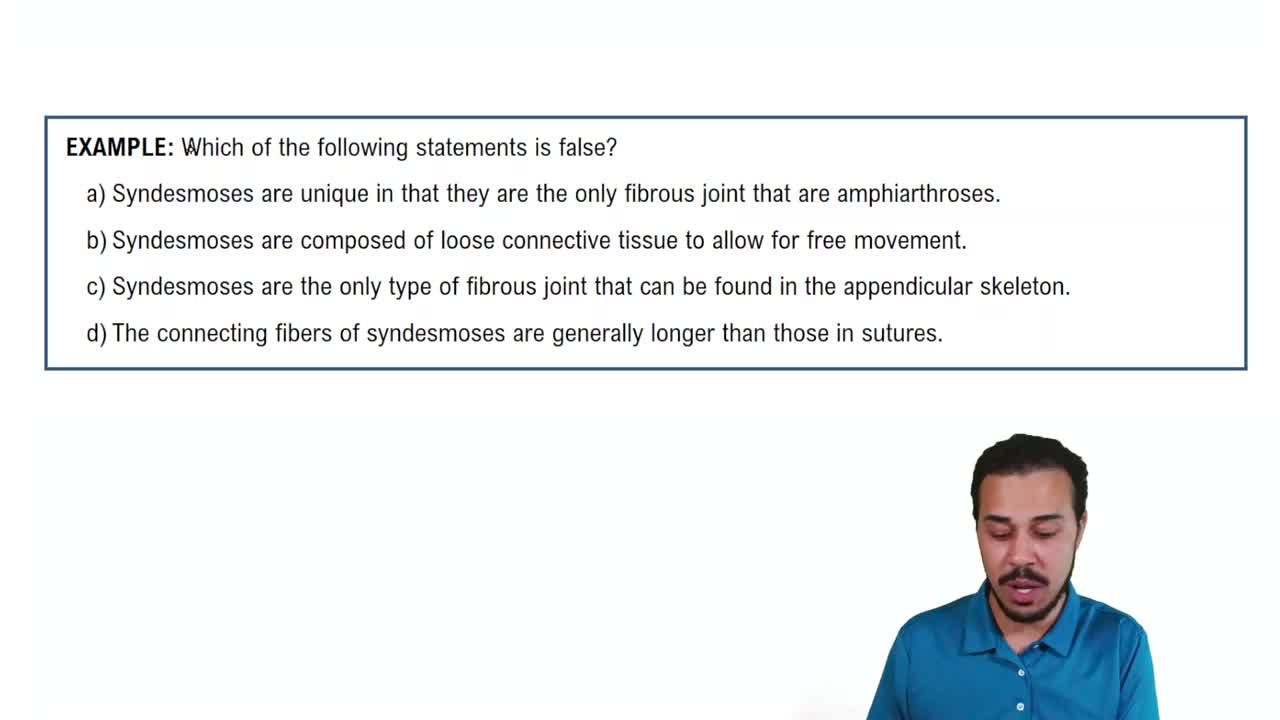
Structural Class: Fibrous Joints Example 3

Function of Fibrous Joints

The primary function of fibrous joints is to provide stability and support to the skeletal system. By limiting movement, these joints protect vital organs and maintain the integrity of the skeletal framework. Their immobility is crucial in areas where strength and protection are more important than flexibility.
Video consigliato:
Percorso guidato
02:41
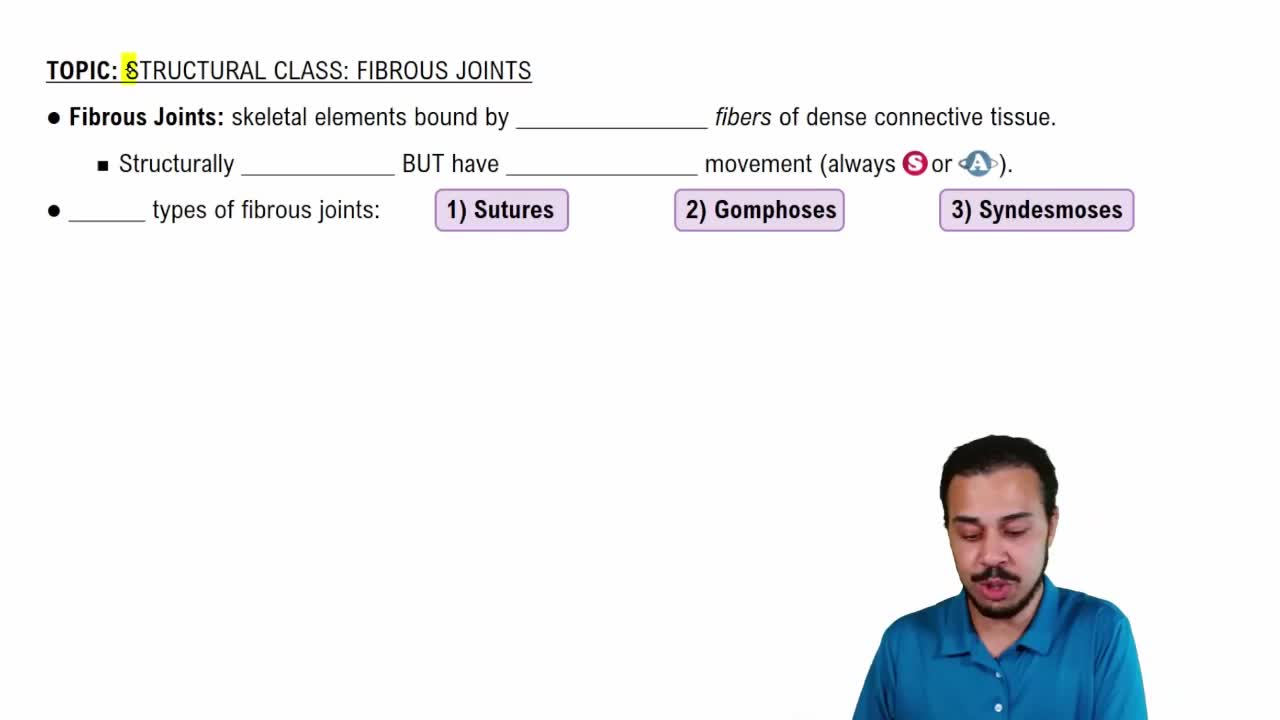
Introduction to Fibrous Joints

Types of Fibrous Joints

There are three main types of fibrous joints: sutures, syndesmoses, and gomphoses. Sutures are found in the skull, syndesmoses allow for slight movement (like the connection between the tibia and fibula), and gomphoses are the peg-and-socket joints found in teeth. Each type is structured to fulfill specific functional roles in the body.
Video consigliato:
Percorso guidato
02:41
Introduction to Fibrous Joints