Ch. 9 The Muscular System
Amerman - Human Anatomy & Physiology 2nd Edition
Amerman2nd EditionHuman Anatomy & PhysiologyISBN: 9780136873822Non è quello che usi tu?Cambia libro di testo
Capitolo 9, Problema 9.1a

Mr. Bell presents with the inability to move certain muscles on one side of his face. You ask him to make various facial expressions and find that on his right side he is unable to purse his lips, pull in his cheeks, elevate his upper lip, and smirk. What muscles is Mr. Bell unable to contract?

Guida verificata passo dopo passo
1
Identify the muscles responsible for the facial expressions Mr. Bell is unable to perform.
For pursing lips, consider the orbicularis oris muscle.
For pulling in cheeks, consider the buccinator muscle.
For elevating the upper lip, consider the levator labii superioris muscle.
For smirking, consider the zygomaticus major muscle.

Risposta video verificata per un problema simile:

Questa soluzione video è stata consigliata dai nostri tutor come utile per risolvere questo problema.

Concetti chiave

Ecco i concetti essenziali che devi comprendere per rispondere correttamente alla domanda.

Facial Muscles

Facial muscles are a group of muscles that control facial expressions. They are primarily innervated by the facial nerve (cranial nerve VII) and include muscles such as the orbicularis oris, buccinator, and zygomaticus. Understanding these muscles is crucial for diagnosing conditions like Bell's palsy, where muscle control is impaired.
Video consigliato:
6:30
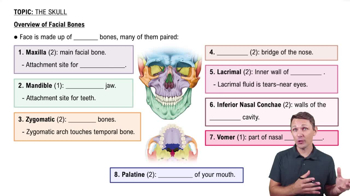
Overview of Facial Bones

Cranial Nerve VII (Facial Nerve)

The facial nerve, or cranial nerve VII, is responsible for the motor control of the facial muscles. It also carries sensory information from the taste buds of the anterior two-thirds of the tongue. Damage to this nerve can lead to weakness or paralysis of facial muscles, as seen in Mr. Bell's case.
Video consigliato:
2:25
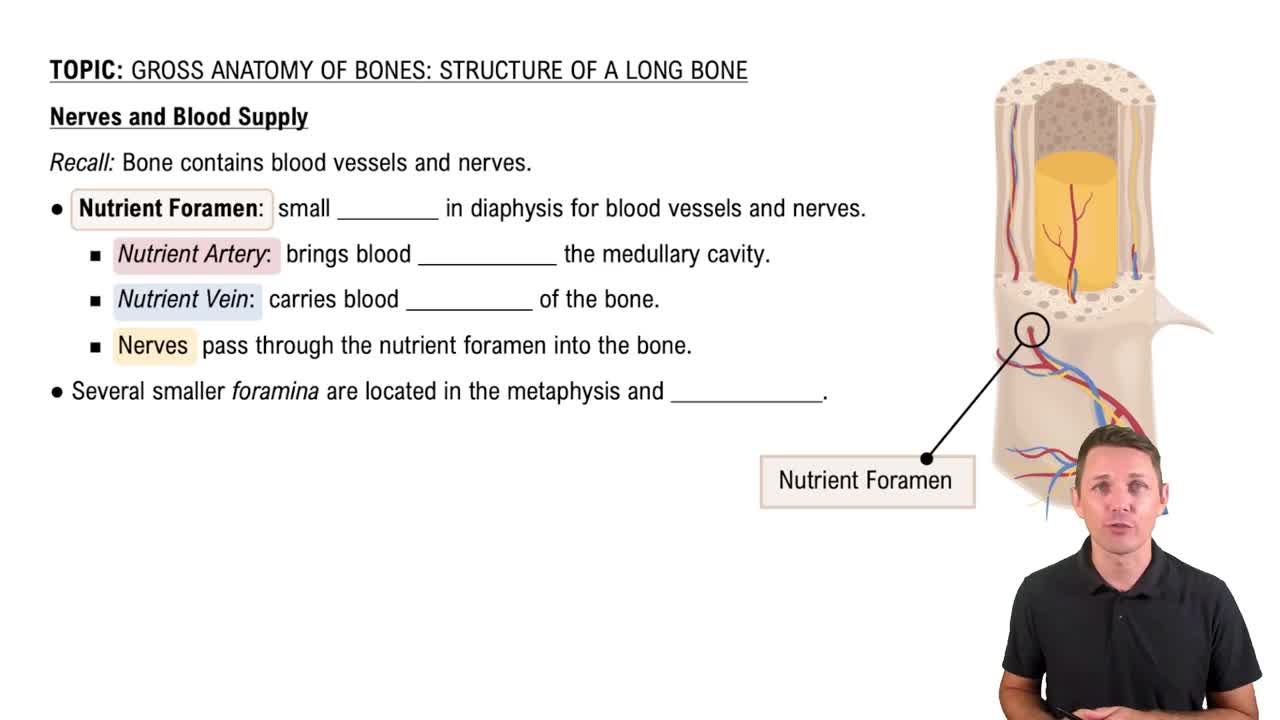
Nerves and Blood Supply

Bell's Palsy

Bell's palsy is a condition characterized by sudden, temporary weakness or paralysis of the muscles on one side of the face. It is often caused by inflammation of the facial nerve and can result in difficulty with facial expressions, as well as other symptoms like drooping of the mouth or eyelid. Recognizing the signs of Bell's palsy is essential for appropriate management and treatment.
Video consigliato:
Percorso guidato
06:49
Biological Membranes
Pratica correlata
Domanda del libro di testo

Which of the erector spinae muscles is most lateral to the vertebral column?

a. Spinalis muscle

b. Iliocostalis muscle

c. Semispinalis muscle

d. Longissimus muscle

995
views

Domanda del libro di testo

Which of the following muscle groups is considered muscles of inspiration?

a. External intercostal muscles

b. Internal intercostal muscles

c. External oblique muscles

d. Internal oblique muscles

855
views
Domanda del libro di testo

Match the muscle with its main action:

_____Sternocleidomastoid muscle     

_____Transversus abdominis muscle     

_____Internal oblique muscle     

_____Rectus abdominis muscle     

_____Splenius capitis muscle     

_____Quadratus lumborum muscle.

a. Laterally flexes the trunk

b. Flexes the trunk

c. Compresses the abdominal cavity

d. Extends the vertebral column

e. Flexes the head

f. Extends the head

712
views
Domanda del libro di testo

Which eye muscle passes through the trochlea and turns the eye inferiorly and laterally?

a. Lateral rectus muscle

b. Inferior rectus muscle

c. Inferior oblique muscle

d. Superior oblique muscle

1021
views
Domanda del libro di testo

Which of the following is not a muscle of the rotator cuff?

a. Teres major muscle

b. Teres minor muscle

c. Subscapularis muscle

d. Infraspinatus muscle

e. Supraspinatus muscle

1238
views
Domanda del libro di testo

The thick, bandlike muscle of mastication that covers much of the ramus of the mandible is the:

a. masseter muscle.

b. temporalis muscle.

c. lateral pterygoid muscle.

d. risorius muscle.

846
views