
Ch. 9 The Muscular System
Amerman - Human Anatomy & Physiology 2nd Edition
Amerman2nd EditionHuman Anatomy & PhysiologyISBN: 9780136873822Non è quello che usi tu?Cambia libro di testo
Capitolo 9, Problema 5

Which function is being fulfilled by a muscle that holds a bone steady during movement?
a. Antagonist
b. Synergist
c. Supinator
d. Fixator

Guida verificata passo dopo passo
1
Step 1: Understand the role of muscles during movement. Muscles work in coordination to produce movement, stabilize joints, and maintain posture. Different types of muscles have specific roles, such as agonists, antagonists, synergists, and fixators.
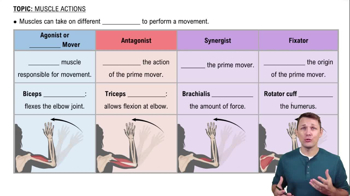
Step 2: Define the term 'fixator.' A fixator is a muscle that stabilizes the origin of another muscle or holds a bone steady during movement, allowing the primary muscle to perform its action effectively.
Step 3: Compare the function of a fixator with the other options provided: - Antagonist: A muscle that opposes the action of the agonist. - Synergist: A muscle that assists the agonist in performing its action. - Supinator: A muscle that rotates the forearm to turn the palm upward.
Step 4: Analyze the question. The problem asks for the muscle type that holds a bone steady during movement. Based on the definition, this function aligns with the role of a fixator.
Step 5: Conclude that the correct answer is 'Fixator,' as it fulfills the function of stabilizing a bone during movement, ensuring efficient action by the primary muscle.

Risposta video verificata per un problema simile:

Questa soluzione video è stata consigliata dai nostri tutor come utile per risolvere questo problema.

Concetti chiave

Ecco i concetti essenziali che devi comprendere per rispondere correttamente alla domanda.

Antagonist

An antagonist muscle opposes the action of another muscle, known as the agonist. During movement, while the agonist contracts to produce motion, the antagonist relaxes to allow that motion to occur. This relationship helps maintain balance and control in muscle actions.
Video consigliato:
5:41
Muscle Actions

Synergist

Synergist muscles assist the agonist in performing a movement. They help stabilize joints and ensure smooth motion by working alongside the primary mover. Synergists can also help to prevent unwanted movements by providing additional support.
Video consigliato:
3:55
Muscle Actions Example 1

Fixator

A fixator muscle stabilizes a joint or bone, allowing other muscles to perform their actions more effectively. By holding a bone steady during movement, fixators ensure that the primary muscles can function without distraction or interference, enhancing overall movement efficiency.
Video consigliato:
5:41
Muscle Actions
Pratica correlata
Domanda del libro di testo

Mark the following statements as true or false. If the statement is false, correct it to make a true statement.

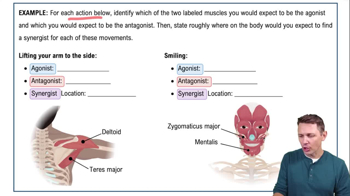
The main action of the zygomaticus major and minor muscles is to pull the corners of the mouth up to produce smiling.

782
views
Domanda del libro di testo

Ms. Cho presents with muscle pain in the area around her anterior neck and superior chest. She explains that she has had a respiratory infection over the past 2 weeks that made it hard for her to breathe. What is likely causing her muscle soreness? (Hint: Remember that the origin and insertion of some muscles can switch and that one likely has to breathe more deeply with a respiratory infection.)

812
views
Domanda del libro di testo

The action of the biceps brachii muscle on the hinge joint of the elbow is an example of which kind of lever system?

a. First class

b. Second class

c. Third class

d. Fourth class

833
views
Domanda del libro di testo

Ms. Hendrix suffered a severe hip fracture that required hip replacement surgery. After an extended recovery period, she is undergoing physical therapy to regain strength and mobility.

Which actions could Ms. Hendrix perform to strengthen these muscles?

701
views
Domanda del libro di testo

Mark the following statements as true or false. If the statement is false, correct it to make a true statement.

The temporalis and occipitalis muscles are attached to each other by the epicranial aponeurosis.

1014
views
Domanda del libro di testo

Mark the following statements as true or false. If the statement is false, correct it to make a true statement.

The orbicularis oris muscle is located around the eye.

908
views